Cycling Glove Buying Guide: Full-Finger vs Half-Finger, Padding, and Summer vs Winter Differences
Introduction
Many road cyclists think of gloves as an “optional” accessory — until after their first 100km ride, when numb palms and a sore thumb web make it clear otherwise. Gloves aren’t just for warmth; they’re essential gear for reducing the vibration transmitted through the handlebar over long rides and protecting the ulnar nerve in your palm.
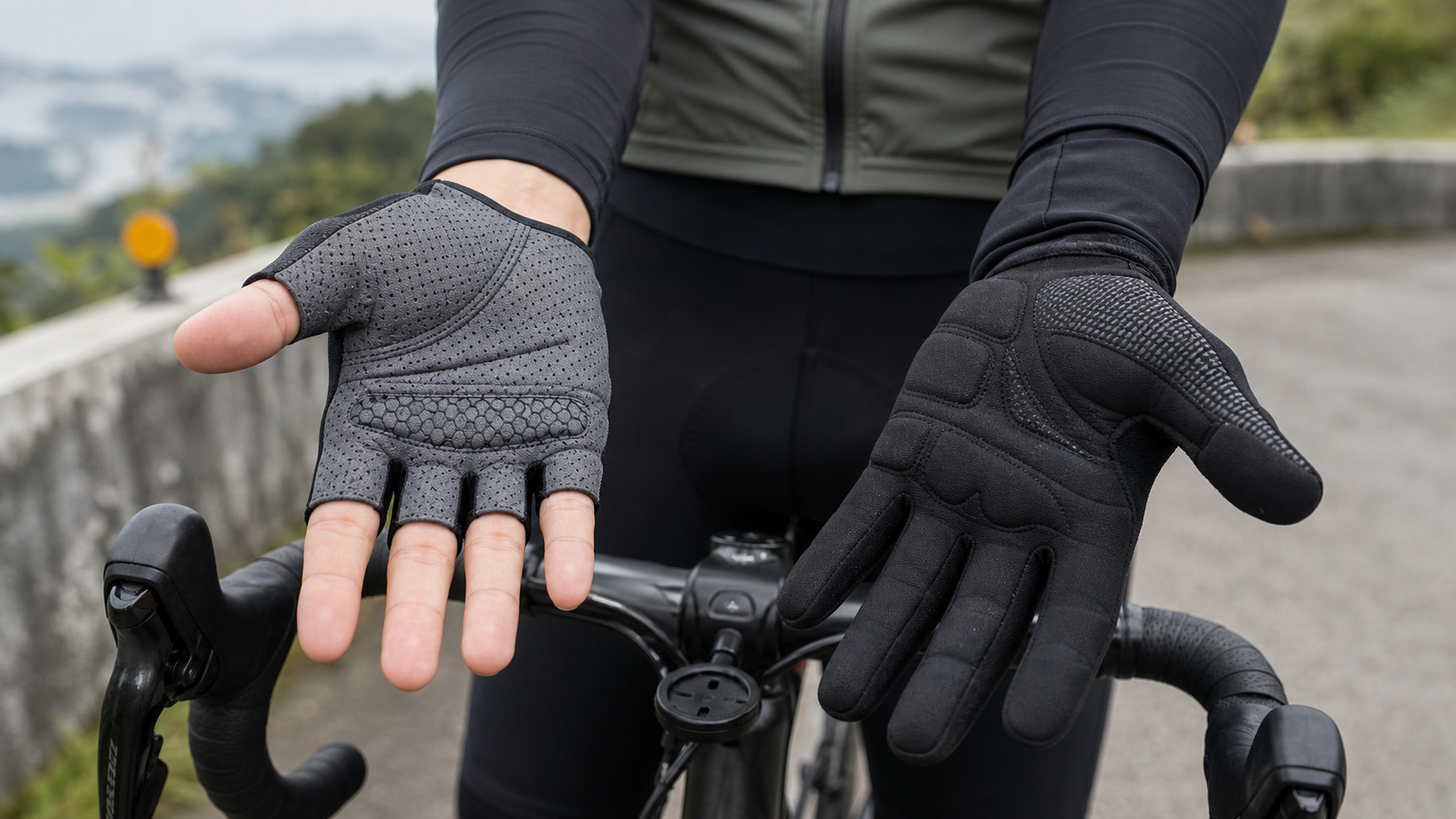
Half-Finger vs Full-Finger: Function and Use Cases
| Type | Pros | Cons | Best For |
|---|---|---|---|
| Half-finger (summer gloves) | Cool and breathable, easy touchscreen use | No finger protection, poor cold resistance | General summer riding |
| Full-finger (winter gloves) | Keeps fingers warm, blocks wind and cold | Can feel stuffy, less touchscreen sensitivity | Autumn/winter riding, cold mornings |
| Thin full-finger | Balances touch feel with light warmth | Limited insulation | Spring/autumn transitional seasons |
| Waterproof full-finger | Blocks wind, rain, and water | Least breathable | Riding in the rain |
Taiwan’s Unique Climate Needs
Taiwan experiences summer-like conditions for 7–8 months of the year, so half-finger gloves are the mainstay. However, early-morning mountain rides (such as a dawn ascent of Wuling) can see temperatures drop to just 5–10°C, making full-finger gloves essential life-saving gear at high altitude. It’s worth keeping a lightweight pair of full-finger gloves in your saddle bag for sudden cold snaps or chilly mountain-top winds.
The Science of Padding Design
Vibration transmitted from the handlebar to your palm can, over time, compress the ulnar nerve — the cause of the numb-hand sensation many cyclists experience. Padding design is one of the most critical functions of a cycling glove.
Common Padding Materials:
- Silicone Gel: The most common option, soft in texture, widely used in entry-level gloves. Extra thickness at specific pressure points (the metacarpal heads and thenar eminence) can effectively reduce vibration, but padding that’s too thick can hurt your feel for the handlebar.
- Memory Foam: Offers a great wrap-around fit that molds to your hand shape for high comfort, though it tends to be less durable than silicone gel over long-term use.
- Multi-layer Gel Grid: High-end gloves use a honeycomb-structured gel to provide even cushioning across the entire palm, as seen in the Castelli Enduro Pro series.
Padding Zone Distribution: Different riding positions create different pressure points. Gripping the drops puts more pressure on the metacarpal heads, while gripping the hoods puts more pressure on the thenar eminence (the base of the thumb). When shopping, check that the padding covers the area of your palm you actually use most.
Key Material Considerations
Back-of-Hand Material
- Stretch mesh: Most breathable, the top choice for summer, not suited to cold weather
- Microsuede: Durable, good texture, decent temperature regulation
- Polartec/Fleece: Common in winter gloves — warm, but less breathable
Palm Material
- Genuine leather: Best grip feel and durability, but requires more maintenance
- Synthetic leather (PU): Durable and easy to clean
- Clarino synthetic leather: Commonly used by Shimano and Pearl Izumi — good texture and water-resistant
Touchscreen Compatibility: Nearly all modern gloves feature touchscreen-compatible fingertips, but sensitivity varies widely. It’s best to test with your phone before buying.
Recommended Gloves by Scenario
Everyday Summer Riding (NT$800–1,500)
- Castelli Dolcissima W Glove
- Shimano Original Gloves
- Pearl Izumi Elite Gel Gloves
Long-Distance (100km+) Specific (NT$1,200–2,500)
- Castelli Enduro Pro Glove (multi-layer gel, built for long distances)
- Sportful Matchy Cycling Gloves
Autumn/Winter Cold Weather (NT$2,000–4,000)
- Gore Wear C3 Cycling Gloves (waterproof and windproof)
- Castelli Estremo Glove (suitable down to -5°C)
- Rapha Classic Gloves Winter (British brand, available via Taiwan resellers)
Practical Tips
- Measure your hand size first: Glove sizing charts vary significantly between brands, so always measure the widest circumference of your palm (in cm) and check it against the size chart
- You still need gloves in summer: Numbness in your palm after a long ride is nerve compression, not something you simply “get used to”
- Don’t buy padding that’s too thick: Overly thick gel can hurt your handling feel — look for padding that’s “thin and evenly distributed” rather than “thick in just one spot”
- Wash your gloves regularly: Sweat and bacteria can easily cause skin problems, so wash at least once a week
- Keep winter gloves in your saddle bag: Regardless of season, temperatures at the top of a mountain climb can be unpredictable
Conclusion
Gloves are one of the lowest-cost yet most frequently used pieces of cycling gear. With a budget of NT$1,000–2,500, you can find a pair that’s fully functional and suited to Taiwan’s climate. In summer, prioritize breathability and light padding; in autumn and winter, prioritize warmth and wind protection; for long-distance rides, prioritize multi-layer gel padding. The most efficient approach is to first buy the pair best suited to your most common riding scenario, then fill in gloves for other situations as needed.
Related Reading
- Cycling Glove Buying Guide: Seasonal Choices for Vibration Damping, Grip, and Breathability
- The Complete Cycling Glove Comparison: Half-Finger vs Full-Finger, Materials, Padding, and Buying Guide
- Cycling Glove Buying Guide: Short-Finger vs Long-Finger Gloves — Seasonal Fit and Function Explained
- Road Bike Glove Buying Guide: Long-Finger vs Short-Finger and the Myths About Gel Padding
大家都在開箱的...單車用藍芽對講耳機真的有幫助嗎? SENA BiKom 20 長距離旅遊 & 海鷗繞圈賽 實際體驗心得 / 公路車 / CT Yeh
9 個月前
多到選擇障礙... 換個單車把帶想一個小時 / BTP / 編織&軟木特有材質超吸睛! / 公路車 / CT Yeh
1 年前
Canyon 公路車斷把手 五年老車特規還能修嗎? 維修保養全記錄 feat. 501單車監理站 | 公路車 | CT Yeh
4 年前
單車 一日北高 ( 雙城 ) 肥宅雙人瘋狂行 紀錄片 REACTO
10 年前
DJI Pocket 單車 東眼山 手持拍攝 Demo 心得歡迎訂閱鎖定
7 年前
再快都跟的上!? 單車跟隨攝影機之王 HOVERAir X1 PROMAX 全面實測 / 唯一!8K畫質&自行車專用模式和跟蹤信標&前後避障 / DJI Neo 可參考/ 公路車 / CT Yeh
1 年前
碟煞公路車 銑面器 !? 原來銑完差這麼多! 降低蹭碟機率! | TIME 公路車 保養小記錄 | CT Yeh
3 年前
2025 自行車錶排行榜 兩萬車友大數據 / Garmin Bryton 排名會大洗牌嗎? / 全新的碼表前身分析 /公路車 / CT Yeh
1 年前