Introduction
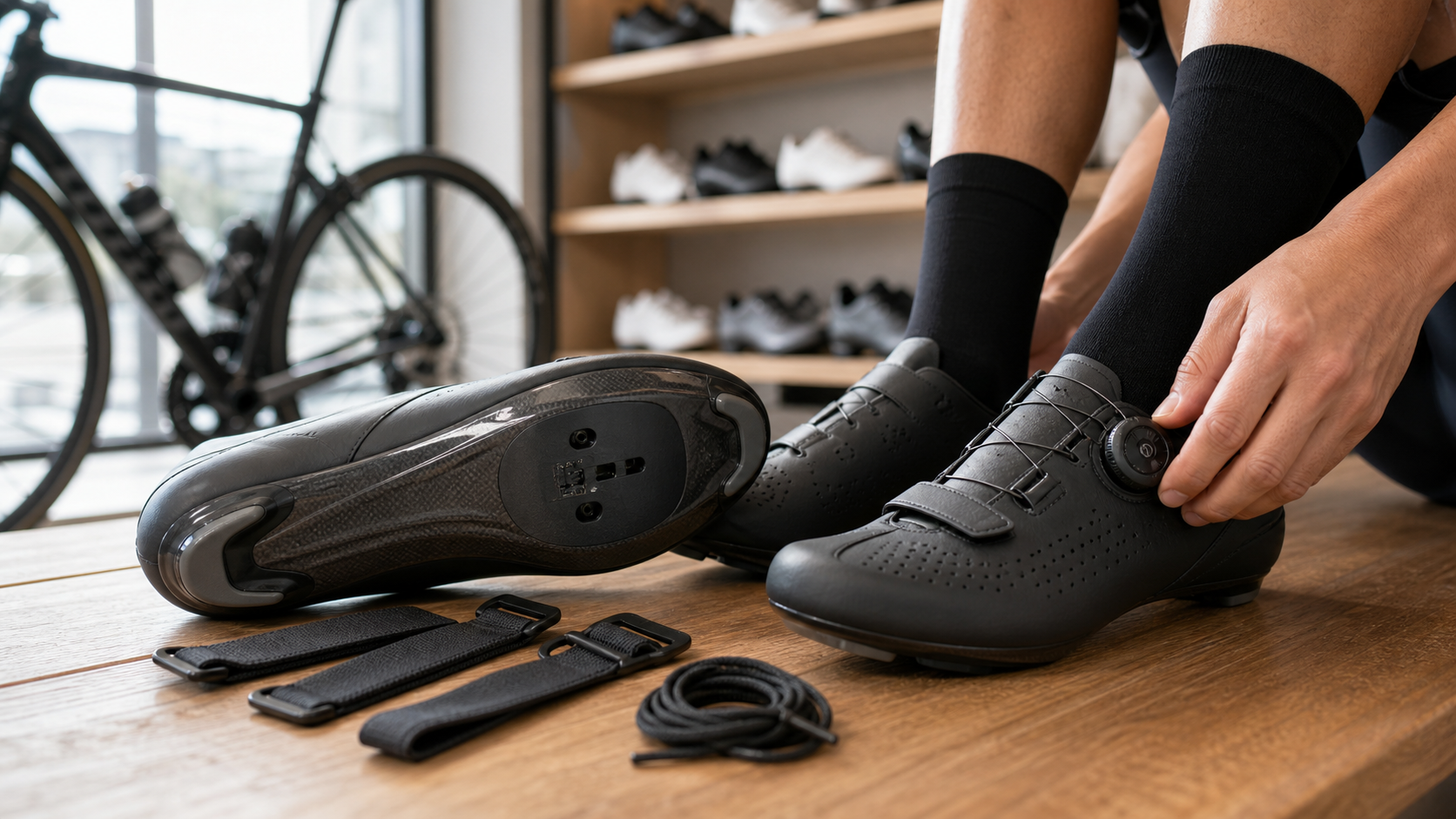
Cycling shoes are the interface connecting the rider to the pedals, and their quality directly affects pedaling efficiency and long-distance comfort. The design philosophy of road cycling shoes is “transfer power from the foot directly to the pedal with zero waste”—a stiff sole, lightweight construction, and a snug fit are the core design principles. However, these characteristics are the complete opposite of everyday comfort, so choosing shoes requires balancing efficiency with practicality.
Sole Stiffness: SPD Index Explained
Sole stiffness (Stiffness Index) is the most important performance indicator for road cycling shoes, describing how much the sole flexes under pedaling force.
| Stiffness Index (Shimano System) | Description | Suitable For | Representative Models |
|---|---|---|---|
| 1–3 | Entry-level, flexes | Commuters, beginners | Shimano RC1 |
| 4–7 | Mid-range, slight flex | Weekend riders, long-distance | Shimano RC5, Fizik Vento |
| 8–10 | High-end, nearly no flex | Racing, high power output | Shimano RC9, Sidi Shot 2 |
| 12+ | Professional racing | Pro riders, time trials | Shimano S-Phyre RC903 |
Higher stiffness does not necessarily mean it’s right for you
High-stiffness soles do improve power transfer efficiency, but for those with insufficient arch support, ultra-stiff soles can actually lead to plantar fasciitis or knee pain. It is recommended that most non-racing riders choose mid-to-high-end models with a stiffness index of 5–8, balancing efficiency and protection.
Closure System Comparison
Boa Dial System
Boa is currently the mainstream tightening method for high-end cycling shoes. Rotating the central dial evenly tightens the wire, while pulling up on the dial releases it quickly, and the operation can be done while wearing cycling gloves.
Advantages:
- Even tightening force, avoiding localized pressure points
- Micro-adjustable while riding (though not recommended to do frequently)
- Durable, and broken wires can be replaced free of charge (Boa warranty)
Disadvantages:
- If the dial is damaged, it is not easy to repair yourself
- Some entry-level models use cheap Boa-lookalike systems with inconsistent quality
Velcro Straps
The most traditional fastening method, commonly found on entry-level models. The advantages are simplicity and low cost; the disadvantages are that the Velcro’s grip diminishes with long-term use, and the tightening force is not as even as Boa. In modern cycling shoes, Velcro is usually paired with a ratchet buckle.
Ratchet Buckle
Usually used in combination with Velcro, providing finer tension adjustment. Shimano’s Micro Adjust ratchet system is the industry standard, being durable and precise.
The Wide Last Issue for Taiwanese Riders
This is a long-overlooked issue in the Taiwanese market. Many Asians (especially men) have wider forefeet, while European brands (Sidi, Giro, Fizik) design their lasts for European foot shapes (narrower forefeet), causing toe squeezing when worn.
Wide-last-friendly brands and models:
- Shimano: Most models offer Wide versions (suffix W in the model name), with forefoot width increased by approximately 4–5mm
- Specialized: The Body Geometry series features Asian-fit designs
- Northwave: Italian brand, some models have a wider toe box
- Spiuk: Spanish brand, with a relatively roomier and more accommodating fit
Key points when trying on shoes:
- Try on with cycling socks (not regular thick cotton socks)
- The heel should be snug, while the five toes in the forefoot should have slight room to move
- After tightening the Boa dial or straps, the longest toe should not touch the toe box
Recommended Models by Price Range
| Price (NT$) | Recommended Models | Features |
|---|---|---|
| 3,000–5,000 | Shimano RC3 (Wide available) | Entry-level Boa, wide last option, durable |
| 5,000–8,000 | Shimano RC5 / Giro Empire E70 | Mid-range stiffness, Boa × 2 |
| 8,000–15,000 | Fizik Vento Infinito Carbon 2 / Shimano RC7 | Carbon sole, high stiffness |
| 15,000 and above | Shimano S-Phyre RC903 / Sidi Shot 2 | Race-grade, extremely lightweight |
Practical Advice
- Be sure to try pedaling while wearing cycling shorts: Cycling shoe comfort should be tested in an aggressive riding position, not by standing upright and walking
- Don’t buy the stiffest shoe right away: When your fitness and muscle strength are insufficient, high-stiffness shoes can actually increase the risk of injury
- Pay attention to cleat mounting space: Check the sole’s cleat hole configuration for compatibility with your pedal system (SPD-SL/LOOK/SPEED PLAY)
- Consider ventilated models for Taiwan’s summer: Choose uppers with sufficient ventilation holes to reduce foot heat and stuffiness
Conclusion
Cycling shoes are the item of road cycling gear that most requires “trying on”—buying online without trying them on is the most common mistake. It is recommended to bring your pedal cleats to a physical store, have the staff install them, and then actually feel the pedaling motion. Wide last issues are very common in Taiwan, and choosing brands that offer Wide versions (such as Shimano) can save you a lot of unnecessary foot chafing trouble.
Related Reading
- 2025 Road Cycling Shoe Buying Guide: BOA, Stiffness Index, and Brand Comparisons
- The Science of Carbon Sole Pedals: The Effect of Carbon Fiber Sole Stiffness Coefficient on Pedaling Efficiency
- The Science of Cycling Shoe Sole Stiffness: The Effect of Carbon Fiber Soles on Pedaling Efficiency and Power Transfer
- Road Cycling Shoes, MTB Shoes, Gravel Shoes: A Complete Guide to Choosing Among Three Types of Cleat Shoes
Nepest NOVA 碳條輪組:輕量、空力、舒適一次滿足!/ 公路車 / CT Yeh
7 個月前
2026 車錶排行榜!誰是最多車友正在使用?練家子最愛哪款?🏆 (2萬名車友數據) / 公路車 / CT Yeh
5 個月前
超開放的自行車錶!可以玩遊戲裝APP!?/ SRAM合併的 Hammerhead Karoo深入開箱!/ 即時爬坡偵測 / 全球導航地圖 / Garmin Bryton / CT Yeh
1 年前
車錶新黑馬? / 超狂續航 / 超好用錶冠 / 無敵準定位 / Dash圖表合成!?/ COROS DURA 評測!/ 公路車 / CT Yeh
2 年前
Unaas X50 全碳纖幅條輪 數據實測對比PK | Lun Hyper 的高階版 | 板輪爬坡也可以很厲害? ! 武嶺2小時大師一起親測! CP值超高 | 公路車 | CT Yeh
4 年前
單車 重低音 藍芽喇叭 音質實測 SoundBot SB525 Real Sound Test
8 年前
2025 自行車錶排行榜 兩萬車友大數據 / Garmin Bryton 排名會大洗牌嗎? / 全新的碼表前身分析 /公路車 / CT Yeh
1 年前
多到選擇障礙... 換個單車把帶想一個小時 / BTP / 編織&軟木特有材質超吸睛! / 公路車 / CT Yeh
1 年前