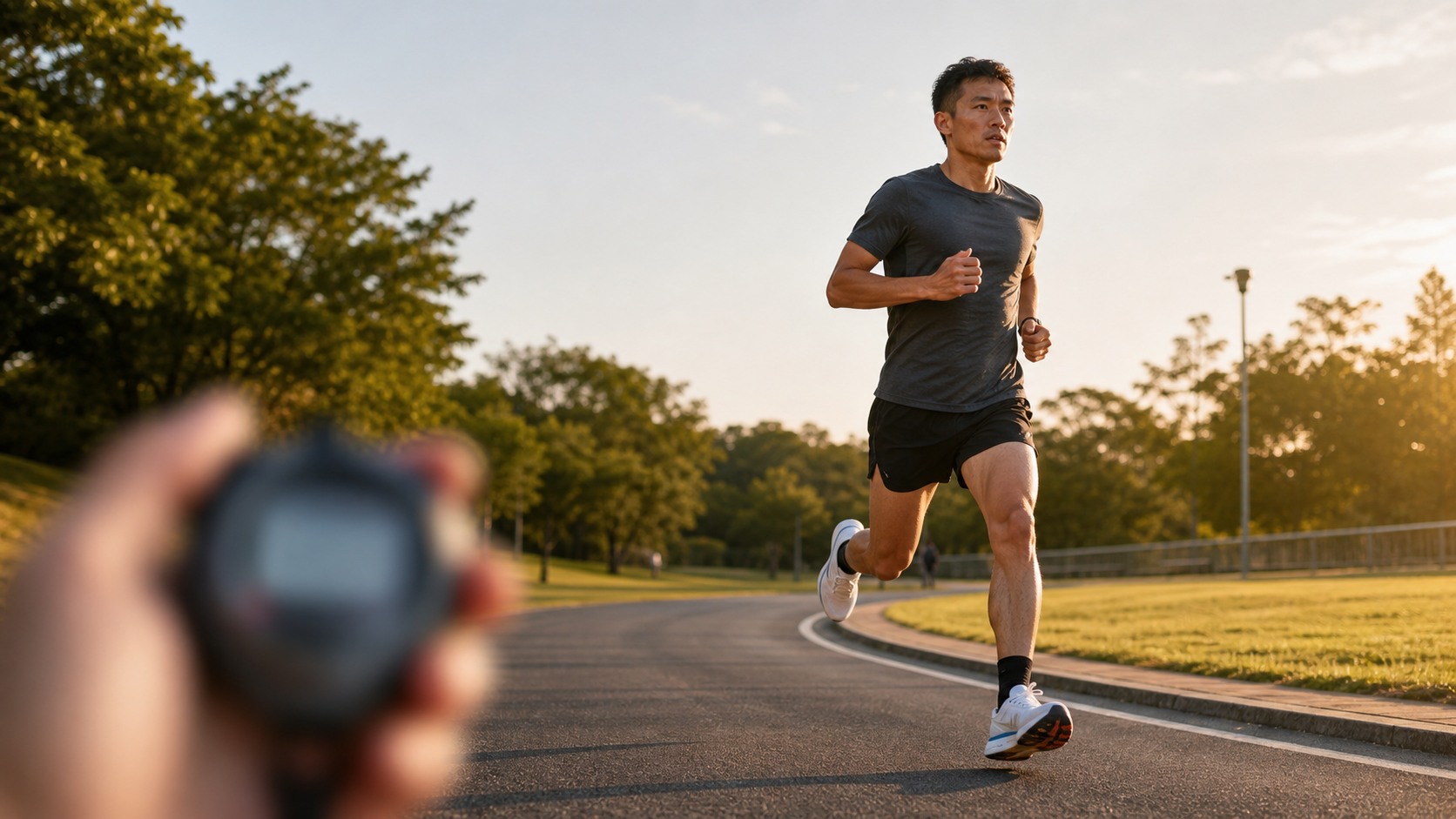
Introduction
Ever since Jack Daniels observed elite runners averaging a cadence of about 180 steps per minute at the 1984 Los Angeles Olympics, this number has become the “holy grail” of the running world. For decades, countless runners have strived to push their cadence up to 180, but scientific research reveals a picture far more complex than this single number.
The Origin and Background of 180 Steps/Minute
Daniels’ original observation targeted Olympic elite runners, whose average cadence did indeed approach 180 steps per minute (90 steps per foot). However, this observation came with several important contextual conditions:
- These were cadences measured at race intensity (not training pace)
- Runners varied greatly in height, and cadence naturally changes accordingly
- 180 was an average value, with the actual range spanning from 170 to 190
- The optimal cadence for amateur runners at easy run pace typically falls between 155 and 175
The Physiological Significance of Cadence
Cadence affects several key aspects of running:
| Lower Cadence (<160) | Moderate Cadence (165-180) | Higher Cadence (>185) |
|---|---|---|
| Overly long stride, heel striking | Balanced stride length and frequency | Shortened stride, efficiency may decline |
| Long ground contact time | Moderate ground contact time | Short ground contact time |
| Large vertical oscillation (excessive bouncing) | Small vertical oscillation | Possible excessive calf tightness |
| Greater load on the knees | Load distributed across the knees | Increased stress on calves and Achilles tendon |
The main benefit of increasing cadence is reducing overstriding—the faulty landing pattern where the foot lands with the heel far ahead of the body’s center of mass. Overstriding increases braking force, reduces running efficiency, and raises the risk of knee injuries.
How to Find Your Optimal Cadence
The optimal cadence varies from person to person, influenced by the following factors:
- Height: Taller runners naturally have a lower cadence; forcing a higher cadence may actually reduce efficiency
- Speed: The faster you run, the higher your cadence naturally becomes; the same runner’s cadence can differ by 15 to 20 steps/minute across different paces
- Terrain: Cadence increases on uphill runs while stride shortens; the opposite occurs downhill
- Strength and Flexibility: Runners with strong ankle drive are better suited to a higher cadence
Simple self-assessment:
- Measure your current natural cadence (count steps for 60 seconds at a comfortable pace)
- If your cadence is below 155 steps/minute, gradually increasing it offers clear benefits
- If you’re already at 160 to 170, there’s no need to force it up to 180 unless you have a clear overstriding problem
Practical Methods for Cadence Training
If your assessment indicates you do need to increase your cadence, the following methods are effective:
- Metronome training: Use a mobile app (such as Metronome Beats) to set your target cadence and land with the beat while running
- Short stride-speed intervals: Add 6 to 8 repetitions of 30-second fast-leg running (keeping stride length unchanged, only increasing step frequency) during each easy run
- Hill training: Running uphill naturally forces a higher cadence and shorter stride, making it a great tool for training the neural pattern of high cadence
- Progress gradually: Increase your weekly cadence target by no more than 5 steps/minute; rapid changes can lead to overuse injuries in the calves and Achilles tendon
Practical Recommendations
- Measure your natural cadence first, then decide whether training is needed
- If your cadence is below 155 steps/minute and you have an overstriding problem, increasing cadence should be a training priority
- If your cadence is already above 165, prioritize improving other technical aspects (core stability, arm swing, etc.)
- Do not deliberately adjust your cadence during races; 2 to 3 months before a race is the time to change technique
- Use the cadence monitoring feature on your GPS watch, but note that calculation methods may vary slightly between brands
Conclusion
180 steps/minute is an observed average among elite runners at race pace, not a one-size-fits-all target. Each runner’s optimal cadence is determined by a combination of height, speed, and training background. What matters is improving running efficiency, not chasing a number.
Related Reading
- The Science of Running Cadence: The Truth Behind the 180 Steps/Minute Myth and Individual Differences
- The Myth and Truth of Running Cadence 180: Finding Your Optimal Rhythm
- The Science of Running Cadence: The 180spm Myth and Your Personal Optimal Cadence
- Is 180spm the Gold Standard? The Scientific Debate on Running Cadence and Stride Length
西進武嶺 免費訓練分析服務 Intervals | 練不夠還是練過頭?你哪一種類型選手?AI模型告訴你! | 備戰神器 | 公路車 訓練 | CT Yeh
4 年前
白沙屯媽祖進香在家走!UREVO 坡度自調走步機 / 可連接訓練遊戲APP MyWhoosh / 邊看直播邊走起來 / CT Yeh
11 個月前
Live) 備戰2019彰化經典百K 賽前攻略 (已完賽請看新影片
7 年前
實景訓練台) 彰化經典百K 高強度喵團 90分鐘 跟著一起練功 2019 Indoor workout Changhua Classic 100 Taiwan
7 年前
單車 一日北高 ( 雙城 ) 肥宅雙人瘋狂行 紀錄片 REACTO
10 年前
CT Talk) 數據面窺看 武嶺大神們 平時的備戰 共通點 (娛樂性質XD)
7 年前
一個測試有沒有認真練車的方法😂 #公路車
10 個月前
#公路車 #Fitting 靠人工智慧APP 幫你調整單車
6 年前