Introduction
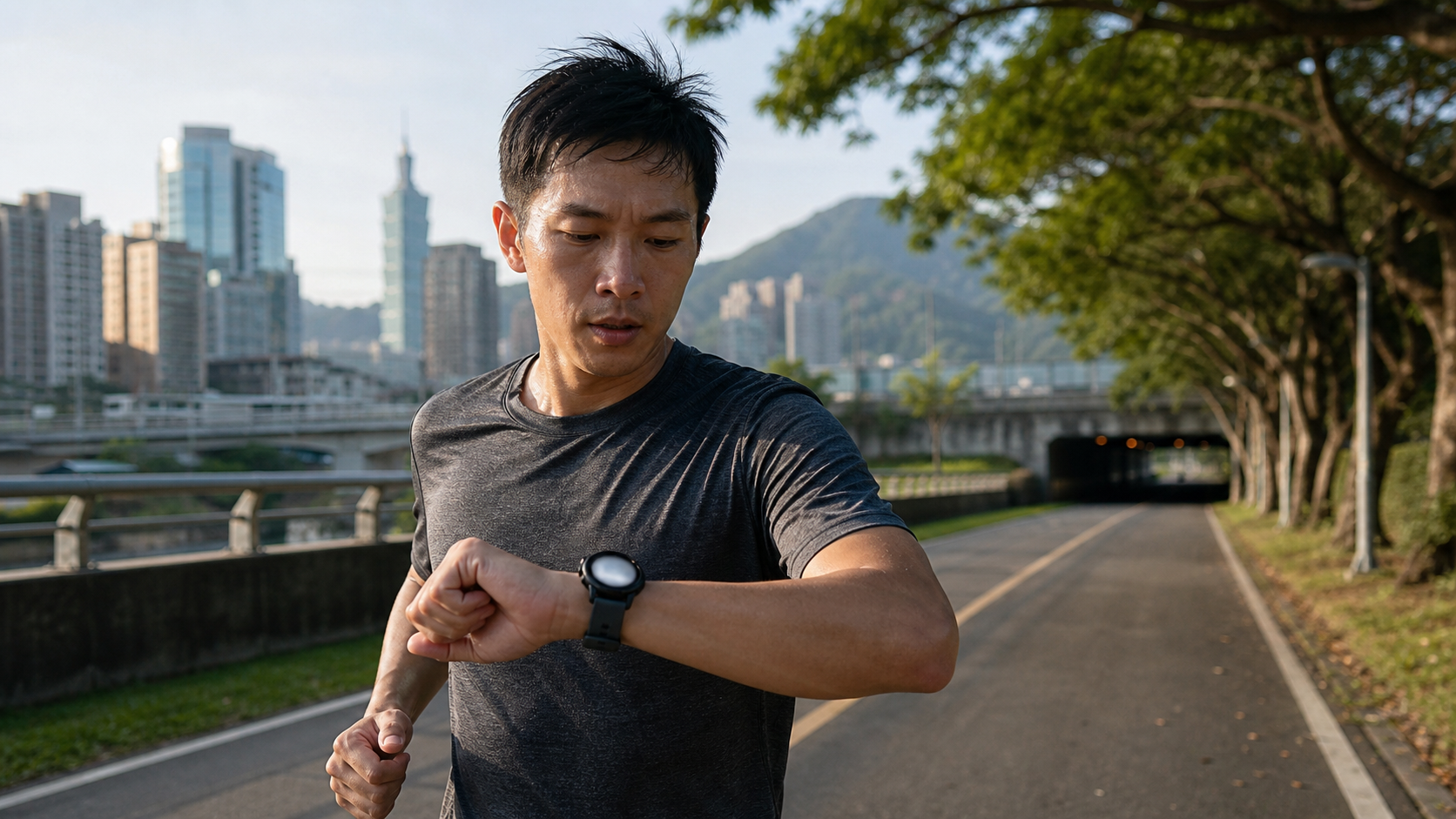
“My watch shows 4:45/km, but it feels harder than usual.” “After going through the tunnel, my watch’s pace suddenly jumped to 3:20/km, but I didn’t speed up at all.” These confusions are extremely common among runners in Taiwan. GPS watches are powerful training tools, but understanding their sources of error is essential for using the data correctly.
Main Sources of GPS Pace Error
1. Satellite Signal Quality
GPS watches receive signals from multiple satellites to calculate position. Signal quality is affected by the following factors:
- Building obstruction: In dense high-rise areas of Taipei City, signal reflection (multipath error) causes deviations in position calculation
- Valley terrain: In Taiwan’s mountain trail running, canyon terrain reduces the number of visible satellites
- Tree cover: On forest trails under dense canopies, satellite signals attenuate noticeably
- Tunnels and underpasses: After complete obstruction, GPS switches to accelerometer estimation, and re-acquisition after exiting creates errors
2. Real-Time Pace vs. Average Pace
| Metric | Stability | Suitable Scenarios |
|---|---|---|
| Real-time pace | Low (1-3 second updates, high fluctuation) | Short sprints, sensing current speed |
| 3-second average pace | Medium | Steady pace training on flat roads |
| 10-second average pace | High | Most training scenarios |
| Per-kilometer pace (updates every 1km completed) | Highest | Long-run pacing strategy adjustments |
It is recommended to set your watch to a 3 to 10-second average pace to avoid misjudgment caused by drastic fluctuations in real-time pace.
3. Differences in Watch Calculation Algorithms
Different watch brands use different GPS chips and pace calculation algorithms, resulting in different error characteristics:
- Garmin: Pace display often lags during the first 30 to 60 seconds after starting, but is generally stable overall
- COROS: Overall GPS accuracy performs excellently among amateur watches, with more immediate pace display
- Apple Watch: GPS+accelerometer fusion algorithm works well, but battery is weaker during long-distance activities
- Suunto: Mountain GPS positioning performs outstandingly, especially suitable for Taiwan’s mountain road training
4. Wrist Accelerometer Fusion
Modern GPS watches fuse GPS signals with built-in accelerometers (detecting wrist swing) to improve the stability of pace display. However, the accelerometer may introduce new errors when running form is inconsistent or arm swing amplitude is abnormal.
Differences Between Actual Distance and Watch Distance
Besides pace, distance error is also a common issue. In Taiwan’s road race events (using road races as an example), watch recordings are typically 0.1 to 0.3 km longer than the official distance. Reasons include:
- Runners choosing a route longer than the shortest path (running on the outside of curves)
- Cumulative errors in GPS position calculation
- Lateral left-right displacement while running being counted into the distance
How to Correctly Interpret GPS Data
- Use per-kilometer pace (average over each completed kilometer) as the primary reference, not real-time pace
- Calibrate watch accuracy on tracks or sections of known distance to understand your watch’s bias tendencies
- Reduce reliance on pace data in poor signal environments (Taipei City, valleys), using heart rate or rating of perceived exertion (RPE) instead
- In races, defer to the official timing system, with watch data for reference only
Practical Recommendations
- Set your watch to display 3 to 10-second average pace to reduce real-time pace noise
- Perform periodic calibration on a track: run 400m and compare watch distance with the actual track distance
- When training in Taipei City, use heart rate as the primary intensity basis, with pace for reference only
- On mountain routes, use GAP (Grade-Adjusted Pace) to assess intensity rather than absolute pace distorted by slope
- Ensure consistent conditions when comparing pace across different days (same route section, similar temperature); otherwise, comparisons are meaningless
Conclusion
GPS watches are training aids, not absolute truth. Understanding their sources of error, combined with heart rate monitoring and subjective perception, is the only way to build a truly reliable training intensity assessment system. Data serves the runner, not the runner serving the data.
Related Reading
- GPS Watch Pace Display Error: Compensation Techniques for Pace Distortion on Curved Sections
- GPS Watch Pace Error and Calibration: Making the Numbers Closer to Reality
- Running Heart Rate Pace vs. GPS Pace: Which Is More Accurate
- The Pacing Guidance Benefits of GPS Running Watches: Research on Real-Time Feedback for Pace Control
西進武嶺 免費訓練分析服務 Intervals | 練不夠還是練過頭?你哪一種類型選手?AI模型告訴你! | 備戰神器 | 公路車 訓練 | CT Yeh
4 年前
2025 自行車錶排行榜 兩萬車友大數據 / Garmin Bryton 排名會大洗牌嗎? / 全新的碼表前身分析 /公路車 / CT Yeh
1 年前
單車AI教練!全新 ChatGPT4o 幫你分析訓練成果!排武嶺課表,分析騎車姿勢! 太神了! / 公路車 / CT Yeh / feat. 緯緯
2 年前
車錶新黑馬? / 超狂續航 / 超好用錶冠 / 無敵準定位 / Dash圖表合成!?/ COROS DURA 評測!/ 公路車 / CT Yeh
2 年前
2020 前十五名 台灣車友還在用的車錶? 同場加映武嶺四小時內的車友都用哪些車錶,以及車錶靈異經驗分享 北高居然騎了960公里!? | 車錶送修分享 | 公路車 | CT Yeh
5 年前
Garmin Edge 1050 旗艦車錶 全台首測!/ 環法冠軍指定 / 對比Edge 1040改進哪些? / 公路車 / CT Yeh
2 年前
西進武嶺配速器 3.0更新 / NEW 免功率FTP估算! / 大數據xAI體能模型 / 如何模擬人止關前集團效應 / 配速儲存功能 / AI全台自行車賽事行事曆 / 公路車 / CT Yeh
1 年前
西進武嶺 自製新版AI配速表產生器 x 賽前攻略 抱佛腳! 沒有功率計也可以產生配速表嗎?有什麼其他眉角賽前要注意的呢? | 西進武嶺 / 東進武嶺 KOM 攻略 | 公路車 | CT Yeh
4 年前