Introduction
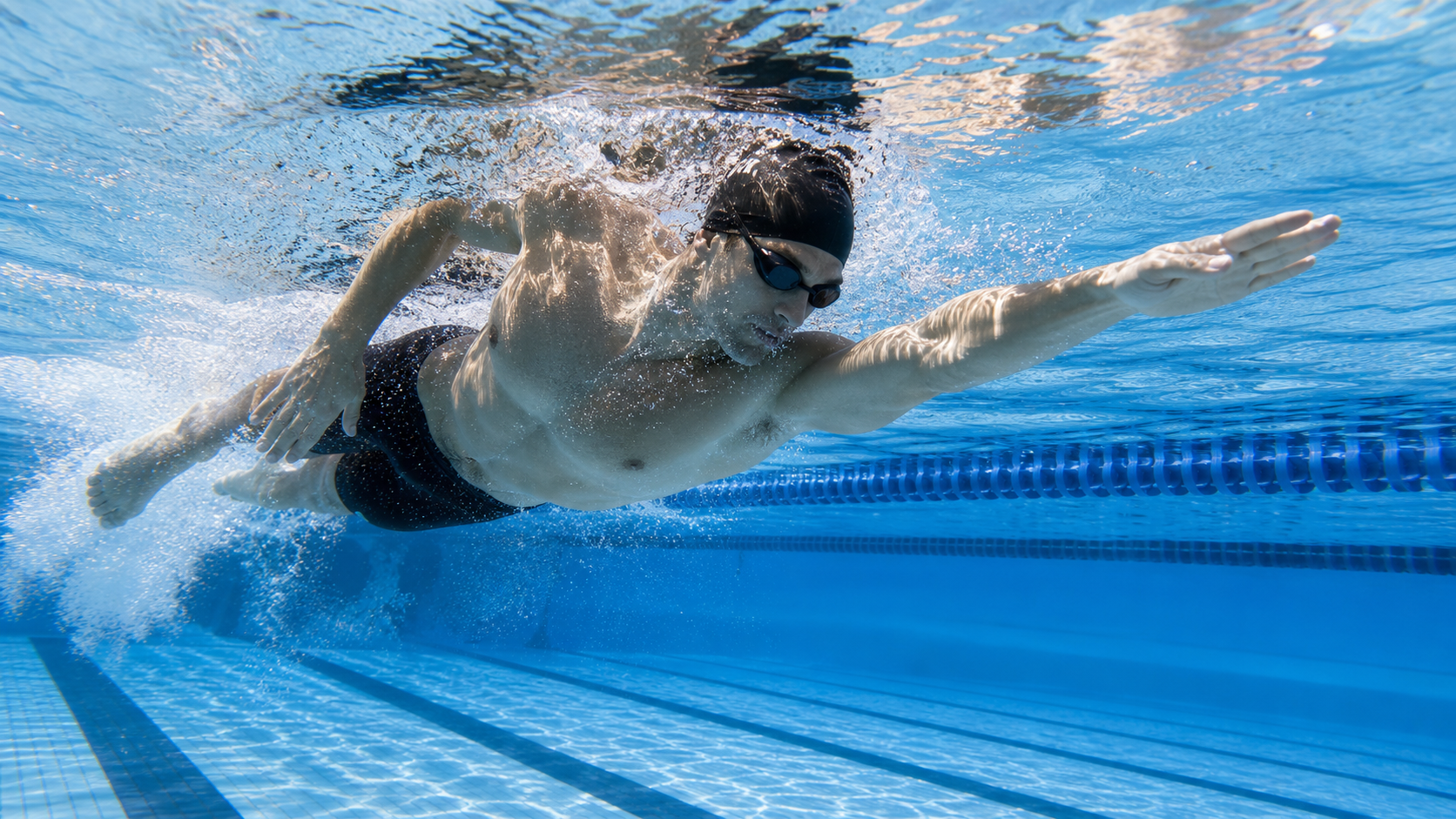
Many swimmers train their arm strength relentlessly, yet overlook the body’s biggest source of power: torso rotation. Freestyle body rotation refers to the alternating side-to-side rolling motion of the body around the spine during the stroke. This seemingly minor detail actually determines stroke efficiency, breathing quality, and even the risk of shoulder injury.
This article will break down the mechanics of body rotation, common mistakes, and how to integrate rotation into your daily swim training through targeted drills.
Why Rotation Improves Efficiency
From a fluid dynamics perspective, the position of least resistance in water is “side-lying,” not “prone.” When the body lies completely flat, shoulder width becomes the largest cross-sectional area, creating significant form drag. After rolling onto the side, the shoulders slice through the water longitudinally, reducing the cross-section and lowering drag.
Beyond reducing resistance, rotation offers the following benefits:
- Longer stroke length: Body rotation allows the arm to reach deeper and farther underwater, increasing the distance propelled per stroke.
- Engages larger muscle groups: Rotation activates the latissimus dorsi and core muscles, rather than relying solely on the smaller shoulder muscles.
- Improved breathing: As the body rolls, the breathing-side face naturally clears the water without excessive head lifting, keeping the neck relaxed.
Correct Rotation Angle and Timing
More rotation is not always better. Research shows that elite freestylers roll at approximately 40–60 degrees. Over-rotation (beyond 75 degrees) can actually disrupt propulsion and create lateral drag from a “snake-like” sway.
| Rotation Angle | Effect | Commonly Seen In |
|---|---|---|
| < 30 degrees | High drag, latissimus dorsi hard to engage | Beginners, when fatigued |
| 40–60 degrees | Optimal efficiency zone | Advanced swimmers |
| > 75 degrees | Reduced propulsion, increased sway | Overemphasis on rotation |
The timing of rotation is equally critical: rotation should begin the moment the hand enters the water, coordinated with the opposite arm’s pull. In other words, when the right hand enters, the body rolls to the right while the left hand completes a high-elbow pull underwater.
Common Mistakes and Fixes
Mistake 1: Rotating from the hips instead of the torso
Many people rotate only their hips while keeping the upper body flat. This type of rotation fails to engage the latissimus dorsi and often leads to tilting the head during breathing. The fix: imagine the spine as a skewer, with the entire body from head to hips rolling as one unit.
Mistake 2: Asymmetrical rotation between sides
The breathing side rotates excessively while the non-breathing side barely rotates at all. This is common among swimmers who breathe to one side only. It’s recommended to practice bilateral breathing, or use a pull buoy between the legs to focus on the symmetry of rotation on both sides.
Mistake 3: Legs whipping side to side during rotation
Body rotation should drive the kicking rhythm, not cause the legs to swing laterally. The core must remain stable throughout the rotation so that energy transfers smoothly from the torso to the arms.
Practical Tips
- Pole drill: Hold a long foam stick or hollow tube across your chest to feel the torso rolling motion in the water, isolating it from arm movement.
- Timed rotation sets: During a 50-meter swim, deliberately pause for 0.5 seconds after each hand entry to feel the rotation complete before starting the pull, reinforcing the neural connection.
- Underwater video review: Film from directly in front or behind to check whether the roll angle on each stroke is symmetrical and within the target range.
- Core training support: Add Russian Twists and Side Plank Rotations to your dry-land routine to improve active control of rotation.
Conclusion
Body rotation is one of the highest “return on investment” elements in freestyle technique. It requires no additional physical output, yet it makes every stroke more efficient and faster without you even noticing. Before your next swim, close your eyes and imagine the sensation of rolling around your spinal axis—make rotation your most natural swimming instinct.
Related Reading
- Freestyle Body Rotation: The Impact of Axial Rotation on Stroke Power Transfer Efficiency
- Freestyle Roll Technique: The Relationship Between Hip Rotation Angle and Stroke Efficiency
- Backstroke Stroke Rhythm and Shoulder Rotation: The Overlooked Efficiency Code
- Backstroke Technique Improvement: Optimizing Body Roll and Hand Entry Angle
戰略) Zwift Race 如何咬在第一集團 如何評估自己要開多少推力 (請開1.5倍速看)
7 年前
如何把 GoPro 影片 翻轉 批次 轉正?
6 年前
靠單車減肥35公斤 心得分享與整理
7 年前
CT 喇低賽) 武嶺牽車 才是王道 西進牽車四小時內秘訣 攝手位置 如何判斷 防抽筋小秘訣
7 年前
Insta 360 One 超級防手震技術實測
7 年前
風櫃嘴 衝刺慢動作回放!
8 年前
類空拍神器 Feiyu Pocket 2s (有優惠連結)三軸穩定 運動攝影機 開箱!比GoPro 還強的滑順視角!三小時長時間錄影 行車記錄器 | 環花東365實測 | 公路車 CT Yeh
4 年前
抖肩舞 APOLLO RIDE 生日趴 搖滾混音無尺度版 Coincidance 甩肩舞
8 年前