Introduction
Breaststroke is the most technically refined of the four competitive swimming strokes, and the kick is the core of breaststroke speed. Among the many technical details, the ankle rotation method (commonly referred to as “pigeon-toed” and “duck-footed”) is the most critical factor affecting propulsion efficiency—yet it is also the most misunderstood. Many swimmers practice breaststroke without understanding the mechanical principles, resulting in kicks that are exhausting yet slow.
This article will clearly analyze the mechanics of ankle rotation during the breaststroke kick from the perspectives of anatomy and fluid dynamics, as well as how to train an efficient water-pushing motion.
The Mechanical Foundation of the Breaststroke Kick
The propulsive force of the breaststroke kick comes from the “arc-like sweep” of the soles of both feet—after being retracted, they sweep outward and then backward—during which the soles apply a backward reaction force against the water. This principle is similar to paddling with an oar blade: the larger the surface area contacting the water, the faster the speed, and the closer the direction is to directly backward, the greater the propulsive force generated.
The entire kick motion is divided into three phases:
- Recovery: The legs are drawn up toward the buttocks, with the knees opening outward. This phase should minimize resistance; the ankles should be relaxed, with the toes naturally pointing downward.
- Outsweep: The feet spread from the inside to the outside, while the ankles begin to evert, establishing a backward-facing pushing surface with the soles.
- Insweep/Kick: The feet rapidly sweep inward from the outside, pushing water with the soles to complete the primary propulsive action, with the legs straightening together at the rear.
The Correct Definition of “Outer Ankle Rotation”
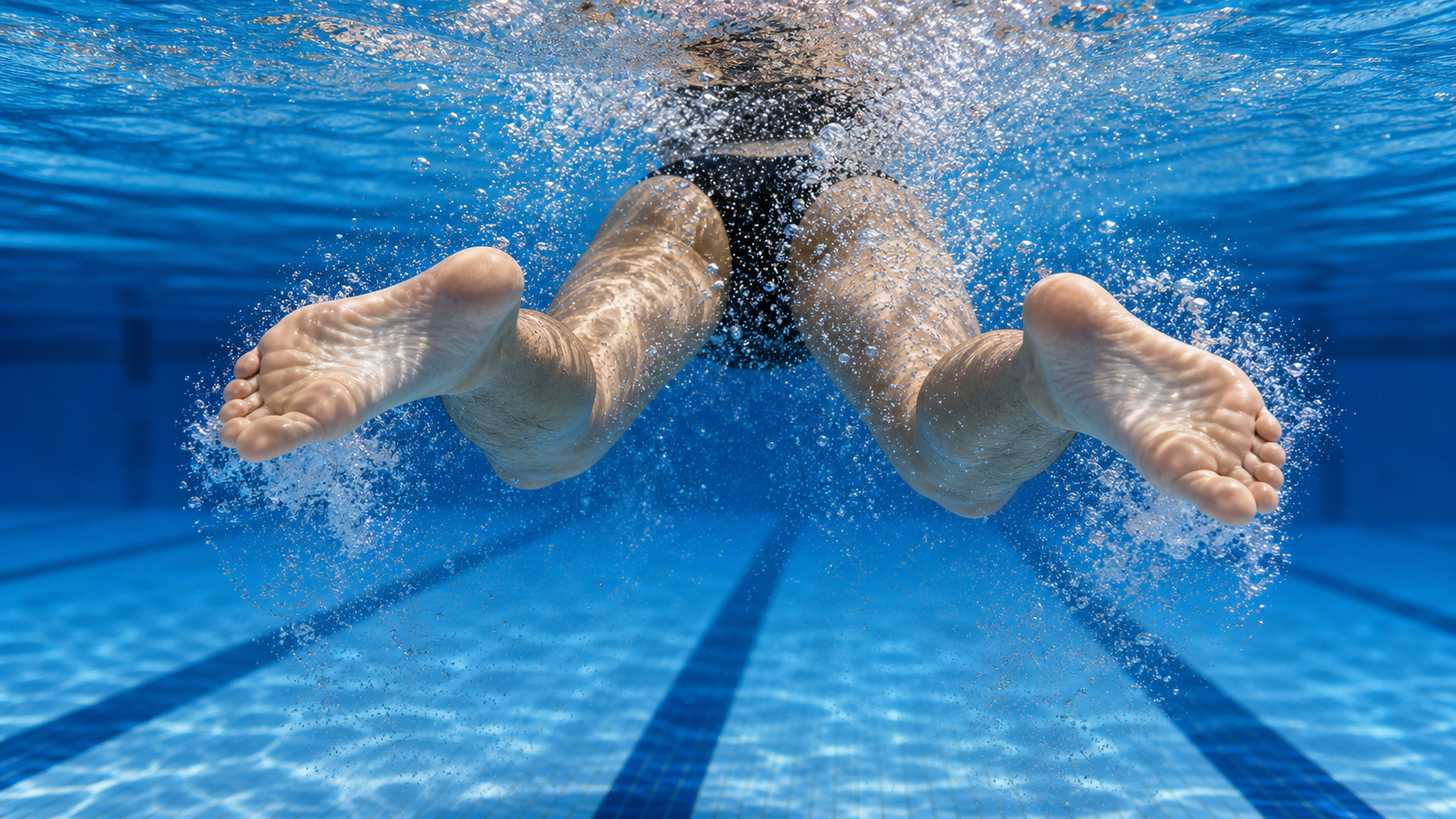
The so-called “outer ankle rotation” refers to the ankle joint rotating outward during the outsweep and insweep phases, causing the soles to face outward and backward, creating the maximum water-pushing surface. This is not a “duck-footed stance” (a static posture with toes pointing outward), but rather a dynamic rotational movement of the ankle joint.
| Ankle Action | Water-Pushing Surface | Thrust Direction | Efficiency |
|---|---|---|---|
| Fully pigeon-toed (no ankle rotation) | Small | Biased downward | Low |
| Correct outer ankle rotation | Maximized | Directly backward | Highest |
| Excessive eversion (ankle collapse) | Moderate | Biased sideways | Moderate |
The incorrect “pigeon-toed kick” (toes pointing inward, ankles not rotated) is the most common problem. With this kicking style, the soles cannot face backward, and a large portion of the force is dispersed in the downward direction (merely lifting the body rather than propelling it forward), or wasted on lateral water pushing.
Anatomical Limitations: The Importance of Ankle Joint Flexibility
Outer ankle rotation requires good external rotation flexibility of the ankle joint. Many swimmers in Taiwan have never specifically strengthened ankle joint mobility before training breaststroke, which means that even if they understand the correct movement, their bodies cannot actually execute it.
Methods to improve ankle joint flexibility:
- Seated ankle rotations: Sit on a chair with feet dangling, and practice the maximum range of ankle external rotation (turning the toes outward), 15 rotations in each direction daily.
- Kneeling ankle eversion stretch: In a kneeling seated position, with the tops of both feet flat on the ground, press the ankles into eversion (toes splaying outward) and hold for 30 seconds.
- Breaststroke kickboard drills: Hold a kickboard and focus on the sensation of ankle rotation, confirming each time whether the soles are truly facing backward during the insweep.
Coordination with Knee Opening Angle
Outer ankle rotation cannot be performed in isolation; it must be coordinated with an appropriate knee abduction angle. During the recovery phase, the knees should open outward to approximately hip width (not excessively wide, as this increases drag). If the knees do not abduct properly, the ankles cannot effectively perform the eversion movement either.
Practical Recommendations
- Vertical kicking drill: Stand in the water with your back against the pool wall and practice the breaststroke kick motion. This allows you to clearly feel whether the soles are truly pushing backward (the water’s reaction force will press your body back against the wall).
- Mirror assistance: On land, sit on the floor and simulate the kick motion, using a mirror to confirm the direction of the soles during ankle rotation.
- Underwater video: Film from behind and underwater to observe the orientation of the soles during the insweep—whether they truly face backward rather than downward or sideways.
- Slow kicking drill: Slow the kick speed to 30% of normal, pausing for 1 second at each eversion to feel the ankle rotation fully engage, then continue the insweep.
Conclusion
The efficiency of the breaststroke kick depends largely on whether ankle rotation is performed correctly. This movement requires both adequate joint flexibility and precise neuromuscular control. Many amateur swimmers in Taiwan, after strengthening ankle joint mobility and correcting their kicking technique, have been able to shave several seconds off their 100-meter breaststroke times while feeling more effortless. Ankle rotation is the technical detail in breaststroke most worth investing in.
Related Reading
- Breaststroke Kick Angle Optimization: Propulsion Differences Between Duck-Footed Kicks and Straight-Line Kicks
- Biomechanics of the Breaststroke Leg Action: A Scientific Analysis of External Rotation and Pushing Thrust
- Rebuilding Water Feel in the Breaststroke Kick: The Science of Hip External Rotation Angle and Propulsive Efficiency
- Breaststroke Outsweep and Insweep: Balancing Knee Protection and Pushing Power
CT 喇低賽) 武嶺牽車 才是王道 西進牽車四小時內秘訣 攝手位置 如何判斷 防抽筋小秘訣
7 年前
西進武嶺 免費訓練分析服務 Intervals | 練不夠還是練過頭?你哪一種類型選手?AI模型告訴你! | 備戰神器 | 公路車 訓練 | CT Yeh
4 年前
抖肩舞 台灣x日本交流版 (台灣 vs 前橋) 赤城山登山賽 coincidance
8 年前
如何把 GoPro 影片 翻轉 批次 轉正?
6 年前
白沙屯媽祖進香在家走!UREVO 坡度自調走步機 / 可連接訓練遊戲APP MyWhoosh / 邊看直播邊走起來 / CT Yeh
11 個月前
戰略) Zwift Race 如何咬在第一集團 如何評估自己要開多少推力 (請開1.5倍速看)
7 年前
單車 梅山36灣 坡度介紹 路段介紹 空拍 (相關遊記影片,請參考說明或我的頻道喔,歡迎訂閱)
6 年前
單車AI教練!全新 ChatGPT4o 幫你分析訓練成果!排武嶺課表,分析騎車姿勢! 太神了! / 公路車 / CT Yeh / feat. 緯緯
2 年前