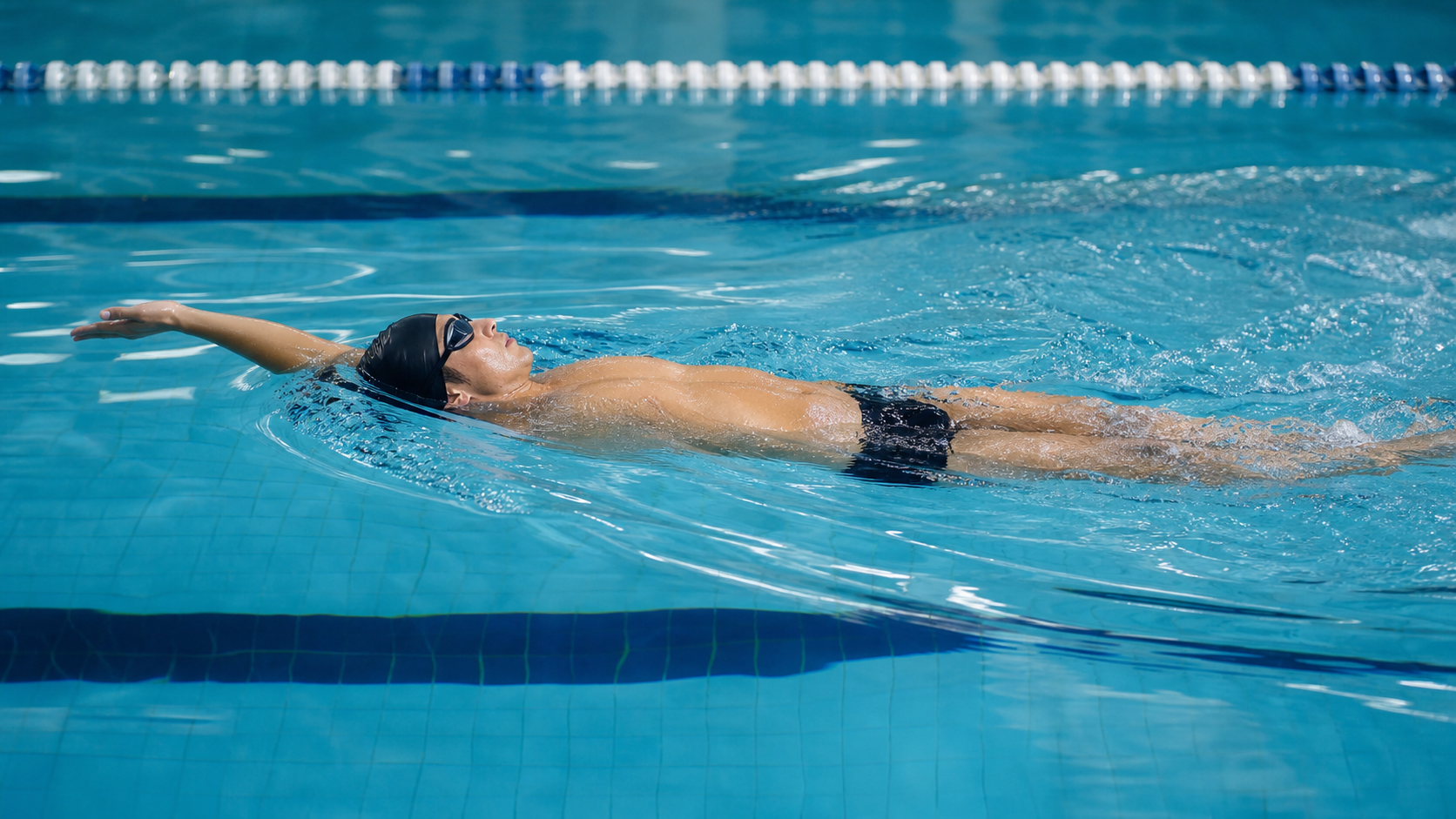
Introduction
Backstroke presents a unique challenge among the four competitive strokes: swimmers cannot directly see where they are going, and the breathing pattern is completely different from the other strokes. But the most common problem beginners and recreational swimmers face is actually more fundamental than orientation—it’s sinking hips.
Sinking hips not only make the swimmer look like they are “swimming while sitting in the water,” but they also directly create a serious hydrodynamic issue: the body shifts from a horizontal to an inclined position, like a boat with a tilted hull, drastically increasing drag and preventing any improvement in speed.
This article will break down the physiological and mechanical mechanisms behind backstroke body balance and provide specific corrective training methods.
The Root Causes of Sinking Hips
The human body’s buoyancy in water is not uniform. The lungs are filled with air, making the chest area the most buoyant; the lower body (especially the legs) has higher muscle density and a stronger natural tendency to sink. When you lie still on your back in the water, your legs will slowly sink—this is a normal physiological phenomenon.
When swimming backstroke, sinking hips usually stem from the following causes:
- Excessive head lifting: Many people try to lift their head to look where they are going. Lifting the head causes the lower body to sink relatively (lever effect).
- Core muscles not engaged: The abs and glutes are relaxed, failing to maintain horizontal tension in the body.
- Insufficient kick tempo: One of the functions of the backstroke flutter kick is to keep the legs near the surface. A weak kick or one with too slow a tempo will let the legs sink.
- Flexed hip posture: Modern people accustomed to sitting have tight hip flexors, so they naturally maintain a flexed hip position in the water, causing the hips to sink.
Key Points for Proper Backstroke Body Position
| Body Part | Correct Position | Common Mistake |
|---|---|---|
| Head | Back of the head rests on the water, ears submerged, eyes looking at the ceiling | Chin lifted, head out of the water |
| Shoulders | Below the surface, rolling with the arm pull | Both shoulders floating above the water, lying too flat |
| Hips | Close to the surface, level with the shoulders | Clearly lower than the shoulders, forming a V shape |
| Legs | Kicking below the surface, knees not breaking the water | Knees coming well out of the water, wasting kick surface area |
The key to maintaining proper position is head placement. Rest the back of your head on the water, let the water just cover your ears, and look toward the ceiling (or about 45 degrees above the water surface)—this head position will naturally bring your body toward horizontal. When swimmers deliberately tuck the chin slightly toward the chest or abdomen (slight retraction), engaging the core also becomes easier.
The Role of the Core Muscles in Backstroke
In backstroke, the core muscles (especially the transversus abdominis and glutes) act as a “buoyancy compensator.” The legs lack sufficient buoyancy, so the core must actively contract to maintain hip height.
Effective ways to engage the core:
- Before swimming, feel a slight abdominal contraction (like the sensation of “pulling the navel toward the spine”) and maintain it throughout the entire swim.
- Keep the glutes slightly contracted to avoid hip flexion and sinking.
- The backstroke kick should be initiated from the hips, not from the knees; this style of kicking involves the core more.
The Supporting Role of the Backstroke Kick
The backstroke flutter kick typically follows a 6-beat rhythm (6 kicks per full arm stroke cycle). Beyond propulsion, this dense kick rhythm plays a more important role: continuously “holding” the legs up near the water’s surface.
Beginners or those with limited flexibility can start with a 2-beat kick (2 kicks per arm stroke cycle), then gradually increase the kick frequency once comfortable.
Practical Tips
- Kickboard supine drill: Hold a kickboard against your chest with both arms and propel yourself using only your legs. Feel the relationship between hip height and kicking power, and confirm your head is properly resting back.
- Star float drill: Spread your arms and legs, float still on your back, and observe your body’s natural floating position. Feel how head position affects hip height.
- Side observation in the water: Ask a training partner to observe the depth of your hips from the side of the lane and provide real-time feedback.
- Off-water hip flexor stretching: Practice the kneeling hip flexor stretch daily to improve hip flexion habits, which helps maintain a horizontal position once in the water.
Conclusion
Building backstroke body balance is not achieved overnight. It requires the simultaneous coordination of head position awareness, core muscle engagement, and kick tempo. But once you find the right feel, drag in backstroke drops significantly, and pace can improve noticeably with almost no additional energy expenditure. Getting the hips up is the first step toward backstroke efficiency.
Related Reading
- Backstroke Back Balance: The Relationship Between Head Position and Hip Buoyancy
- Swimming Body Position: The Impact of Horizontal Posture on Drag
- Freestyle Sinking Feet: Causes of Sinking Hips and Core Engagement Drills
- Backstroke Technique Core: The Triangular Relationship Between Body Roll, Straight-Arm Entry, and Steady Kicking
CT 喇低賽) 單車 比賽總是沒照片? 攝影師的觀點大公開 姿勢就是力量! 請加速1.25倍收看
7 年前
一日北高/長距離團騎 常見問題補充篇 / 組團或跟團的眉角 / 壯車友容易被瘦車友慢性拉爆 / 原來屁股痛可能是這個原因...? / 風場配速法 / 公路車 / CT Yeh
2 年前
一日北高常見問題大集合 | 攻略 | 路線 | 訓練 | 補給 | 自行車 單車 | 一日雙城 | 雙塔 | TWB北高360 | 屁股痛
6 年前
[教學] Premiere 影片 手震 修正 教學 防抖 單眼 影像 GoPro 穩定 Video Stabilization
8 年前
CT 喇低賽) 武嶺牽車 才是王道 西進牽車四小時內秘訣 攝手位置 如何判斷 防抽筋小秘訣
7 年前
單車 梅山36灣 坡度介紹 路段介紹 空拍 (相關遊記影片,請參考說明或我的頻道喔,歡迎訂閱)
6 年前
下次拍照前要查清楚啦🤣 #cycling
7 個月前
2016/05/13 單車 冷水坑下滑
10 年前