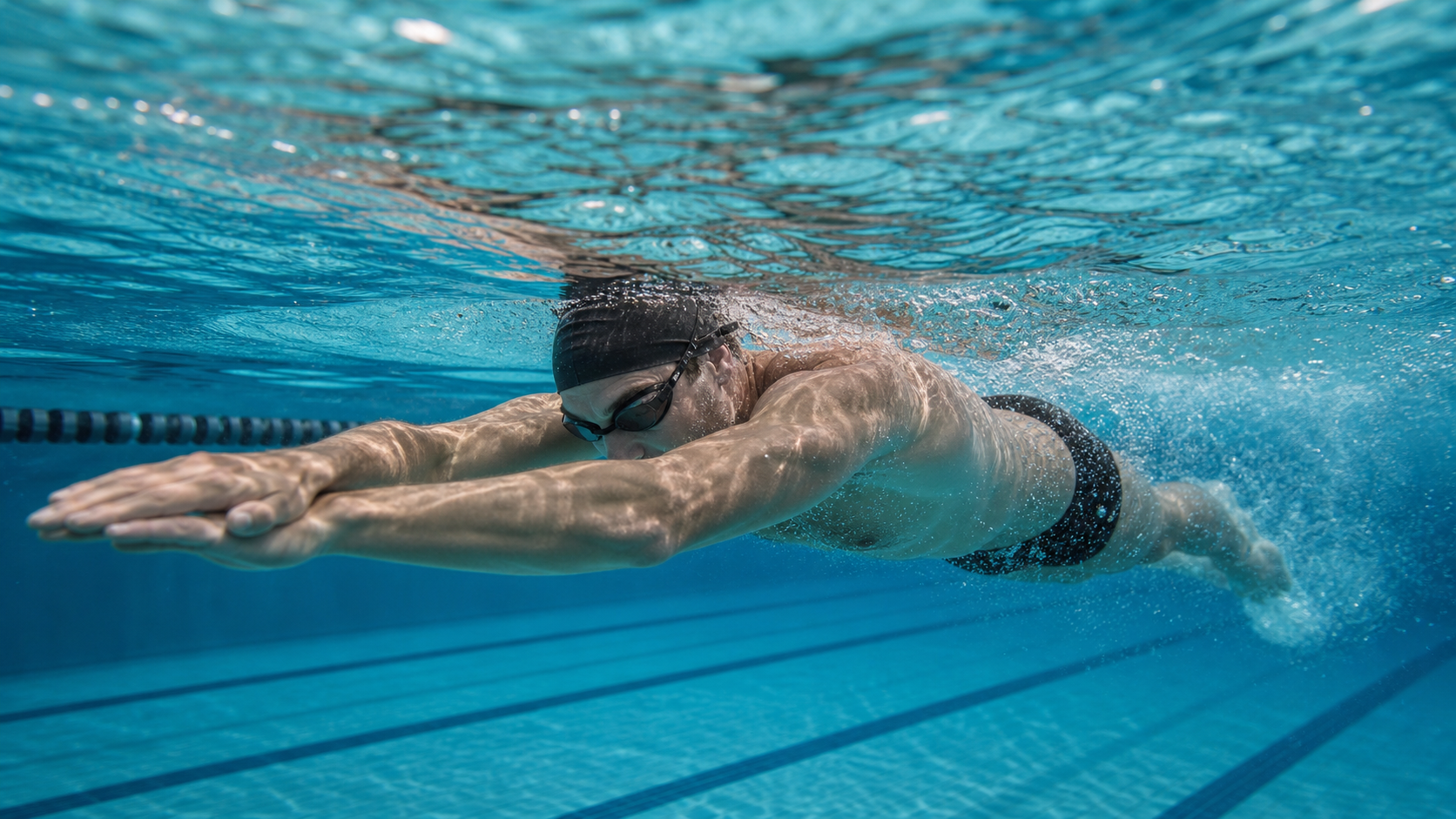
Introduction
Improving speed fundamentally comes down to only two paths: increasing propulsion, or reducing drag. Many swimmers spend a great deal of time training arm strength (increasing propulsion) while overlooking the fact that efficiency gains from reducing drag are often more significant.
Drag force in water can be divided into three main categories: Form Drag, Friction Drag, and Wave Drag. Understanding the physical mechanisms behind these three types of drag can help swimmers target drag reduction from a technical standpoint.
Definitions and Proportions of the Three Types of Drag
| Drag Type | Primary Cause | Proportion of Total Drag (Competitive Swimmers) | Main Influencing Factors |
|---|---|---|---|
| Form Drag | Body cross-sectional area | 50–60% | Body position, horizontal angle |
| Wave Drag | Water surface disturbance | 20–30% | Swimming speed, water depth, swimming posture |
| Friction Drag | Friction between skin/swimsuit and water | 10–20% | Swimsuit material, body hair, swimming speed |
It should be noted that these proportions are not fixed values; they vary significantly with swimming speed, stroke, and skill level. At slower speeds, form drag accounts for a higher proportion; as speed increases, the importance of wave drag also rises.
Form Drag: The Largest Source of Drag
Form drag is the resistance generated when an object “blocks” the forward flow of water, and its magnitude depends primarily on the frontal area (the cross-sectional area in the direction of water flow).
For swimmers, the most effective ways to reduce form drag are:
- Maintaining a horizontal body position: A dropped hips significantly increases the cross-sectional area, making this one of the primary sources of form drag.
- Streamlined body alignment: When the arms are extended forward, tuck the head between the arms (except in backstroke) to create a “torpedo-shaped” entry position with minimal cross-sectional area.
- Reducing sway: Excessive side-to-side rocking in freestyle or excessive leg abduction in breaststroke both increase lateral cross-sectional area.
In long-course races, the streamline glide phase after the start can reach speeds faster than the swimming stroke itself, precisely because form drag is extremely low in a streamlined position.
Wave Drag: The Hidden Killer of Speed
When a swimmer moves near the water surface, the body generates waves. Producing these waves requires energy, and the waves also exert a reaction force on the swimmer, creating wave drag.
Wave drag has several important characteristics:
- Proportional to the square of speed: Doubling speed increases wave drag by approximately four times, which is why drag-reduction technique becomes more critical as elite swimmers reach higher speeds.
- Depth effect: The closer the swimmer’s body is to the water surface, the greater the wave drag; this is also why underwater dolphin kicking is faster than surface swimming over short distances after starts and turns.
- Wave interference: Waves from adjacent lanes can superimpose on one another, which is one reason swimmers compete for the middle lanes in high-level competitions (waves from both sides cancel each other out).
Friction Drag: Details Determine Victory
Friction drag is the frictional force between the water flow and the swimmer’s surface. Although it accounts for the smallest proportion, it still matters at the competitive level.
Methods to reduce friction drag:
- Competitive swimsuits (e.g., LZR Suit): High-tech swimsuits use superhydrophobic materials, with surface textures designed as “shark-skin-inspired” microstructures that can significantly reduce friction.
- Shaving body hair: Elite swimmers shave their entire body before competitions. Although the improvement is limited, it is still considered a necessary step at the highest level of competition.
- Swim caps and goggles: The head is also a source of friction drag; a well-fitted silicone swim cap can reduce friction on the head.
Practical Recommendations
- Prioritize fixing posture: For recreational swimmers, optimizing form drag (maintaining a horizontal body, reducing sway) yields far greater speed improvements than purchasing competitive swimsuits.
- Practice underwater gliding after starts: Practice streamlined gliding underwater after the start to master the feel of the position with minimal wave drag, and carry that sensation into surface swimming.
- Self-filming for observation: Side-view underwater footage most clearly reveals form drag issues, particularly when observing hip depth and whether the legs deviate from horizontal during kicking.
- Feel the “drag wall”: While swimming, deliberately relax for a stretch and then pull hard again, feeling the speed difference between high-drag (poor position) and low-drag (good position) states to build proprioceptive awareness of drag.
Conclusion
Swimming drag analysis reminds us that the ceiling on speed is determined not only by physical conditioning but also by technique. For most recreational swimmers, reducing form drag (improving posture) is the most worthwhile investment; for competitive swimmers, managing wave drag (including the use of underwater dolphin kicking) is an important tactical consideration. Only by understanding drag can you truly master the water.
Related Reading
- Introduction to Swimming Biomechanics: The Three Types of Drag and Every Watt You Can Save
- The Science of Water Drag in Swimming: The Ratio of Form Drag vs. Friction Drag and Drag-Reduction Strategies
- The Science of Water Drag in Swimming: How Streamlined Posture Reduces Drag
- The Science of Water Drag in Swimming: Streamlined Technique and Energy Expenditure
一日北高前的西濱集訓 | 跟著11小時軍團 | 300W踩不動的大逆風 | 輪車破風差幾瓦?
6 年前
一日北高/長距離團騎 常見問題補充篇 / 組團或跟團的眉角 / 壯車友容易被瘦車友慢性拉爆 / 原來屁股痛可能是這個原因...? / 風場配速法 / 公路車 / CT Yeh
2 年前
西進武嶺 免費訓練分析服務 Intervals | 練不夠還是練過頭?你哪一種類型選手?AI模型告訴你! | 備戰神器 | 公路車 訓練 | CT Yeh
4 年前
戰略) Zwift Race 如何咬在第一集團 如何評估自己要開多少推力 (請開1.5倍速看)
7 年前
3D 列印車褲墊 / 舒適改善? / 無痕 x 分區壓縮 / ATK & Decider系列 / JE22黑科技 / #公路車 #CTYEH
11 個月前
靠單車減肥35公斤 心得分享與整理
7 年前
一日北高常見問題大集合 | 攻略 | 路線 | 訓練 | 補給 | 自行車 單車 | 一日雙城 | 雙塔 | TWB北高360 | 屁股痛
6 年前
CT 喇低賽) 武嶺牽車 才是王道 西進牽車四小時內秘訣 攝手位置 如何判斷 防抽筋小秘訣
7 年前