Introduction
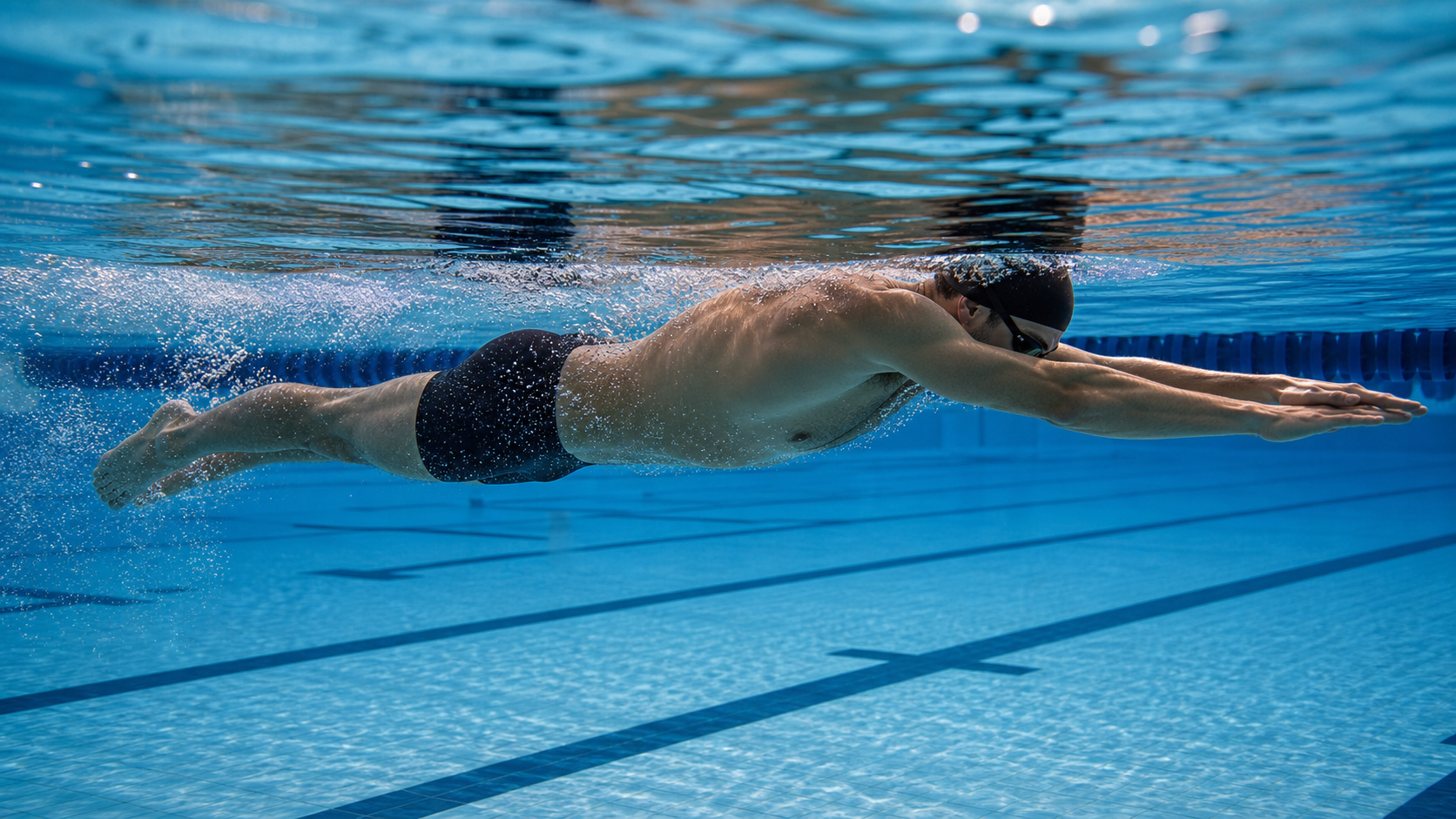
Among the many details of swimming technique, the importance of head position is often underestimated. The head accounts for only about 7% of the human body’s weight, yet because it sits at the very front of the body, it has a lever-like effect on overall posture. If the head rises 5 cm, the hips may sink 10–15 cm; if the head’s forward direction deviates, the body’s midline shifts accordingly.
This article will systematically analyze the head position requirements for each stroke, as well as the specific impact of incorrect head position on drag and speed.
The Lever Effect: Why Head Position Matters So Much
The body’s center of gravity is near the hips, while the center of buoyancy (the lungs) is near the chest cavity. The head is located in front of the center of gravity, so changes in its position produce a noticeable lever effect on body posture:
- Head raised: This is equivalent to adding weight to one end of a lever, causing the hips and legs to sink relatively, increasing the cross-sectional area and raising form drag.
- Head pressed too deep: The hips rise relatively, and while this reduces some drag, excessive pressing affects forward vision (breaststroke/butterfly breathing) and can easily cause neck muscle fatigue.
- Head tilted to the side: This disrupts midline alignment, causing a snaking, swaying motion and increasing lateral drag.
Head Position Guidelines for Each Stroke
| Stroke | Head Position | Line of Sight | Key Considerations |
|---|---|---|---|
| Freestyle | Waterline cuts across the hairline at the forehead | Diagonally downward at 45 degrees | Rotate the head when breathing, do not lift it |
| Backstroke | Back of the head rests on the water, ears below the surface | Ceiling/diagonally upward | Slight chin tuck |
| Butterfly | Eyes look at the bottom, forehead slightly exposed | Directly downward | Lead with the chin when breathing, not by lifting the whole head |
| Breaststroke | Forehead below the surface, eyes looking forward and down | Forward and downward | Chin leads out of the water when breathing |
Freestyle Head Position
The ideal head position in freestyle is to have the waterline cut across the hairline at the forehead, with the line of sight directed diagonally downward (about 45 degrees). At this point, the cervical spine and the rest of the spine form a natural extension, and the neck muscles do not need extra contraction to maintain the posture.
Many beginners habitually lift their heads to look forward. This extends the cervical spine backward, which in turn arches the lumbar spine, sinking the hips and creating a “banana-shaped” body curve that significantly increases drag.
Butterfly Breathing Head Movement
Butterfly breathing is the stroke where head position problems are most severe. The correct breathing motion is: the chin leads forward and out of the water, then is immediately retracted after the breath is taken. The head moves “forward” rather than “upward.” Incorrect breathing involves lifting the entire head substantially upward, which causes the hips to sink sharply and requires extra energy to “refloat” the body.
Breaststroke Head and Breathing Coordination
When breathing in breaststroke, the chin extends just above the water, with the eyes and forehead kept as close to the surface as possible. Many swimmers lift their entire head substantially during breaststroke breathing, causing the chest to press down and the hips to rise, disrupting the streamlined posture and increasing impact drag upon re-entry into the water.
Head Symmetry and Breathing Direction
When breathing in freestyle, the head should rotate around the spine as its axis, rather than bending laterally around the cervical spine. Rotational breathing keeps the head synchronized with the body’s side roll without introducing additional deflection; lateral bending during breathing, on the other hand, impedes the rotation of the opposite shoulder.
Practical Tips
- Waterline awareness training: While swimming freestyle at a slow pace, deliberately feel where the waterline cuts across the head, confirming it is at the hairline rather than the middle of the forehead or the eyes.
- Relax the neck: Perform neck relaxation exercises before swimming (gentle rotations in all directions) to avoid stiffness that leads to unconsciously lifting the head while swimming.
- Video comparison: Mount a phone on the side of the lane and record a parallel-angle video of the water surface to clearly see whether the head is at the correct height.
- Butterfly breathing simulation: Stand in shallow water and practice the butterfly breathing motion to feel the difference between leading with the chin forward versus lifting the head upward.
Conclusion
Correcting head position is often one of the fastest ways to see improvement in swimming technique. Simply changing the habit of lifting the head to lowering it and letting the water cover the top of the head allows many swimmers to immediately feel reduced drag and increased speed. In the water, the head is the bow of the ship—when the bow is straight, the entire ship can move in a straight line.
Related Reading
- Key to Stroke Correction: How Head Position Affects Full-Body Alignment
- Improving Body Position in Water: The Relationship Between Streamlined Posture and Head Position
- Freestyle Head Position Too High: Effects on Sinking Legs and Corrections
- Swimming Body Position: The Impact of Horizontal Posture on Drag
CT 喇低賽) 武嶺牽車 才是王道 西進牽車四小時內秘訣 攝手位置 如何判斷 防抽筋小秘訣
7 年前
一日北高/長距離團騎 常見問題補充篇 / 組團或跟團的眉角 / 壯車友容易被瘦車友慢性拉爆 / 原來屁股痛可能是這個原因...? / 風場配速法 / 公路車 / CT Yeh
2 年前
西進武嶺 自製新版AI配速表產生器 x 賽前攻略 抱佛腳! 沒有功率計也可以產生配速表嗎?有什麼其他眉角賽前要注意的呢? | 西進武嶺 / 東進武嶺 KOM 攻略 | 公路車 | CT Yeh
4 年前
風櫃嘴 | 全台最多大砲的單車路線 | 尋寶網攝影師告訴你怎麼擺拍起來才好看 | 熱門攝影地點巡禮
6 年前
抖肩舞 台灣x日本交流版 (台灣 vs 前橋) 赤城山登山賽 coincidance
8 年前
戰略) Zwift Race 如何咬在第一集團 如何評估自己要開多少推力 (請開1.5倍速看)
7 年前
西進武嶺 8000名單車友數據分析 PART1 | 從新手到高手數量/瓦數/推力比/FTP推力比/功率計使用率 大解析 | 公路車 | CTYeh
5 年前
西進武嶺 免費訓練分析服務 Intervals | 練不夠還是練過頭?你哪一種類型選手?AI模型告訴你! | 備戰神器 | 公路車 訓練 | CT Yeh
4 年前