Introduction
In Taiwan’s swimming environment, short-course meters (SCM, 25 meters) and long-course meters (LCM, 50 meters) are the two most common competition formats. Many swimmers find that they perform well in short-course events but noticeably slow down when switching to long-course; conversely, some swim smoothly in long-course but struggle with rhythm in short-course due to overly frequent turns.
This difference is no coincidence. Short-course and long-course swimming do have fundamental differences in technique, energy distribution, and strategy. Understanding these differences can help swimmers prepare more effectively for different competitions.
Energy Characteristics of Turns in Swimming
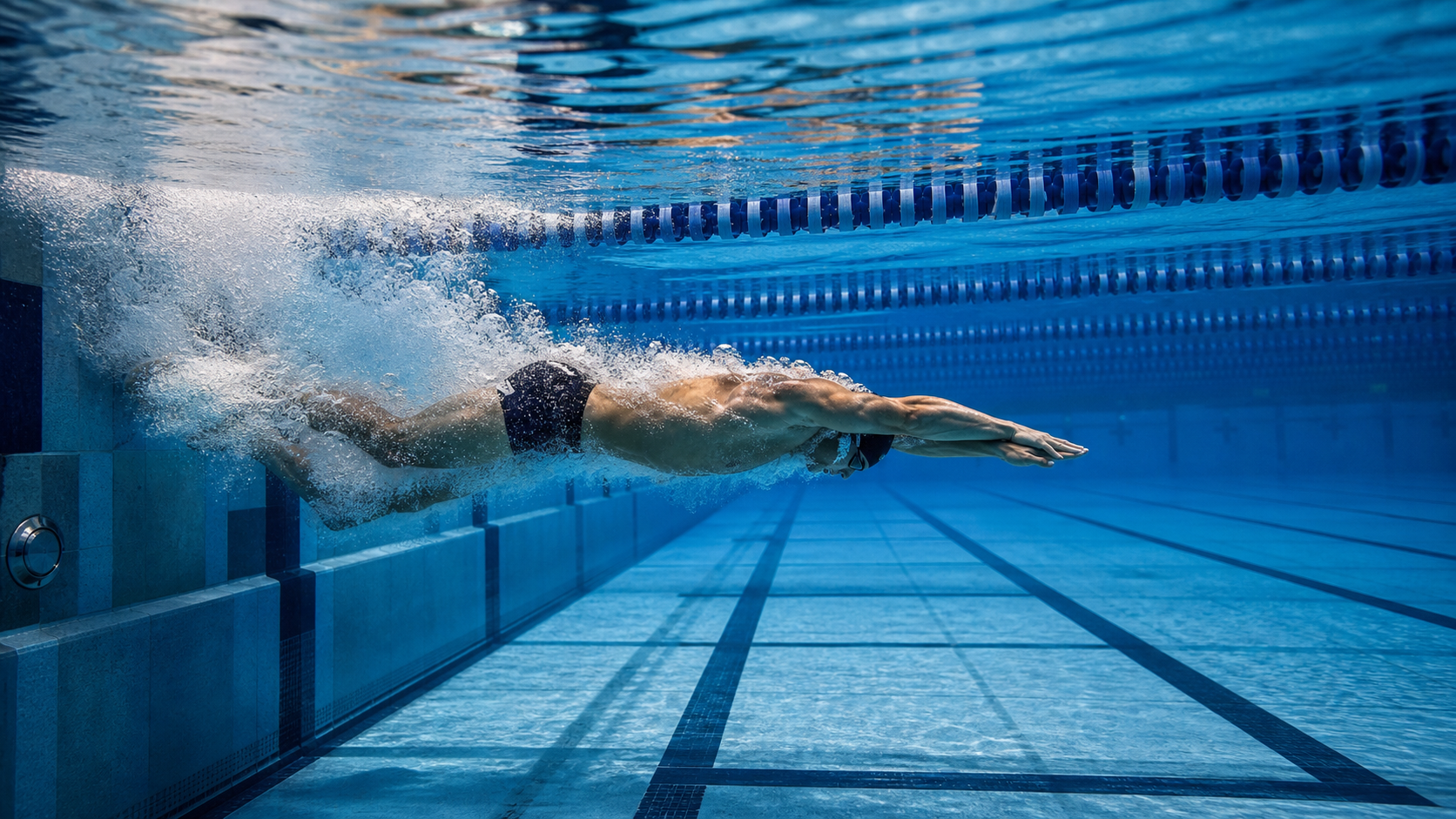
Flip turns, like starts, are among the fastest phases in swimming. At the moment of the turn, swimmers use the rebound force of the wall and streamlined gliding to reach instantaneous speeds higher than normal swimming speed, and the drag during this glide is far lower than swimming at the surface.
| Pool Length | Number of Turns per 100m (Freestyle) | Turn Proportion (Estimated by Glide Distance) |
|---|---|---|
| 25m Short Course | 3 | Approximately 15–20% |
| 50m Long Course | 1 | Approximately 5–8% |
This means that in short-course races, as much as 15–20% of the distance is spent in a “low-drag glide” state, while in long-course it is only 5–8%. For swimmers with excellent turn technique, short-course is an advantageous environment; for those with weaker turn technique, short-course becomes a challenging zone instead.
Technical Demands of Short-Course Swimming
Short-course swimming places higher demands on the following techniques:
Flip Turn Speed and Efficiency
Turn speed (from wall contact to wall push-off) directly affects short-course performance. Elite short-course swimmers can complete a flip turn in 0.4–0.6 seconds, while amateur swimmers typically need 0.8–1.5 seconds. Each turn that takes 0.5 seconds longer adds up to 1.5 seconds over a 100m short-course race—a significant gap.
Use of Underwater Dolphin Kick
The underwater dolphin kick after each turn is a major source of propulsion in short-course swimming. Skilled swimmers can stay underwater for 10–15 meters before surfacing, and their underwater speed exceeds their surface swimming speed. In short-course, there is an opportunity to dolphin kick every 25 meters, making technical differences especially apparent in this phase.
Rhythm Management
A 25-meter pool requires frequent adjustments to breathing rhythm (holding breath before the turn, breathing after the turn) and stroke rhythm (accelerating after the start, slowing down to adjust before approaching the turn). This frequent rhythm switching demands a higher level of technical maturity.
Technical Demands of Long-Course Swimming
Long-course swimming places higher demands on the following techniques:
Pacing Strategy
In long-course races, energy management is more critical than in short-course. Taking the 100m freestyle as an example, swimmers who go out too fast in the first 50m typically show a significant slowdown in the second 50m (the so-called “second-half collapse”). The ideal pacing should have the second half slightly slower than the first half, but with a controllable margin.
Stroke Consistency
In long-course swimming, the process from the start to reaching the opposite wall spans 50 meters, with no “reset opportunity” provided by turns in between. Stroke consistency and fatigue resistance become more important.
Breathing Frequency Adjustment
Longer long-course swims typically require more frequent breathing (every 2 strokes or every 3 strokes), whereas in short-course, swimmers can use the moments around turns to reduce breathing frequency, minimizing the disruption breathing causes to stroke mechanics.
Cross-Pool Training Strategies
If your primary goal is long-course races but your daily training takes place in a short-course pool (many swimming facilities in Taiwan only have short-course pools), you can adopt the following strategies:
- Deliberately avoid relying on turn acceleration: Skip the underwater dolphin kick after turns and swim straight out to train pure swimming technique.
- Simulate long-course pacing rhythm: Treat two 25-meter laps as one 50-meter segment for pacing purposes, and do not view the turn as a “reset point.”
- Strengthen aerobic endurance sets: Short-course training tends to develop high-frequency sprint habits. Add 10×100m and slow 200m aerobic sets to build the sustained endurance required for long-course racing.
Practical Recommendations
- Record and compare your results over the same distance in short-course versus long-course pools to determine whether you are a “short-course advantage” or “long-course advantage” swimmer, then target your weaknesses for improvement.
- Practice flip turn efficiency: Spend 10 minutes before each training session repeatedly practicing flip turns in the shallow end, timing from wall contact to the first arm stroke.
- Strengthen underwater dolphin kick technique: The stronger your lower-body power and dolphin kick technique, the greater your short-course advantage—this is also a major trend in modern competitive swimming.
Conclusion
Short-course and long-course are not just about “different pool sizes”—they are two distinct forms of swimming competition. By understanding the technical differences between the two, swimmers can prepare more specifically rather than using the same training approach for different competition environments. Knowing which pool length suits you best while simultaneously strengthening your weaknesses is the correct path to improving your overall swimming performance.
Related Reading
- Technical Differences Between 50m Short-Course and Long-Course Swimming: Turn Proportion and Pacing Strategies
- Race Strategy Differences Between Short-Course (25m) and Long-Course (50m) Pools
- 25m Short-Course vs 50m Long-Course: What Exactly Is Different in Training Strategy?
- Training Differences Between 50m and 25m Pools in Taiwan: A Complete Guide to Workout Adjustments
Live) 備戰2019彰化經典百K 賽前攻略 (已完賽請看新影片
7 年前
西進武嶺 免費訓練分析服務 Intervals | 練不夠還是練過頭?你哪一種類型選手?AI模型告訴你! | 備戰神器 | 公路車 訓練 | CT Yeh
4 年前
SRAM FORCE E1 首發!/ 改成短腿了 / 煞車升級有感嗎? / TIME ADH 變速大升級 / 公路車 / CT Yeh
1 年前
半日 小台灣 極限單車路線挑戰實錄
7 年前
CT 喇低賽) 武嶺牽車 才是王道 西進牽車四小時內秘訣 攝手位置 如何判斷 防抽筋小秘訣
7 年前
2019 夏季KOM 5小 完賽心得 準備攻略 東進武嶺 夏季登山王之路 Taiwan KOM Challenge
7 年前
碟煞公路車 優缺點?換車一年半實際經驗分享 / 公路車 / CT Yeh
2 年前
靠單車減肥35公斤 心得分享與整理
7 年前