Handling Unexpected Situations on a Round-Island Ride: Flat Tires, Mechanical Failures, and Weather Response
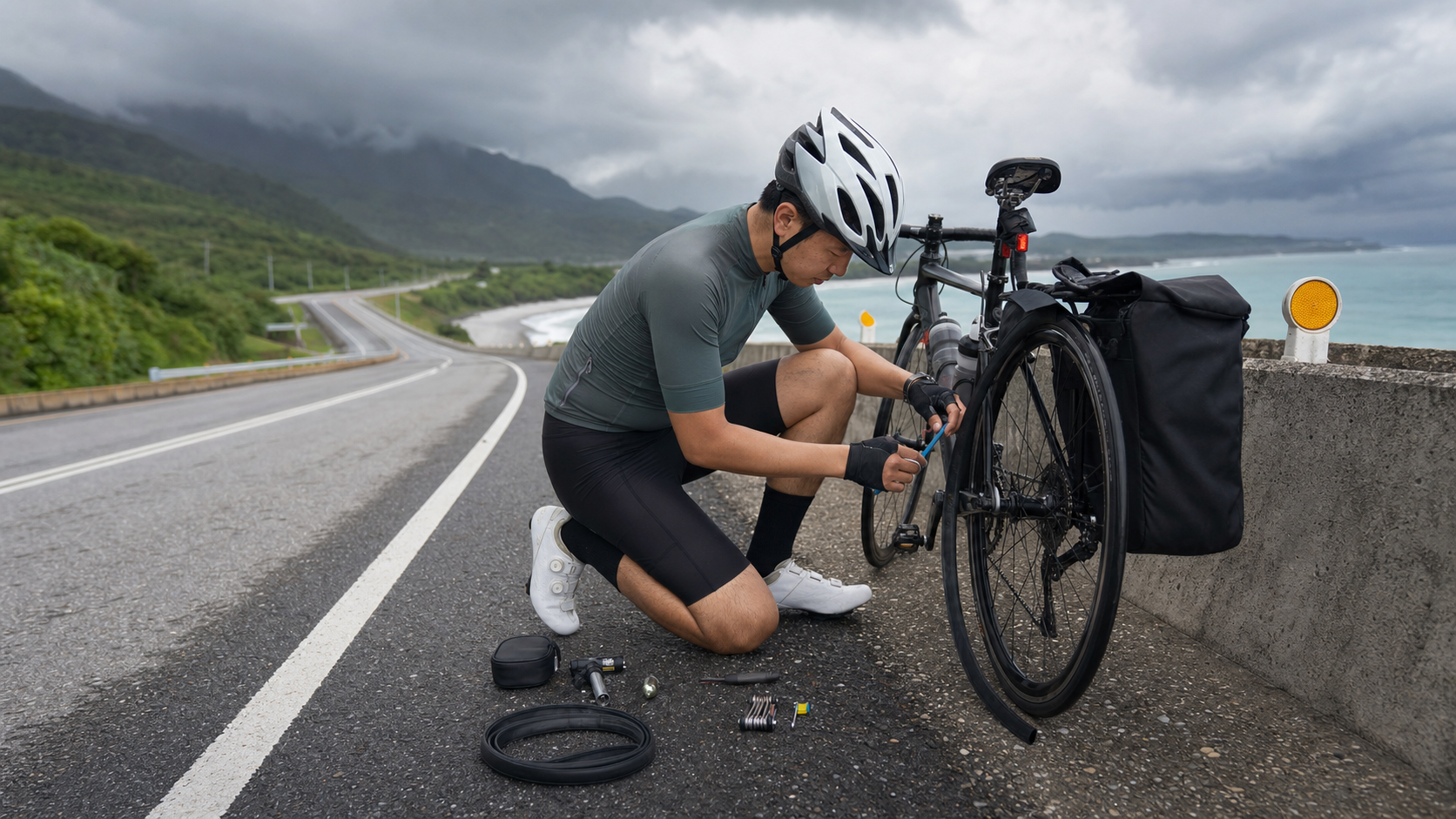
Introduction
Being well-prepared before departure is the best strategy for handling unexpected situations. But even the most thorough plan cannot predict every nail or every gust of wind on the road. What round-island riders need is not fear, but the mental readiness and practical knowledge to “stay calm and handle problems when they arise.” This article provides the most practical emergency guide for the road, covering flat tire repair, mechanical fault diagnosis, and severe weather decision-making.
1. Flat Tire Handling
Flat tires are the most common unexpected issue on a round-island trip, with most riders encountering them at least 1–2 times during a 10-day journey.
Identifying a Flat Tire
- Slow leak: The ride gradually feels heavier—this is the most common precursor to a flat
- Sudden blowout: You hear a “pop” and the bike immediately veers; this is an emergency—grip the handlebars firmly to maintain control
- Snake bite: A hard impact causes the inner tube to be pinched between the rim and the road, resulting in two parallel small holes
Steps to Replace an Inner Tube
- Stop in a safe location (roadside, parking lot—avoid working in the traffic lane)
- Flip the wheel over and remove the quick-release skewer
- Use tire levers to pry one side of the tire off the rim, working around the circumference
- Remove the punctured old inner tube
- Run your hand along the inside of the tire to locate the penetrating object (nail, glass) and remove it
- Install the new inner tube, inflating it slightly so it doesn’t fold or twist
- Seat the tire bead fully back onto the rim, starting from the side opposite the valve
- Inflate with a CO₂ cartridge to the proper pressure (road bike approx. 80–100 psi, mountain bike approx. 40–60 psi)
- Reinstall the wheel and confirm the quick-release is securely tightened
Common Mistakes
- Failing to locate the penetrating object first, then getting another flat 5 minutes after installing the new tube (the most common error)
- Not checking that the inner tube is seated flat when mounting the tire, causing another blowout once pressure is high
- Running out of CO₂ cartridges before realizing you don’t have enough spares—carry at least 2
2. Common Mechanical Failures
Chain Drop
The most common mechanical issue and usually harmless.
- Fix: Use your hand or a tire lever to guide the chain back onto the smallest chainring, then pedal a few easy revolutions to confirm smooth operation
- Prevention: Before departure, make sure the chain is clean and lubricated and the shifting is properly adjusted; avoid forcing extreme gear combinations while climbing
Shifting Malfunctions
| Symptom | Possible Cause | Fix |
|---|---|---|
| Sluggish shift response | Loose shift cable | Tighten the barrel adjuster next to the rear derailleur cable by half a turn |
| Chain skipping gears | Chain too long or cassette worn | Shorten the chain with a quick link; if it’s a cassette issue, visit a bike shop |
| Cannot shift to the largest chainring | Limit screw adjustment issue | Fine-tune the H screw; if beyond adjustment range, visit a bike shop |
Brake Failure
- Worn brake pads: Most common on long descent sections (Suhua Highway, South Link Highway). Check pad thickness before departure and re-check halfway through the trip
- Loose brake cable: Adjust the fixing bolt on the handlebar, or tighten the brake cable barrel adjuster
- Hydraulic disc brake issues: If the brake lever suddenly feels spongy, air may have entered the system. This requires professional service—do not attempt a roadside fix; be sure to find a bike shop in the next city
Severe Frame or Wheel Damage
If the frame is cracked or the wheel is badly bent (taco’d), it cannot be repaired roadside. Here’s what to do:
- Retreat to the nearest sheltered location (temple, gas station, convenience store)
- Call 110 or 119 (if injured)
- Contact the nearest bike shop and ask if they offer pickup service (some do)
- Use TRA (Taiwan Railways) or a bus to transport the damaged bike to the next city for repair
3. Weather Response
Thunderstorms
Afternoon thunderstorms are a summer norm in Taiwan. Key principles:
- Take shelter early: When you see clouds building over the opposite ridge or hear thunder, immediately seek cover (convenience store, temple, gas station canopy)
- Wait for the rain to stop before riding: Taiwan’s afternoon thunderstorms typically end within 30–60 minutes—be patient
- Riding in the rain: Reduce speed (cut it in half on descents); tire grip drops by 30–50%
- Never ride during lightning: Riding in open terrain is a high-risk activity for lightning strikes. The moment you see lightning, get off the bike and take shelter indoors
Typhoons and Strong Winds
- Taiwan’s typhoon season runs from July to September. If a typhoon warning is issued during your trip, find accommodation immediately and take shelter
- In strong winds, keep a low posture, grip the handlebars firmly, and don’t fight crosswinds
- Mountainous areas like Suhua and the South Link Highway often have rockfalls after typhoons; wait for the Directorate General of Highways to lift road closures before proceeding
Practical Tips
- Learn self-rescue before you hit the road: Practice changing a tire once at home using YouTube tutorials to confirm you can do it independently
- Carry emergency contact information: TRA inquiry hotline, local bike shop numbers, and accommodation contact details
- Take note of landmarks at your stopping points: If you need assistance, you can quickly describe your location
- Join round-island rider communities: Facebook groups like “單車環台” (Cycling Around Taiwan) are the most immediate mutual-aid resource on the road
Conclusion
Unexpected situations are part of a round-island ride, not a sign of failure. Every flat tire fixed before continuing on, every thunderstorm waited out before setting off again—these moments give the journey its texture. When problems arise, stay calm and analyze the situation. Taiwan’s warmth and hospitality will always show up when you need a helping hand.
Related Reading
- Handling Mechanical Issues on a Round-Island Ride: Self-Rescue Steps for Flat Tires and Broken Chains in the Wild
- Emergency Flat Tire Repair: A 10-Minute Guide to Quickly Replacing an Inner Tube Mid-Ride
- Bicycle Mechanical Failure Response: On-the-Spot Handling of Flat Tires and Broken Chains While Riding
- Bicycle Flat Tire First Aid: The Complete SOP for Replacing and Patching Inner Tubes by the Roadside
爬陡坡被爆胎的車友跑步超車 #cycling #里佳部落
9 個月前
單車胎壓觀察到的有趣現象,SRAM Quarq TyreWiz 2.0 無內胎胎壓計 / 裝了有哪些幫助? / Tubeless / 公路車 / CT Yeh
1 年前
單車 一日北高 ( 雙城 ) 肥宅雙人瘋狂行 紀錄片 REACTO
10 年前
碟煞公路車 銑面器 !? 原來銑完差這麼多! 降低蹭碟機率! | TIME 公路車 保養小記錄 | CT Yeh
3 年前
摔車後補裝備: 好市多新款單車安全帽& Specialized Romin 北高整路屁股都不痛的坐墊 | 一千元居然有MIPS | CT Yeh | 公路車
4 年前
鎮西堡 公路車首航 你排乳酸 我排卵... | 宇老又爆胎 要直接棄坑了嗎?
4 年前
金門 ! 我騎過最棒的離島了 / 最後可以騎車上金門大橋的機會!?/ 公路車 / CT Yeh
1 年前
一日北高/長距離團騎 常見問題補充篇 / 組團或跟團的眉角 / 壯車友容易被瘦車友慢性拉爆 / 原來屁股痛可能是這個原因...? / 風場配速法 / 公路車 / CT Yeh
2 年前