Introduction
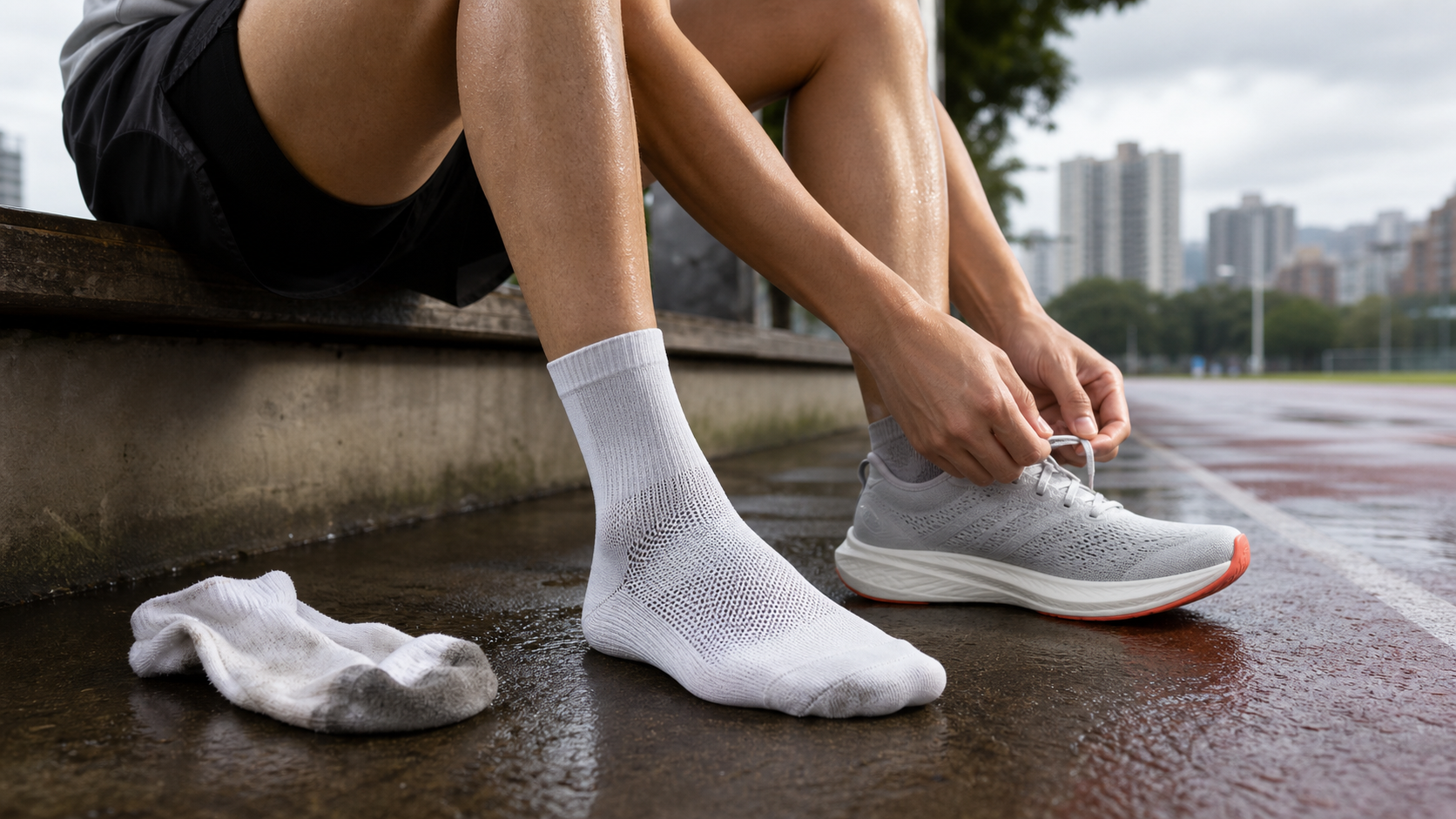
“The most overlooked gear is often what’s closest to your skin.” Running socks may be a small accessory, but they directly affect running comfort and the likelihood of blisters. Especially during Taiwan’s hot and humid summers, or when your feet swell in the latter half of a full marathon, the right pair of running socks can determine whether you make it to the finish line.
Why Are Cotton Socks Unsuitable for Running?
The Fundamental Problem with Cotton
Cotton is a natural absorbent material—a trait that’s an advantage in everyday wear, but in running it becomes three major drawbacks:
Absorbs but doesn’t wick: Cotton socks absorb sweat but drain it very slowly. After exercise, cotton socks turn into a “wet sponge,” clinging to the skin and causing friction.
Slow drying: During summer runs in Taiwan, feet sweat heavily. Cotton socks stay damp for long periods, significantly increasing the risk of blisters.
Added weight: After absorbing water, weight can increase by 30–50%, affecting stride rhythm and running efficiency.
Research shows: Runners wearing cotton socks for a full marathon have a 3–5 times higher blister rate than those wearing specialized running socks.
Comparison of Three Main Running Sock Materials
Merino Wool
Merino wool is one of the top-tier running sock materials:
- Naturally antibacterial: The wool fiber structure inhibits bacteria, resisting odor even with prolonged wear
- Temperature regulation: Warm in winter, cool in summer—especially suitable for mountain running in Taiwan’s winter
- Excellent moisture wicking: Absorbs sweat while keeping skin feeling dry
- Drawbacks: Higher price (NT$500–1,200/pair), less durable than synthetic materials
Representative brands: Darn Tough, Smartwool, Icebreaker
Synthetic Fibers (Polyester/Nylon)
Currently the market mainstream with the best value for money:
- Quick-drying: Wicks sweat rapidly, keeping feet dry
- Durable: Withstands heavy washing and has a long lifespan
- Lightweight: No impact on running efficiency
- Drawbacks: Less antibacterial than wool; may develop odor after repeated use
Representative brands: Balega, Feetures, Injinji
CoolMax/Coolmax Elite
Coolmax is Invista’s patented moisture-wicking fiber used in high-performance athletic apparel:
- Four-channel fiber design: Quickly draws sweat away from the skin’s surface
- Widely available: Many Taiwanese local sports brands such as Test Rite and Decathlon offer CoolMax running socks
- Affordable pricing: NT$150–350/pair
Key Functional Design Features of Running Socks
| Feature | Description | Importance |
|---|---|---|
| Seamless construction | Prevents friction from seams at the toe seams | ★★★★★ |
| Compression support | Light compression reduces vibration fatigue | ★★★★ |
| Variable thickness | Extra padding at heel/toe, thin and breathable at instep | ★★★★ |
| Arch support | Elastic band secures the arch, prevents slipping | ★★★ |
| Left/right foot design | Anatomical 3D cut based on foot shape | ★★★ |
Introduction to Specialized Running Socks
Toe Socks (e.g., Injinji)
The five-toe design wraps each toe individually, completely eliminating friction between toes. Especially suitable for:
- Ultramarathon runners
- Runners prone to blisters between toes
- Those with unusual toe shapes (e.g., overlapping toes)
Compression Running Socks
Provide graduated pressure from the ankle to the calf (typically 15–25 mmHg), improving venous return:
- Reduces calf swelling in the latter half of long runs
- Wearing them during recovery accelerates lactic acid clearance
- Taiwanese brands such as Phiten and Taiwan-made XCOOL offer such products
Buying Recommendations for Taiwan’s Climate
Summer (May–October): Choose ultra-thin synthetic fiber running socks with Ultra Light cushioning (about 1–2mm), prioritizing breathability and quick-drying.
Winter (November–March): Especially for mountain running, opt for Merino wool or mid-weight socks that balance warmth and moisture management.
Marathon race day: Wear a familiar pair you’ve already run in at least 2–3 times. Don’t race in brand-new running socks (unworn friction points may not be broken in yet).
Practical Tips
- Budget NT$300–600/pair: Feetures Elite and Balega Hidden Comfort are the highest-rated entry-level choices among Taiwanese runners
- Budget under NT$200: Decathlon’s Kalenji line of running socks offers excellent value—buy several pairs to rotate
- Backup rule: Always keep a clean pair of running socks in your race bag for immediate changes if it rains or your feet become uncomfortable
- Washing advice: Turn socks inside out to wash; avoid high-heat dryer cycles that can damage elastic fibers; air-dry naturally to extend lifespan
Conclusion
A good pair of running socks costs anywhere from a few hundred to over a thousand NT dollars—compared to running shoes that easily cost several thousand, it’s the most cost-effective gear upgrade you can make. Toss your cotton socks, switch to a pair of professional running socks, and your feet will thank you after every long run. In Taiwan’s hot climate, quick-drying, moisture-wicking running socks are a non-negotiable essential.
Related Reading
- In-Depth Running Sock Selection Guide: A Comprehensive Comparison of Materials, Thickness, and Waterproofing
- Don’t Overlook Your Feet’s Second Skin: The Importance of Running Socks and a Complete Buying Guide
- The Importance of Running Socks: Choosing Between Wool vs. Synthetic, Thickness, and Waterproofing
- Running Top Buying Guide: Moisture-Wicking Fabrics, Cut Design, and the Best Choices for Taiwan’s Summer
3D 列印車褲墊 / 舒適改善? / 無痕 x 分區壓縮 / ATK & Decider系列 / JE22黑科技 / #公路車 #CTYEH
11 個月前
CT暗黑廚房) 車友必備 宇宙無敵鮮蚵湯 幫助訓練恢復 天然食補 好市多 超肥鮮蚵 破PR
7 年前
Live) 備戰2019彰化經典百K 賽前攻略 (已完賽請看新影片
7 年前
用了AirTag 單車就不怕被偷?盲點大測試 結果… |公路車|CT Yeh
5 年前
2026 車錶排行榜!誰是最多車友正在使用?練家子最愛哪款?🏆 (2萬名車友數據) / 公路車 / CT Yeh
5 個月前
2025 自行車錶排行榜 兩萬車友大數據 / Garmin Bryton 排名會大洗牌嗎? / 全新的碼表前身分析 /公路車 / CT Yeh
1 年前
[防寒衣體驗] 鐵人魂 三鐵 防寒衣試穿會 於松運 深水游泳池 鯨魚池
8 年前
台北大雁西飛 約騎挑戰 feat. Doris | 公路車 | CT Yeh
3 年前