Introduction
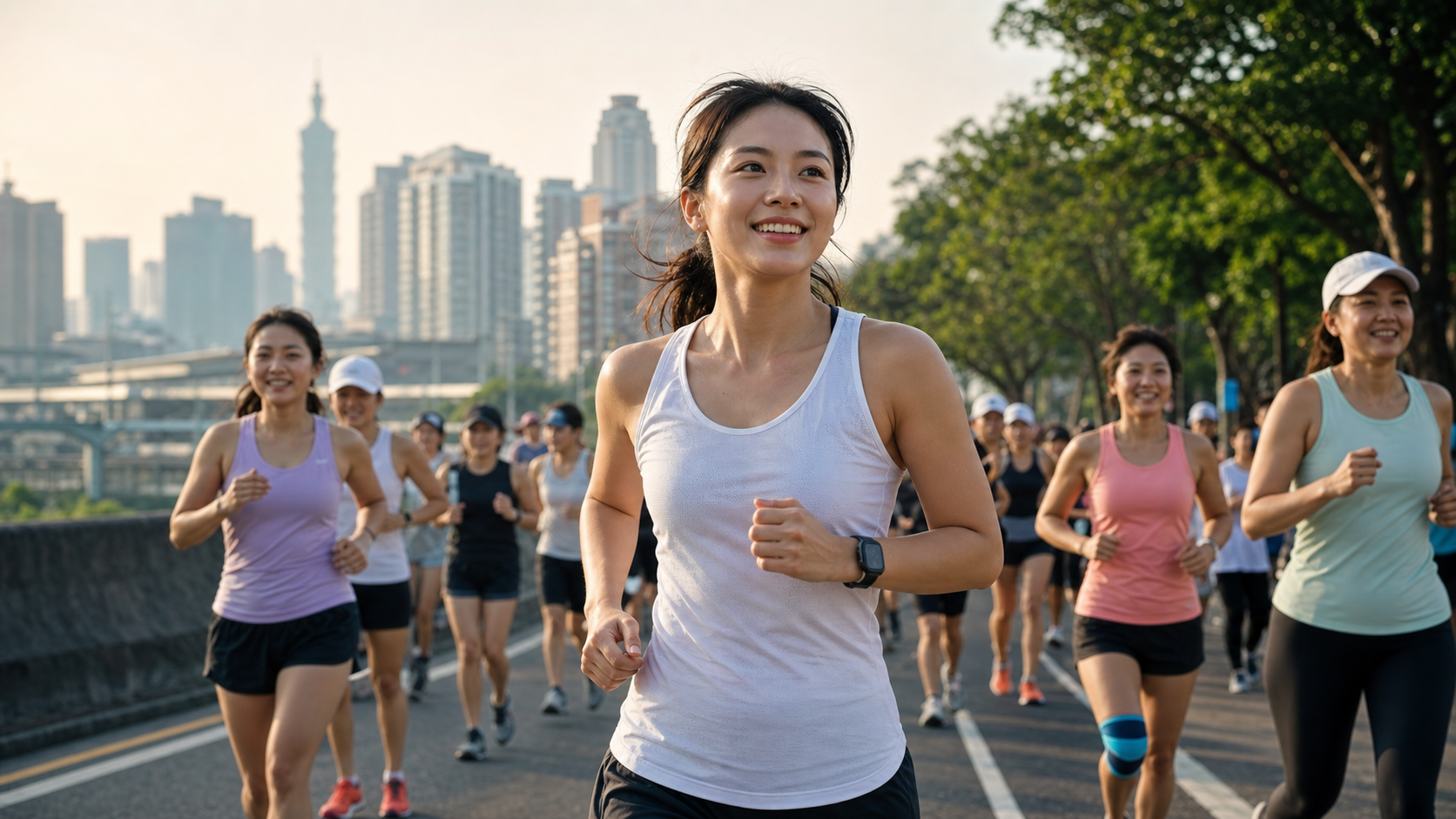
A decade ago, female faces at Taiwan’s marathon events were few and far between; today, female runners in vibrant running gear are already a major presence in Taiwan’s road running scene. According to statistics from multiple large-scale events, the proportion of female participants in Taiwan’s full marathons has climbed from under 15% in 2010 to 35–40% today, and in half marathons and 10K races, female participation in some events is now on par with men. This is not just a change in numbers—it is a cultural shift.
The Context Behind the Rise of Female Runners in Taiwan
Several intertwined social currents lie behind the surge of women taking up road running in Taiwan:
Rising fitness awareness and female self-determination: In the 2010s, the fitness mindset of Taiwanese women shifted from “slimming down” to “getting strong,” with running becoming a way to showcase physical capability rather than merely pursuing body-shape goals. More and more female runners openly declare, “I don’t run to lose weight; I run to feel how strong I am.” This discourse has reshaped the framework of meaning around women’s participation in road running.
The demonstration effect of social media: The rise of Taiwanese female runner communities on Instagram has allowed more people to see examples of “people like me are running too.” When an ordinary office-working mother shares tearful moments after finishing a race on Instagram, the resonance it triggers is far more influential than the records of elite athletes.
An increase in women-friendly events: Organizers have begun paying attention to female runners’ needs, from changing room facilities, nursing spaces, and the number of women’s restrooms, to staggered wave starts for men and women—all reflecting how events value female runners and further lowering the psychological barrier to participation.
The role of women’s running groups: Multiple women-only running groups have emerged in Taiwan, such as women’s power runner clubs and mother running groups, providing running spaces free from gender stereotype pressure and allowing women to build running habits in an environment of mutual understanding.
| Year | Proportion of Women in Taipei Marathon Full Marathon | Key Milestones for Female Runners in Taiwan |
|---|---|---|
| 2010 | Approx. 12% | Female running communities begin to appear online |
| 2014 | Approx. 22% | First wave of female ultramarathon runners gains media attention |
| 2018 | Approx. 32% | Women-only road running events emerge |
| 2022 | Approx. 38% | Mother runners and postpartum return-to-running culture take shape |
| 2025 | Over 40% | Women become the largest audience segment for certain events |
Distinctive Aspects of Taiwan’s Female Running Culture
Taiwan’s female runner community features several highly distinctive cultural phenomena:
Postpartum return-to-running culture: A cohort of “mother runners” has emerged in Taiwan. After giving birth, they view resuming running as a way to reclaim their sense of self and escape the around-the-clock pressures of parenting. Early morning or evening running slots have become the only hour of the day that belongs solely to many mothers. This group has formed a powerful mutual-support community online, sharing experiences on postpartum fitness recovery, pace adjustment, and juggling running with breastfeeding.
Aesthetic awareness in running attire: Taiwanese female runners generally place a high premium on the aesthetics of running apparel, driving an upgrade in sportswear consumption. Many female runners treat running as a stage for “expressing personal style,” valuing functionality and aesthetics equally.
A running discourse centered on emotion and mental health: Compared with male runners, who more often discuss pace and results, conversations within Taiwan’s female runner community more frequently address running’s role in mental health, stress relief, and self-dialogue, fostering a running culture more attuned to the “inner experience.”
Practical Advice
For Taiwanese women interested in taking up running, the following points are especially worth considering:
- Find a women-friendly running group: Joining a group whose members are predominantly female or that is explicitly women-friendly can provide more tailored advice on running that accounts for women’s physiological characteristics
- Understand the menstrual cycle and training: Different phases of the menstrual cycle affect running performance in various ways; leveraging cycle-based training can improve results more efficiently
- Do not overlook running safety: When running alone in the early morning or late at night, pay attention to route safety, let family know your whereabouts, or join a group that trains on a regular schedule
- Set goals that are your own: There is no need to set overly ambitious targets just to “keep up with male running buddies”—female runners have their own progression curve
- Support women-focused running media: Several blogs and communities in Taiwan are dedicated to female runners; subscribing and engaging with them can provide more targeted information
Conclusion
The rise of female runners in Taiwan is a quiet cultural revolution. With every footstep, they write the declaration “I can do it too” on the running course. It is not merely an improvement in health metrics—it is an ability to define oneself: defining one’s own physical limits, defining one’s own time, and defining one’s own interpretation of strength. When more and more Taiwanese women raise their hands at the finish line, they are celebrating not just completing the race, but also a more complete version of themselves.
Related Reading
- The Rise of Women’s Marathon Culture in Taiwan: A Transformation from the Margins to the Mainstream
- Women’s Road Running Communities in Taiwan: The Local Culture of Running Sister Groups and Mother Runners
- Women’s Road Running Communities: The Development and Support Networks of Women’s Running Groups in Taiwan
- Road Running Attire Culture: The Fashion Aesthetics and Personal Style of Runners in Taiwan
「悲情男車友」創作單曲 爆笑MV / 公路車 / CT Yeh / 4K劇情版
7 個月前
日本公路最高登山賽,台灣首位YT挑戰實錄,乘鞍登山賽40週年,賽前篇完整版,請到我的YT收看 #公路車 #cycling
11 個月前
2025 紫南宮99.9K環縣自行車挑戰賽 直播 / 第一集團跟了20K / CT動態數據直播系統 / 公路車 / CT Yeh
1 年前
抖肩舞 台灣x日本交流版 (台灣 vs 前橋) 赤城山登山賽 coincidance
8 年前
Live) 備戰2019彰化經典百K 賽前攻略 (已完賽請看新影片
7 年前
新屋團體繞圈賽 | 眾多菁英好手賽道奔馳 | 千瓦女子軍團 | 無敵交管狂獲好評 明年你一定不能錯過 | #公路車
5 年前
台北大雁西飛 約騎挑戰 feat. Doris | 公路車 | CT Yeh
3 年前
2018 田中馬拉松 全程健跑 VR 360 環景錄影 體驗現場狂野加油氣氛! Insta 360
7 年前