Introduction
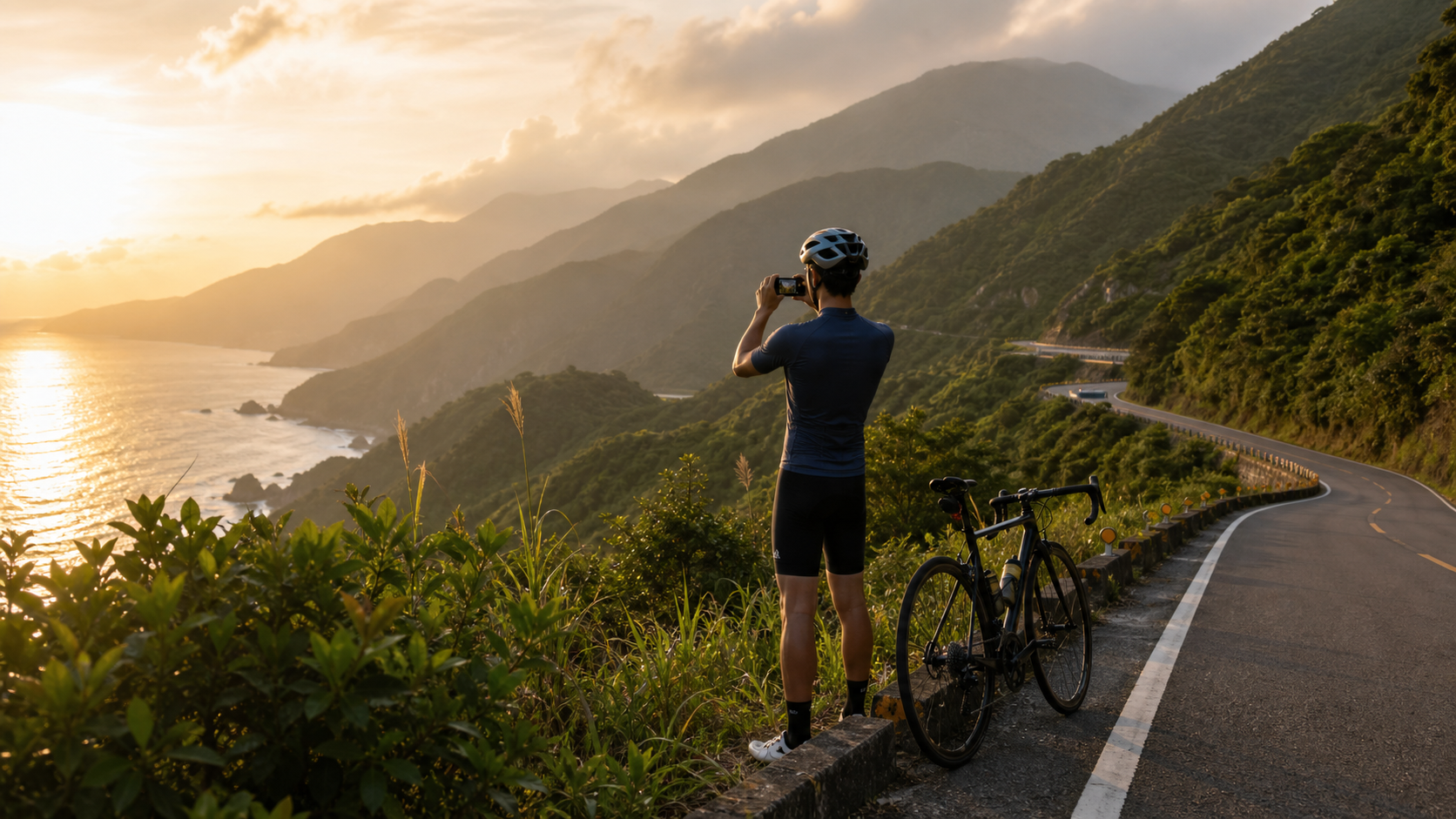
Some say the best scenery is always just around the next bend. Cyclists know this feeling well—when the coastline unfolds in the morning light, or mountain roads appear and disappear through the mist, pressing the shutter at that moment captures not just the view, but the most direct dialogue between body and nature.
Taiwan is a paradise for cycling photographers: Wuling at 3,275 meters above sea level, golden coastlines, and small roads winding through rice paddies—every stretch of road offers a reason to stop and document. This article will elevate your cycling photography, from gear and technique to route recommendations.
Choosing Gear for Cycling Photography
Prioritize Lightweight
When carrying photography equipment on a bike, weight and convenience come first. Here are several common setups:
| Gear Type | Pros | Cons | Best For |
|---|---|---|---|
| Smartphone (with phone mount) | Lightweight, instant sharing, GPS logging | Limited optical performance | Daily documentation, social media posts |
| Mirrorless camera | Excellent image quality, interchangeable lenses | Requires a separate bag | Half-day to full-day rides |
| Action camera (GoPro, etc.) | Waterproof, shockproof, wide-angle view | More post-processing required | Dynamic video while riding |
| Compact prime camera | Great image quality, easy to carry | Fixed focal length | Scenery-focused photography rides |
Choosing Your Mounting Method
Shooting can be divided into two modes: “stopped shooting” and “shooting while moving”:
- Stopped shooting: The safest and most stable in quality, suitable for any camera
- Handlebar mount: Can secure a smartphone or action camera, ideal for capturing the riding perspective
- Chest mount: GoPro with a chest harness, capturing body movement and the road ahead
- Rear bag hook: A lightweight camera hung on the outside of a top-tube bag for quick access
Composition and Technique for Shooting While Riding
Golden Rules for Stopping to Shoot
Safety always comes first. When shooting on Taiwan’s mountain roads, these rules are essential:
- When stopping, make sure your bike is fully pulled over and does not obstruct other traffic
- Never stop to shoot on sharp curves where approaching vehicles have limited visibility
- After taking photos, confirm the road conditions before setting off again
Three Key Composition Points
- Using leading lines: The winding road itself is the best leading line—let it stretch from the foreground into the distance to create a sense of depth
- Foreground framing: Use roadside rice stalks, flower clusters, or tree branches as foreground elements to add layers
- Timing the light: Taiwan’s golden shooting hours are 6–8 AM and 4–6 PM; side lighting and warm tones give scenes more dimensionality
Taiwan’s Most Worthwhile Stretches to Stop and Shoot
The following routes are renowned for being cyclist-accessible and visually outstanding:
- Yilan: Wai’ao to Toucheng: Waves, sandy beaches, and distant mountains—one of Taiwan’s most photogenic flat coastal stretches
- Huatung Valley farmland section (Yuli to Ruisui): Rice paddy landscapes with green mountain backdrops—a rural tableau along Provincial Highway 9
- Nantou: Around Cingjing Farm: High-mountain pasture atmosphere, an intriguing blend of European-style architecture and Taiwan’s mountain scenery
- Miaoli: Near Shengxing Station in Sanyi: The old mountain railway line paired with tung blossoms (April–May) or autumn leaves (October)—a popular photography hotspot
- Taitung: Dapo Pond in Chishang: Vast farmland, Bunun culture, and blue skies with white clouds—a must-visit for island-circumnavigation cyclists
Practical Tips
- Check sunrise and sunset times before departure: Use apps like “PhotoPills” or “The Photographer Ephemeris” to predict light direction
- Don’t give up on cloudy or foggy days: Taiwan’s mountain seas of clouds and light mist can often produce photos with more atmosphere than sunny days
- Post-process in moderation: The appeal of cycling photography lies in its authenticity; over-editing loses the sense of being there. A little brightening and color adjustment is enough
- Back up to the cloud: Back up your photos immediately after every ride to avoid losing them to a dropped phone or a camera damaged by moisture
Conclusion
Cycling photography is the art of slowing down. Every time you stop to frame a shot, you observe the details of this land more closely: how light dances on leaves, how roads echo the mountain ridges, how wind tilts rice into golden waves. Cycling takes you there; photography lets you remember the moment. Taiwan’s beauty is worth stopping for—take a good, long look.
Related Reading
- Cycling Photography Tips: How to Capture Beautiful Taiwan Landscape Photos While Riding
- The Complete Guide to Cycling Photography: 10 Secrets for Great Shots While Riding
- Photographing and Documenting Your Island Tour: How to Capture Great Images on the Road
- Bike Touring Photography Tips: Documenting Your Cycling Story
太平山單車員工旅遊 | 這樣玩CP值最高!| 公路車
5 年前
風櫃嘴 | 全台最多大砲的單車路線 | 尋寶網攝影師告訴你怎麼擺拍起來才好看 | 熱門攝影地點巡禮
6 年前
再快都跟的上!? 單車跟隨攝影機之王 HOVERAir X1 PROMAX 全面實測 / 唯一!8K畫質&自行車專用模式和跟蹤信標&前後避障 / DJI Neo 可參考/ 公路車 / CT Yeh
1 年前
西進武嶺最新路況場勘,台14到清境,還適合騎單車上去嗎?/ 居然有這優勢!?/請開啟字幕/當天現剪/公路車/CT Yeh
2 年前
CT 喇低賽) 單車 比賽總是沒照片? 攝影師的觀點大公開 姿勢就是力量! 請加速1.25倍收看
7 年前
單車 一日北高 ( 雙城 ) 肥宅雙人瘋狂行 紀錄片 REACTO
10 年前
DJI Osmo Action 6 / 單車運動拍攝實用技巧 公路車 CT Yeh
7 個月前
4K單車實境) 嘉義 梅山36灣 訓練台 爬坡 輕鬆騎
6 年前