How to Extend the Lifespan of Running Shoes: A Complete Guide to Proper Running Gear Maintenance
Introduction
Many runners spend a fortune on a good pair of running shoes, only to see their lifespan drastically shortened by improper maintenance. Taiwan’s hot and humid climate means that if running shoes are not properly cared for after use, the midsole foam will break down faster, the upper materials are prone to mold, and ultimately the shoes lose their support—potentially even causing injuries. This article integrates sports science with real-world conditions in Taiwan to provide a complete guide to running gear maintenance.
How Running Shoes Age
Understanding how running shoes age is the key to extending their lifespan:
Compression Breakdown of Midsole Foam
The midsole of running shoes (EVA, PEBA, PU foam) is the core of cushioning, but every step compresses the foam’s air cells at a microscopic level, leading to:
- Early stage (0–200 km): The foam breaks in moderately, providing the best underfoot feel
- Mid stage (200–500 km): The foam gradually compresses, and cushioning performance begins to decline
- Late stage (500–800 km): Cushioning loss of 20–40%, with significantly reduced joint protection
Factors affecting the rate of aging:
- Body weight (heavier runners compress the foam faster)
- Running surface (asphalt wears shoes faster than tracks)
- Storage environment (high temperatures accelerate foam breakdown)
The Unique Challenges of Taiwan’s Climate for Running Shoes
| Taiwan Climate Issue | Impact on Running Shoes | Prevention Method |
|---|---|---|
| High temperatures (35°C+) | Accelerated aging of midsole foam | Avoid storing in hot car trunks/balconies |
| High humidity (80%+) | Mold on insoles and uppers | Dry thoroughly after every use |
| Sudden heavy rain | Uppers absorb water and become heavy; leather/synthetic materials deform | Dry promptly, but avoid direct heat sources |
| Beach running (salt) | Salt crystals damage upper stitching | Rinse with clean water immediately after use |
The Correct Way to Clean Running Shoes
Daily Cleaning (After Every Run)
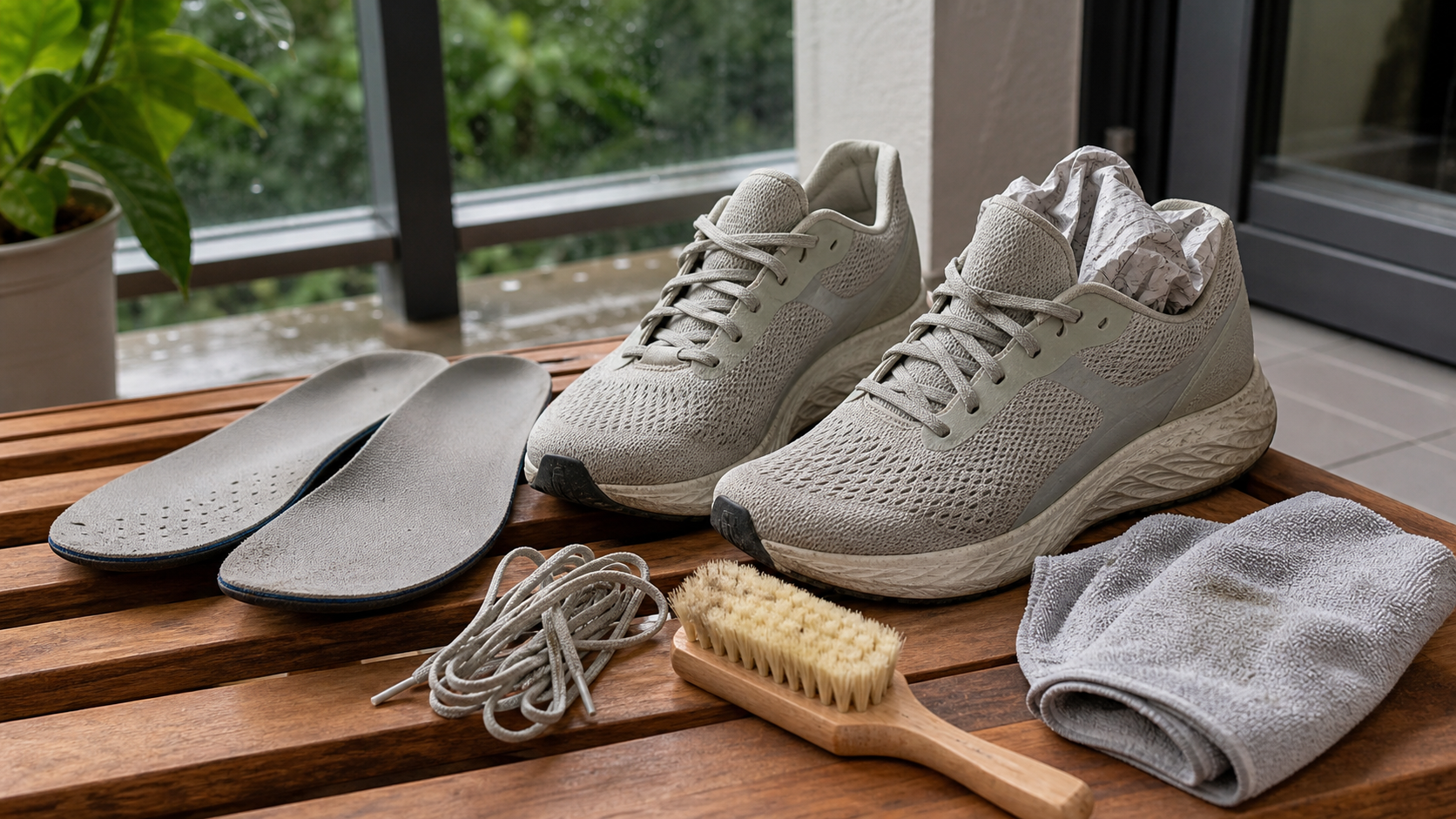
- Remove dirt and mud while still wet: Wipe the uppers with a damp cloth immediately after running—removing dirt before it dries takes the least effort
- Remove laces and insoles: Allow the inside of the shoe to breathe fully, preventing moisture from being trapped inside
- Stuff with newspaper: Newspaper absorbs moisture from inside the shoe, speeding up drying. If no newspaper is available, use a dry towel
- Air dry naturally: Place in a ventilated, shaded area. Avoid direct sunlight or placing near heaters/dryers
Deep Cleaning (1–2 Times per Month)
- Tools: A soft-bristled old toothbrush, mild detergent (bleach-free), clean water
- Steps:
- Remove the insoles and laces and wash them separately
- Dip the toothbrush in a small amount of detergent and gently scrub the uppers, paying special attention to the grooves in the outsole tread
- Rinse thoroughly with clean water to ensure no detergent residue remains
- Pat dry the surface with a dry towel, then stuff with newspaper and air dry naturally
Things to avoid:
- Do not put them in the washing machine (even if labeled machine-washable, high-speed friction accelerates adhesive failure)
- Do not use a dryer (high heat rapidly ages EVA foam and can shorten lifespan by 30–50%)
- Do not point an electric fan directly at them (it is acceptable, but keep a distance of at least 30 cm and use the low-speed setting)
Special Care for Carbon-Plated Racing Shoes
The midsole material of carbon-plated running shoes (Pebax/TPE-based) is more fragile than standard EVA and requires extra attention:
- Use only for races/speed sessions: Each pair of carbon-plated shoes has a recommended lifespan of 300–500 km; avoid wasting them on daily training
- Store in their original box: Put them back in the original shoebox with the original packing inserts to maintain the shoe’s shape
- Avoid hot car interiors: Pebax material is especially sensitive to high temperatures; avoid leaving them in the car during summer
- Clean gently: Avoid scrubbing the carbon plate area with a stiff brush
Insole Care and Replacement
Insoles are the most overlooked part of running shoe maintenance, yet they equally affect running comfort:
Cleaning frequency: Wash once a week (more often during heavy-sweat summer periods)
Cleaning method:
- Hand wash with mild detergent and rinse with clean water
- Squeeze out excess water and air dry naturally; do not machine dry
- Insoles typically wear out faster than the shoes themselves; it is recommended to replace them every 300 km or every 6 months
Upgrading insoles: Stock insoles are usually basic. Consider purchasing custom or semi-custom insoles such as Superfeet or Footbed for better arch support, priced at NT$800–1,800 in Taiwan.
How to Tell When Running Shoes Need Replacing
Objective indicators:
- Mileage: Regular training shoes 600–800 km; carbon-plated shoes 300–500 km
- Time in use: Even if the mileage hasn’t been reached, shoes older than 12–18 months should be replaced because the foam naturally oxidizes and ages
Subjective feel indicators:
- Increased knee or ankle pain after runs
- The cushioning feel disappears on landing—it feels like “your feet are hitting the ground directly”
- Uneven outsole wear (wear exceeding 3 mm in depth on one side)
Simple test: Place the shoe on a hard, flat surface and observe from behind whether the heel still stands vertically. If it is visibly tilted inward or outward, the midsole support structure has broken down and the shoes must be replaced.
The Multi-Shoe Rotation Strategy
Many professional runners in Taiwan adopt a “multi-shoe rotation” strategy, which not only extends the lifespan of each pair but also reduces the risk of specific injuries:
- Recommended setup: Rotate between 2 pairs of daily training shoes
- Benefits of rotation: Rotating between the same model allows the midsole foam 48 hours to recover its shape; research shows this can extend lifespan by 20–30%
- Differentiated setup: Rotate between different models (one cushioned pair + one stability pair) to expose your feet to different stimuli and reduce repetitive stress injuries
Practical Tips
- Track your mileage: Use Garmin Connect, Strava, or a phone memo to record the cumulative mileage of each pair of running shoes, avoiding the use of overly worn shoes
- Mold prevention in Taiwan’s summer: Air dry shoes for at least 24 hours before storing them, and place desiccants (bamboo charcoal packs or silica gel) inside the shoes
- Travel running notes: When running on business trips or vacations, take the running shoes out of your luggage after the run to avoid trapping them in a sealed space
- Backup shoe strategy: Do not wear brand-new shoes within 2–3 weeks before a race; they need at least 10–15 km of break-in time
Conclusion
A good pair of running shoes is the most important investment in your running training, and proper maintenance habits will allow them to serve you for much longer. In Taiwan’s hot and humid environment, thoroughly drying after every run, cleaning regularly, tracking mileage, and replacing shoes at the right time are the three key principles for extending the lifespan of running shoes. Investing the money you save on shoes into more training or gear upgrades is the smartest equipment management strategy for any runner.
Related Reading
- How Many Kilometers Before Replacing Running Shoes? Maintenance Tips to Extend Lifespan
- Running Gear Maintenance: The Right Way to Clean Running Shoes and Maintain Watch Water Resistance
- Running Shoe Lifespan Fully Explained: When to Get New Shoes? 7 Wear Signs and Scientific Mileage Management
- When Should Road Running Shoes Be Replaced? A Complete Guide to Judging Wear Signs and the Risks of Continuing to Wear Old Shoes
摔車後補裝備: 好市多新款單車安全帽& Specialized Romin 北高整路屁股都不痛的坐墊 | 一千元居然有MIPS | CT Yeh | 公路車
4 年前
單車 一日北高 ( 雙城 ) 肥宅雙人瘋狂行 紀錄片 REACTO
10 年前
Live) 備戰2019彰化經典百K 賽前攻略 (已完賽請看新影片
7 年前
詳測) 小米 電動打氣筒 公路車胎要充多久? 值得買嗎? 米家充氣寶 小心燙手!
7 年前
2025 自行車錶排行榜 兩萬車友大數據 / Garmin Bryton 排名會大洗牌嗎? / 全新的碼表前身分析 /公路車 / CT Yeh
1 年前
一日北高前的高裝檢 | 北高 360 | 挑戰11小時的裝備 | 一日雙塔 | 補給
6 年前
2020 前十五名 台灣車友還在用的車錶? 同場加映武嶺四小時內的車友都用哪些車錶,以及車錶靈異經驗分享 北高居然騎了960公里!? | 車錶送修分享 | 公路車 | CT Yeh
5 年前
#Canyon Aeroad 公路車 三年騎乘 #心得 | 出保方式 | 購買價格計算 | 同場加映累積三年大保養慘況
6 年前