Introduction
Cycling pedaling is one of the most efficient mechanical movements humans perform, but “pedaling hard” is not the same as “pedaling correctly.” Every pedal stroke requires the knee, ankle, and hip joints to coordinate within milliseconds. If any link in this chain is off balance, power is lost, and over time, injuries accumulate. Many amateur cyclists in Taiwan neglect pedaling biomechanics and develop knee pain after completing long climbs such as Wuling or Hehuan Mountain. The root cause is often not “riding too much,” but rather “incorrect pedaling technique.”
The Four Quadrants of the Pedal Stroke
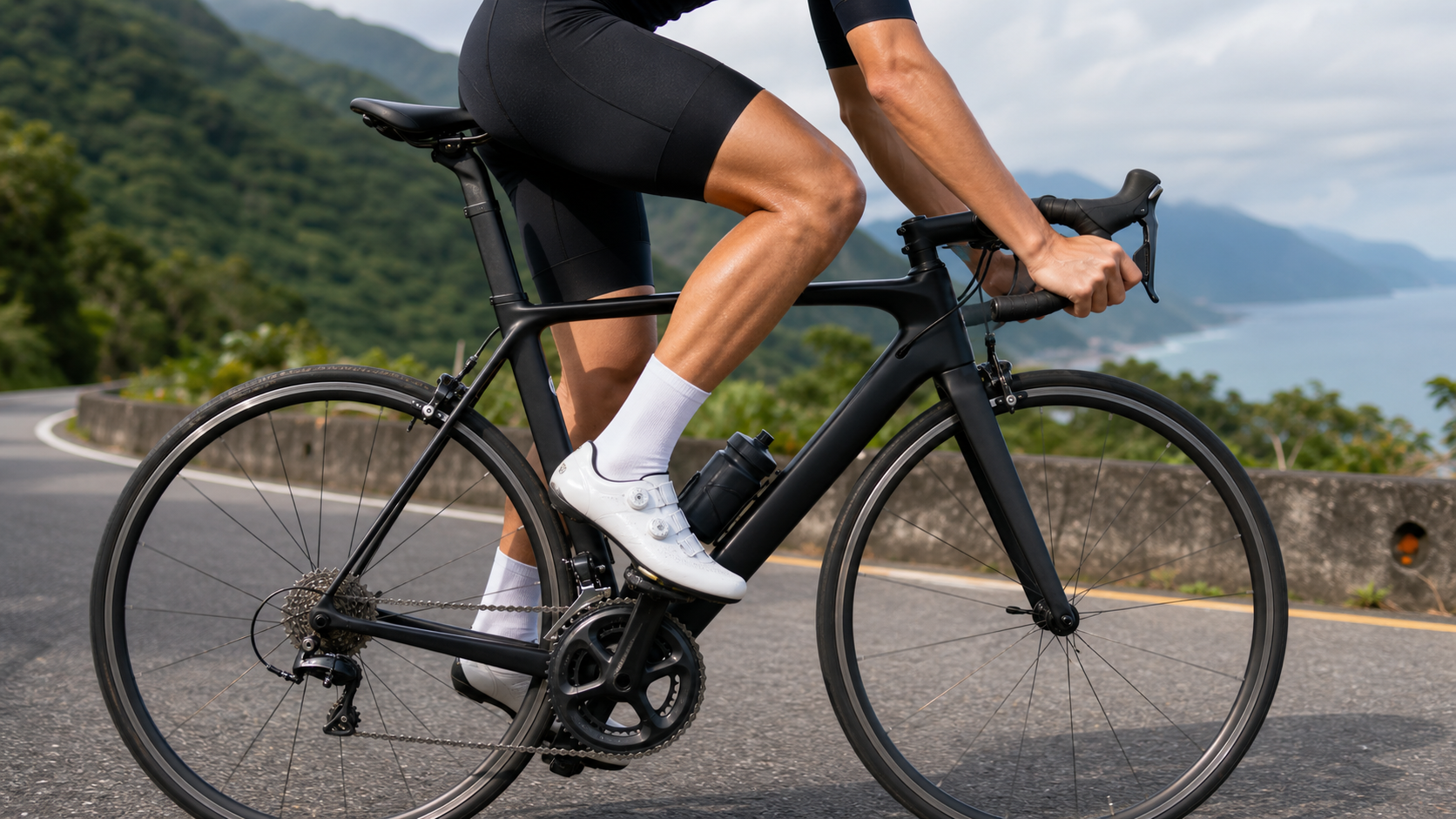
A complete pedal stroke can be divided into four quadrants:
| Quadrant | Crank Angle | Primary Muscles | Key Joint Actions |
|---|---|---|---|
| Power | 0°–90° | Quadriceps, Gluteus Maximus | Hip extension, Knee extension |
| Drive | 90°–180° | Gastrocnemius, Soleus | Ankle plantarflexion |
| Pull | 180°–270° | Hamstrings, Gluteus Medius | Hip flexion, Knee flexion |
| Recovery | 270°–360° | Iliopsoas, Rectus Femoris | Ankle dorsiflexion, Hip flexion |
The power quadrant is the primary source of wattage. Here, the hip transitions from flexion to extension, and the quadriceps contract forcefully. If the saddle is too low, the quadriceps cannot fully extend at the starting angle, limiting power output and causing anterior knee pain.
The drive quadrant may seem passive, but ankle joint angle control is critical. Keeping the ankle in slight plantarflexion (toes pressed slightly downward) extends the lever arm and engages the gastrocnemius. Many beginners habitually drop their heels (dorsiflexion), turning the ankle into a “power leak.”
The pull and recovery quadrants are often overlooked. Skilled riders can actively lift the pedal through these two quadrants, reducing the load on the opposite leg. Research shows that professional riders have a Pedaling Efficiency Index (PEI) 10–15% higher than amateurs, with the main difference found in the second half of the stroke.
Knee Tracking and Common Deviations
The knee is the most vulnerable joint in pedaling biomechanics. Ideally, the knee should move vertically directly above the ankle throughout the entire pedal stroke, without deviating inward (knee valgus) or outward (knee varus).
Common causes of deviation:
- Weak hip abductors (gluteus medius): Leads to knee valgus and a significantly higher risk of ITBS (Iliotibial Band Syndrome)
- Pedal Q-factor not matching pelvic width: Pedal spacing that is too narrow or too wide forces the knee to drift
- Incorrect cleat angle setup: Cleats fix the foot’s angle; if they don’t match the natural float angle, the knee endures prolonged torsional stress
- Saddle height too low: Forces the knee to produce power at high flexion angles, multiplying patellar cartilage pressure
During long summer rides in Taiwan, muscle fatigue makes these deviations more pronounced. It is recommended to undergo a new Bike Fitting at regular intervals (e.g., every 3,000 km ridden) and to observe knee tracking using slow-motion video.
Practical Recommendations
- Single Leg Drill: Twice a week, 30 seconds per leg × 5 sets, to strengthen active lifting in the second half of the stroke
- Heel Angle Awareness: While cruising on flat roads, deliberately keep the ankle in a neutral-to-plantarflexed position, using the “scraping mud” mental image to guide the pedal stroke
- Gluteus Medius Strengthening: Side-lying leg raises and banded lateral walks, 3 sets each, to prevent knee valgus
- Professional Bike Fitting: Have at least one comprehensive measurement done, including static measurements (femur length, pelvic width) and dynamic analysis
- Film Your Pedal Stroke from the Side: Mount your phone on the right side to observe ankle angle and knee tracking—more accurate than relying on feel
Conclusion
Pedaling biomechanics is the foundation of cycling performance. The coordination of the knee, ankle, and hip joints is not innate—it is a skill that can be progressively refined through conscious training and equipment adjustments. Taiwan’s mountainous riding environment demands sustained high-intensity output. Correct pedaling technique not only makes you faster, but also allows you to ride longer and get injured less. Starting today, treat “pedaling in circles” as a training goal just as important as “pedaling hard.”
Related Reading
- Cycling Biomechanics Research: The Efficiency Debate Between Circular vs. Elliptical Pedaling Paths
- The Effect of Cadence on Knee Joint Torque: Biomechanics of High Cadence Protecting the Knee Joint
- The Dynamic Impact of Saddle Height on Pedaling Efficiency: A Study on Knee Flexion Angle
- Quantifying Pedal Smoothness: Research on New Power Meter Analysis Metrics
#公路車 #Fitting 靠人工智慧APP 幫你調整單車
6 年前
單車 一日北高 ( 雙城 ) 肥宅雙人瘋狂行 紀錄片 REACTO
10 年前
一日北高常見問題大集合 | 攻略 | 路線 | 訓練 | 補給 | 自行車 單車 | 一日雙城 | 雙塔 | TWB北高360 | 屁股痛
6 年前
武嶺配速表最佳使用方式 #bike
1 年前
高雄綠園道鐵路自行車道 / 外地人能輕鬆駕馭 還是整路崩潰? / 2025 全線開通 春節實地探索一次!(附GPS連結)/ 公路車 / CT Yeh
1 年前
大禹嶺 到 武嶺牌樓 全程前後實況錄影 | 北進武嶺 | 東進武嶺 | KOM | 訓練台 | 坡度分析 | Taiwan KOM Last 10 km HARD | 公路車
6 年前
全台首發!邁金P715踏板功率計!市場價格撼動者再出招 / 功率對比實測 / FAVERO ASSIOMA 可參考! / 公路車 / CT Yeh
1 年前
本週北高前練習,連同天比的226們也來⋯鐵車真的太猛了 #cycling #北高
2 年前