Introduction
Whenever the discussion turns to exercise and bone health, cycling is often seen as a “gentle and safe” choice. But this intuition overlooks an important fact: bone strengthening requires mechanical loading stimulation, and cycling’s non-weight-bearing, low-impact nature is precisely what deprives bones of this critical stimulus. Research has repeatedly shown that professional road cyclists have lower bone mineral density (BMD) than runners or triathletes of the same age, with a relatively higher risk of fractures. For the hundreds of thousands of cyclists in Taiwan who use cycling as their primary sport, this is a health issue worth taking seriously.
The Mechanical Principles of Bone Remodeling
Bone is living tissue, constantly renewing itself through the dynamic balance between osteoclasts breaking down old bone and osteoblasts building new bone. This process is strongly regulated by mechanical loading:
- Impact and vibration (such as running, jump rope) effectively stimulate osteoblast activity
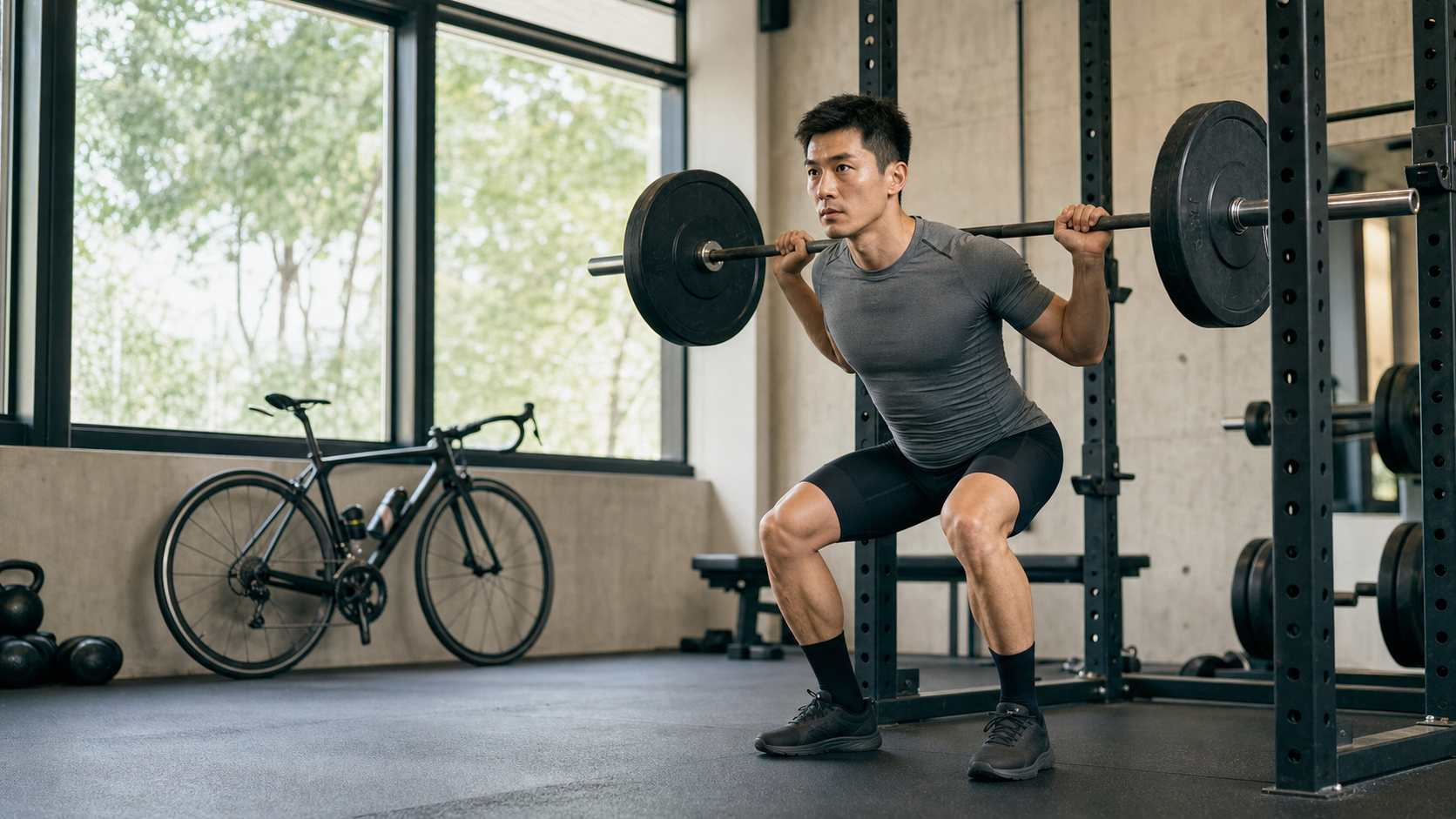
- Muscle pull (such as the quadriceps pulling on the femur during squats) is also an important signal for bone remodeling
- Cycling: the saddle bears body weight, the feet experience almost no impact, and the mechanical loading transmitted to the bones is extremely small
| Exercise Type | Bone Impact (multiples of body weight) | Effect on Bone Density |
|---|---|---|
| Running | 2.5–3.0x | Significantly positive |
| Jump rope | 3.0–4.0x | Strongly positive |
| Basketball, volleyball | 4.0–5.0x | Extremely positive |
| Cycling | 0.8–1.2x (nearly body weight) | Almost no effect |
| Swimming | 0.5–0.8x | Slightly negative |
| Strength training (squats) | Up to 5.0x | Strongly positive |
Bone Density Studies in Pro Cyclists
Multiple studies on professional road cyclists reveal striking results:
- Hip bone density: pro cyclists are on average 10–15% lower than runners of similar age
- Lumbar spine bone density: some pro cyclists already meet the criteria for osteopenia
- Fracture events: some crash fractures in major races like the Tour de France are partly due to low bone density rather than sheer impact force
Beyond insufficient impact, other aggravating factors include:
- Chronic high cortisol from high training volume (suppresses osteoblasts)
- Loss of calcium and magnesium through heavy sweating
- Caloric restriction to maintain low body weight (affects women more severely)
- Vitamin D deficiency (long hours riding but fully covered, insufficient sun exposure)
How Strength Training Protects Bone
Strength training strengthens bones through the following pathways:
- Direct mechanical loading: muscle contraction pulls on bones, stimulating osteoblast activation
- Promotes anabolic hormones: high-intensity resistance training raises testosterone and IGF-1, both of which promote bone formation
- Improves muscle mass: more muscle = more sustained pulling stimulus at bone attachment sites
Practical Recommendations
- Strength training twice a week: schedule on non-riding days, 45–60 minutes per session, focusing on multi-joint compound movements
- Bone-priority exercise list:
- Back Squat / Goblet Squat: 3 sets × 8–12 reps
- Romanian Deadlift: 3 sets × 6–8 reps
- Bulgarian Split Squat: 3 sets × 10–12 reps (both sides)
- Farmer’s Walk: 3 sets × 30 meters
- Jump rope or box jumps: 2–3 times per week, 5–10 minutes per session, the most direct impact stimulus
- Calcium and vitamin D supplementation: daily calcium intake of 1000–1200mg (tofu, dried fish, dairy products), vitamin D recommended at 2000–4000 IU
- Sun exposure strategy: 15–20 minutes of daily sun exposure on face and arms (in Taiwan’s summer, pay attention to sun protection and timing)
- Regular bone density screening: for high-frequency cyclists over 35, a DEXA bone density scan every 2–3 years is recommended
Conclusion
Loving cycling is a wonderful thing, but bone health should not be the price you pay. Strength training and cycling are not in conflict—they complement each other: stronger leg muscles make pedaling more powerful, and higher bone density gives you an extra layer of protection in a crash. Gyms are becoming increasingly accessible in Taiwan, so scheduling two “bone-building sessions” per week into your training plan is the most cost-effective investment in your future self.
Related Reading
- The Bone Density Crisis for Cyclists: Why Pure Cyclists Need to Add Strength Training
- The Impact of Long-Term Cycling on Bone Density: Why Cyclists Need to Add Gravity-Based Training
- Osteoporosis Risk for Cyclists: The Skeletal Cost of Low-Impact Exercise
- Cycling and Bone Health: The Impact of Low-Impact Exercise on Bone Density and Supplementation Strategies
靠單車減肥35公斤 心得分享與整理
7 年前
高雄綠園道鐵路自行車道 / 外地人能輕鬆駕馭 還是整路崩潰? / 2025 全線開通 春節實地探索一次!(附GPS連結)/ 公路車 / CT Yeh
1 年前
摔車後補裝備: 好市多新款單車安全帽& Specialized Romin 北高整路屁股都不痛的坐墊 | 一千元居然有MIPS | CT Yeh | 公路車
4 年前
鉅齒紋輪組!? ControlTech MEG-T50 EVO 碳纖維幅條輪組/ 功率對比實驗 / 公路車 / CT Yeh
2 年前
再一組! 全碳幅條 碟煞/無內胎輪組 開箱! 到底好騎嗎? UNAAS X40 | 公路車 | CT Yeh
4 年前
一個測試有沒有認真練車的方法😂 #公路車
10 個月前
2026 車錶排行榜!誰是最多車友正在使用?練家子最愛哪款?🏆 (2萬名車友數據) / 公路車 / CT Yeh
5 個月前
碟煞公路車 銑面器 !? 原來銑完差這麼多! 降低蹭碟機率! | TIME 公路車 保養小記錄 | CT Yeh
3 年前