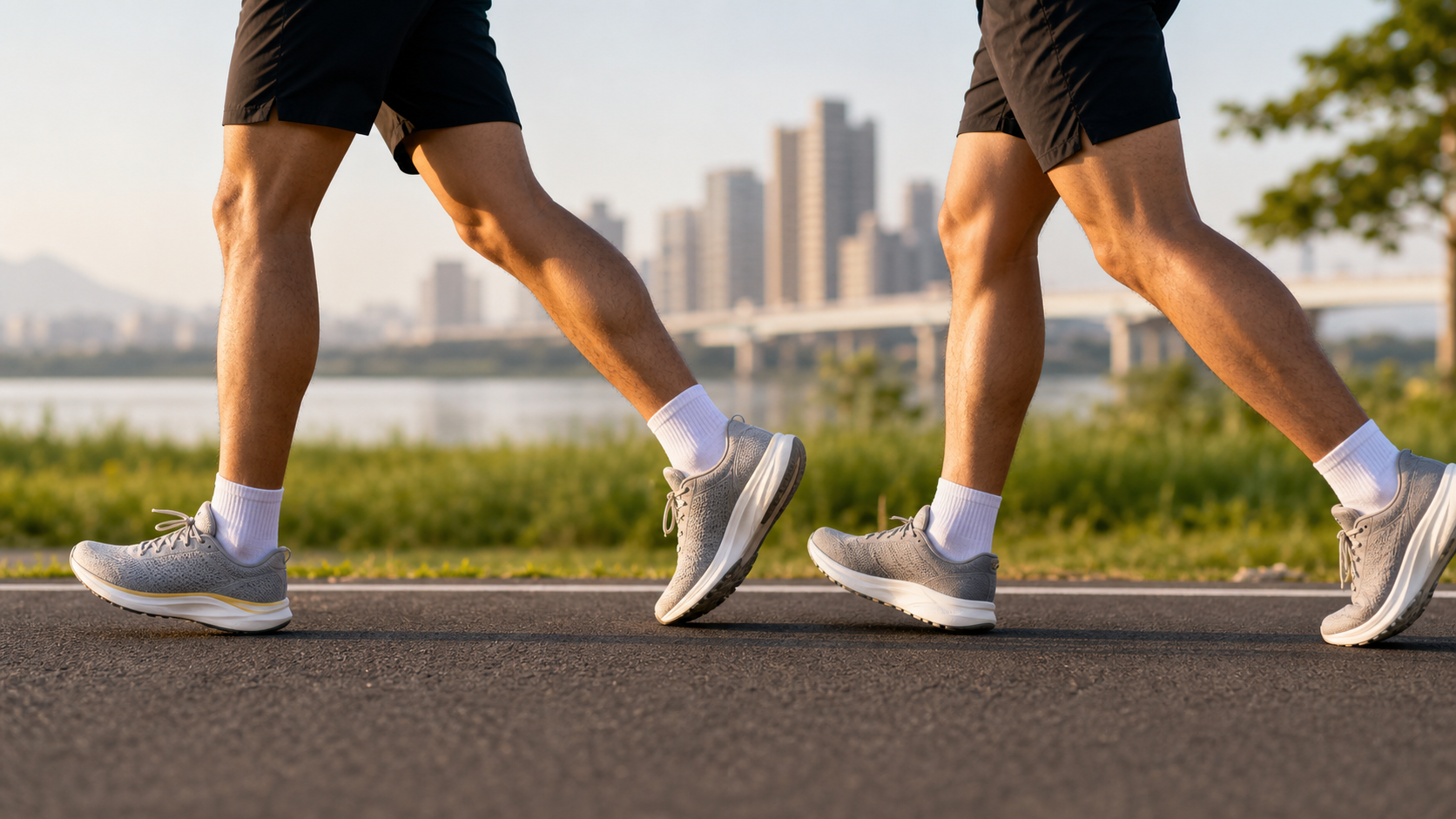
Introduction
With the rise of barefoot running and the popularity of the book Born to Run, the idea that “forefoot striking is the only correct running form” has swept through the global running community. In Taiwan’s road-running circles, there has also been a surge of calls to “switch to forefoot striking,” but frequent cases of Achilles tendinitis and stress fractures have followed. What does sports science research tell us? The choice of foot strike pattern is far more complex than we imagine.
Definitions of the Three Foot Strike Patterns
Running foot strike patterns are mainly divided into three categories:
| Strike Type | Definition | Initial Contact Point | Percentage Among Amateur Runners |
|---|---|---|---|
| Rearfoot Strike (RFS) | Heel contacts the ground first | Outer heel | Approximately 75–80% |
| Midfoot Strike (MFS) | Midfoot contacts the ground simultaneously | Midfoot arch | Approximately 15–20% |
| Forefoot Strike (FFS) | Forefoot contacts the ground first | Head of the 5th metatarsal | Approximately 3–5% |
It is worth noting that the vast majority of elite marathon runners use a midfoot strike at race pace, not a forefoot strike—this differs significantly from the myth that “elite runners all use forefoot striking.”
Key Findings from Scientific Research
Differences in Impact Forces: Heel striking produces two impact peaks: the impact transient appears approximately 50 ms after ground contact, and this peak nearly disappears in forefoot striking. However, the total impulse between the two strike patterns is not significantly different when form is correct.
Different Injury Distributions: Research shows that different foot strike patterns correspond to different injury sites:
Heel striking is more associated with:
- Patellofemoral pain syndrome (knee pain)
- Iliotibial band syndrome
- Tibial stress fractures (anterior side)
Forefoot/midfoot striking is more associated with:
- Achilles tendinitis
- Plantar fasciitis (actually increased!)
- Metatarsal stress fractures
- Calf muscle strains
Conclusions on Running Economy: A 2012 Harvard University study first claimed that forefoot striking is more economical, but subsequent rigorous studies (including a 2017 systematic review in Sports Medicine) pointed out that under one’s habitual foot strike pattern, there is no significant difference in running economy. Forcibly changing one’s foot strike pattern initially tends to increase oxygen consumption by 5–10%, until the nervous system fully adapts to the new pattern (which typically takes 3–6 months).
External Factors Influencing Foot Strike Choice
Situational factors commonly encountered by Taiwanese runners:
- Speed Effect: As running speed increases, the foot strike point naturally moves forward—this is a normal physiological adjustment
- Incline Effect: The proportion of heel striking increases during downhill running; Taiwan’s mountain road races require special attention to downhill technique
- The Role of Shoes: High-drop (10mm and above) running shoes tend to encourage heel striking; zero-drop shoes encourage midfoot/forefoot striking
- Fatigue Effect: In the latter half of a marathon, forefoot strikers often revert to heel striking, indicating that forefoot striking demands greater muscular endurance
Practical Recommendations
Foot strike strategy recommendations for Taiwanese runners:
- Do not force a change in your habitual strike pattern: If you are not currently troubled by specific injuries, forcing a change in foot strike carries more risk than benefit
- If you have a history of knee pain: You may try progressively shifting your strike point forward, combined with cadence-increasing training
- If you have Achilles tendon/calf issues: Temporarily avoid forefoot strike training; strengthen calf eccentric contraction capacity before considering it
- Changing your foot strike must be extremely gradual: Increase the proportion of forefoot striking by 10% every 2 weeks, giving tendons and bones sufficient adaptation time
- Pair with progressive shoe upgrades: Progress gradually from high-drop shoes to low-drop shoes (8mm→6mm→4mm); never jump straight to zero-drop
- For Taiwan’s summer mountain road races: Learn to flexibly switch foot strike patterns—use forefoot striking on uphills, a natural pattern on flats, and midfoot/rearfoot striking on downhills to reduce cumulative fatigue on specific tissues
Conclusion
There is no absolute “correct answer” in choosing a foot strike pattern. The consistent conclusion from scientific research is: the best foot strike pattern is the one that causes you the fewest injuries and feels most natural. Forefoot striking is not a panacea, nor is heel striking a scourge. Taiwan’s road-running community should move beyond online myths and make individualized, informed decisions based on their own injury history, training goals, and shoe choices, in conjunction with assessments from professional coaches or physical therapists.
Related Reading
- Running Gait Analysis: The Science of Forefoot vs. Midfoot vs. Heel Strike
- Running Foot Strike Patterns: Biomechanical Comparison of Forefoot, Midfoot, and Heel Strike
- Running Gait Analysis: A Scientific Comparison of Heel Strike vs. Forefoot Strike
- Forefoot Strike vs. Heel Strike: Which Running Form Suits You?
CT 喇低賽) 武嶺牽車 才是王道 西進牽車四小時內秘訣 攝手位置 如何判斷 防抽筋小秘訣
7 年前
#公路車 #Fitting 靠人工智慧APP 幫你調整單車
6 年前
抖肩舞 台灣x日本交流版 (台灣 vs 前橋) 赤城山登山賽 coincidance
8 年前
CT 喇低賽) 單車 比賽總是沒照片? 攝影師的觀點大公開 姿勢就是力量! 請加速1.25倍收看
7 年前
單車元宇宙新霸主?TrainingPeaks Virtual 實測 / Zwift 完美平替? 還是超越?/ 有台灣國旗!前身 indieVelo / 公路車 / CT Yeh
1 年前
風櫃嘴 | 全台最多大砲的單車路線 | 尋寶網攝影師告訴你怎麼擺拍起來才好看 | 熱門攝影地點巡禮
6 年前
Live) 備戰2019彰化經典百K 賽前攻略 (已完賽請看新影片
7 年前
下次拍照前要查清楚啦🤣 #cycling
7 個月前