Introduction
“Your entry angle is off”—the coach has said it dozens of times from the pool deck, but the swimmer simply cannot feel what is wrong. This is a common dilemma in competitive swimming training: the limitations of proprioception prevent swimmers from accurately assessing their own movements.
Underwater video analysis is precisely the most effective tool for solving this problem. It allows swimmers to “see themselves swim” for the first time, and through objective footage, identify technical issues that are difficult to detect during training.
Why Is Underwater Video More Important Than Surface Video?
Surface video captures the swimmer’s overall posture and breathing, but most swimming movements occur underwater: the pull path, kick pattern, wall push-off angle during turns, and the glide position after the start dive. Without underwater footage, coaches and swimmers are only seeing “half the story.”
Core advantages of underwater video:
- Visualizing the pull path: high-elbow catch, completeness of the push phase
- Kick efficiency analysis: kick rate, knee bend angle, ankle range of motion
- Streamline posture check: body angles that minimize drag
- Start dive entry angle: a key factor in underwater glide efficiency
- Turn breakdown: optimizing wall push-off force and angle
Standard Workflow for Underwater Video Analysis
Step 1: Filming Setup
| Camera Angle | Analysis Focus |
|---|---|
| Direct side view (underwater) | Body streamline, kick depth, pull path |
| Diagonal front view (underwater) | Entry angle, high-elbow catch |
| Front view (underwater) | Left-right symmetry, kick width |
| Side view of start | Entry angle, block push-off power |
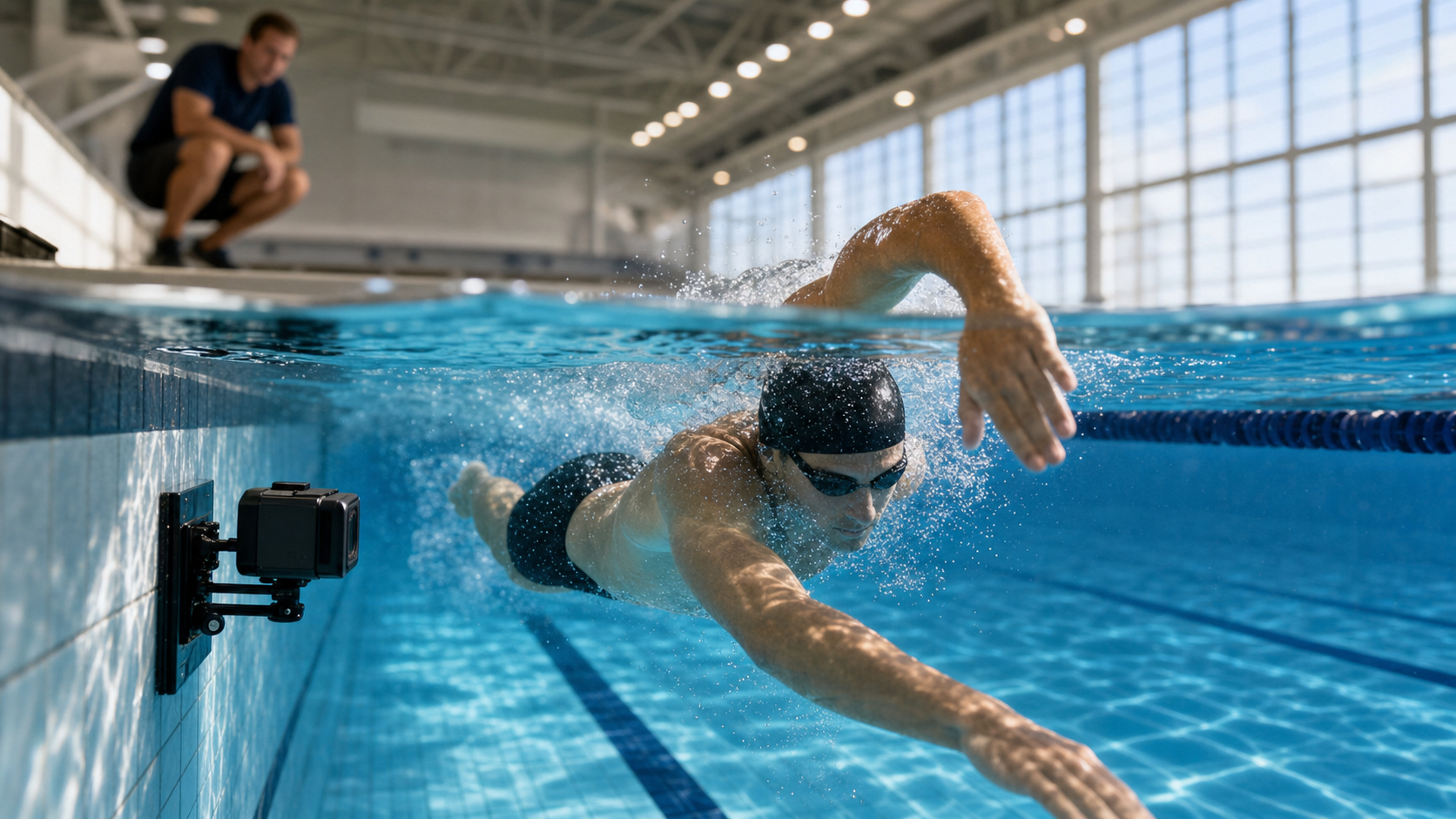
It is recommended to use a waterproof camera (such as the GoPro series) mounted on the pool wall, or use a professional pool with viewing windows.
Step 2: Video Marking and Quantification
Raw footage alone has limited value; it must be paired with quantitative analysis:
- Stroke Rate: number of complete stroke cycles per minute
- Distance Per Stroke: distance traveled per stroke cycle
- Stroke Index: speed × distance per stroke (the higher the value, the better the efficiency)
- Kick rate and amplitude: kicks per second and knee bend angle
Step 3: Comparative Analysis
The value of a single recording session is limited. True progress tracking comes from “temporal comparison”:
- Before training vs. after training (after 2–4 weeks of corrections)
- Differences in movement between fatigued and rested states
- Technical comparison between the swimmer’s current movement and a reference swimmer (e.g., Olympic-level demonstration footage)
Step 4: Correction Plan and Follow-up
Once issues are identified, a specific technical correction plan must be developed:
- Technical focus for each training session (no more than 2 items)
- Auxiliary drills (e.g., pull buoy, kickboard isolation drills)
- Re-record after 4 weeks to confirm the effectiveness of corrections
Practical Difficulties for Grassroots Coaches in Taiwan
Many grassroots swim teams in various counties and cities lack professional underwater filming equipment and analysis software. Here are low-cost alternatives:
- GoPro Hero series + poolside mounting bracket: total cost approximately NT$8,000–15,000
- Free analysis software: Kinovea (PC) or the CoachMyVideo app (mobile), offering frame-by-frame playback and angle measurement
- Systematic filming 1–2 times per month: no need to record every session; the key is accumulating a time-series for comparison
Practical Recommendations
- Build a personal video archive for each swimmer: attach the date and training cycle markers to every recording
- Let swimmers watch and identify problems themselves: self-discovery is more convincing than coach explanations
- Combine surface video with underwater video: gain a complete understanding of overall movement
- Avoid correcting too many issues at once: focus on 1–2 technical points per correction cycle
- Compare technical condition before and after competitions: understand how race fatigue affects technique
Conclusion
Video training is not a high-tech luxury; it is a fundamental tool in modern competitive swimming. When swimmers see their underwater movements for the first time, that shock of “so that’s how I swim” is often the starting point of technical breakthroughs. Making good use of underwater video analysis to evolve training from “feel-driven” to “data-driven” is an important step in raising Taiwan’s competitive swimming standards.
Related Reading
- Swimming Video Analysis: Key Observations for Surface and Underwater Filming
- Swimming Technique Video Analysis: How to Use Underwater Filming to Identify Your Own Flaws
- Self-Analysis Through Swimming Video: Technical Diagnostic Methods for Surface and Underwater Filming
- Post-Race Swimming Performance Analysis: A Systematic Approach to Identifying Technical Errors Through Video Review
CT 喇低賽) 單車 比賽總是沒照片? 攝影師的觀點大公開 姿勢就是力量! 請加速1.25倍收看
7 年前
西進武嶺 免費訓練分析服務 Intervals | 練不夠還是練過頭?你哪一種類型選手?AI模型告訴你! | 備戰神器 | 公路車 訓練 | CT Yeh
4 年前
[教學] Premiere 影片 手震 修正 教學 防抖 單眼 影像 GoPro 穩定 Video Stabilization
8 年前
單車 梅山36灣 坡度介紹 路段介紹 空拍 (相關遊記影片,請參考說明或我的頻道喔,歡迎訂閱)
6 年前
如何把 GoPro 影片 翻轉 批次 轉正?
6 年前
滑雪新手們慘摔學習全紀錄(請開字幕),滑雪好好玩 | Snowboard + Ski | 岩原 スキー場 | 滑雪APP使用 | GoPro Max
6 年前
下次拍照前要查清楚啦🤣 #cycling
7 個月前
教學) 如何做出專業 慢動作 影片 Slow Motion 120fps GoPro 7 ActionCam AX700 A99II
7 年前