Introduction
“Swimming is all about getting in the water—what’s the point of land training?” This mindset is still widespread in Taiwan’s grassroots swimming community. However, in the weekly schedules of elite swimmers, dryland training typically accounts for 20–30% of total training time.
Dryland training is not about “making up for insufficient swimming with land work”; rather, it targets the specific strength and power required for in-water movements and enhances them through a land-based environment. Buoyancy in water limits muscle loading, so many high-intensity movements must be performed on land.
Core Objectives of Swimming Dryland Training
Different swimming events have different dryland training demands, but the shared core objectives are:
- Latissimus Dorsi Strengthening: The primary muscle group for the pulling phase of the stroke
- Core Stability: The foundation for maintaining a streamlined body position
- Hip Flexors and Gluteus Maximus: The power source for butterfly and freestyle kicking
- Shoulder Girdle Stability: Preventing swimmer’s shoulder injuries
- Lower-Body Explosive Power: The power source for start height and wall push-offs on turns
Main Types of Dryland Training
1. Stroke-Specific Resistance Training
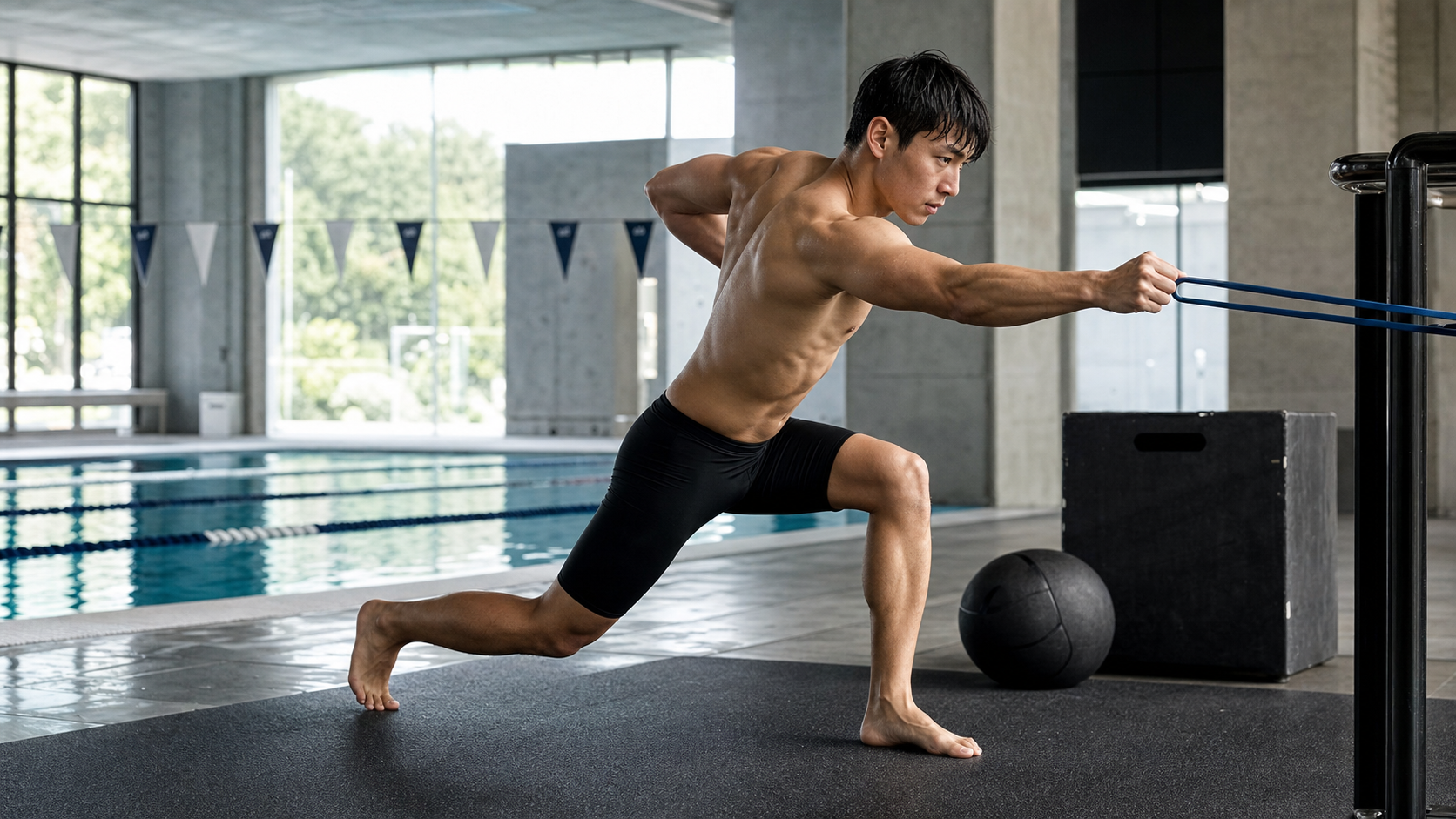
Using resistance bands or a swim trainer rope to simulate stroke mechanics:
- Swim Ergometer (Paddle Ergometer): Closest to the in-water pulling pattern, emphasizing high-elbow catch
- Band Pulling: Standing or prone, simulating freestyle/butterfly pull paths
- Pull-up Variations: Explosive pull-ups to train starting acceleration
2. Core Training Series
| Exercise | Primary Goal | Sets/Reps |
|---|---|---|
| Reverse Plank | Posterior chain core + shoulder girdle stability | 30–60 seconds |
| Pallof Press | Rotational stability | 3×12 reps |
| Hanging Leg Raise | Hip flexors + rectus abdominis | 3×15 reps |
| Swiss Ball Stroke Simulation | In-water balance + core control | 3×20 reps |
3. Lower-Body Explosive Power Training
- Jump Squat: Enhances explosive power for wall push-offs on turns
- Single-leg Box Jump: Strengthens asymmetrical lower-limb strength
- Resistance Band Squat: Accelerates force development, simulating the drive of a start
4. Shoulder Girdle Prevention Training (Injury Prevention)
Swimmer’s shoulder is the most common overuse injury, and the following exercises are the core of prevention:
- Band External Rotation
- Y-T-W shoulder girdle stabilization drills
- Scapular retraction training (Rowing variations)
Weekly Integration Example
| Day | Dryland Training Focus | Duration |
|---|---|---|
| Monday | Upper-body resistance (stroke-specific + shoulder girdle) | 45 minutes |
| Wednesday | Core + lower-body explosive power | 40 minutes |
| Friday | Full-body combination + flexibility | 50 minutes |
| Tuesday, Thursday, Saturday | Water-only training | — |
The Key to Bridging Land and Water: The Specificity Principle
For dryland training to truly transfer to in-water performance, the Specificity Principle must be followed:
- Movement patterns should approximate the joint angles and velocities of the in-water pull
- Avoid overusing free weights as a substitute for swimming-specific movements
- After water training on the same day (or the following day), deliberately feel the activation of land-trained muscle groups in the water
Practical Recommendations
- The best time for dryland training is after the evening session: Avoid compromising the technical quality of the morning water session
- Younger athletes (under 14) should focus on bodyweight resistance: Avoid introducing heavy loading equipment too early
- Rotate the dryland program every 6–8 weeks: Prevent adaptation plateaus
- Log land training load and compare it with in-water results: Identify the optimal ratio of dryland training’s impact on swimming performance
- During injury, dryland training is key to maintaining fitness: Wrist injuries still allow leg and core training
Conclusion
Dryland training is the bridge connecting training volume to competitive performance. It compensates for the high-load strength stimulus that the aquatic environment cannot provide, and through specific movement design, it directly converts land-based effort into speed and efficiency in the water. Systematically integrating dryland training into the weekly schedule is a crucial pathway for Taiwanese swimmers to elevate their competitive level.
Related Reading
- A Complete Guide to Land-Based Supplementary Training for Swimmers: Resistance Bands, Pull Racks, and Explosive Power Development
- Land-Based Strength Training for Swimmers: Which Exercises Offer the Most Transfer Effect
- Why Swimmers Need Land-Based Strength Training
- Supplementary Strength Training for Swimmers: Designing a Dryland (Dry Training) Program
一個測試有沒有認真練車的方法😂 #公路車
10 個月前
CT 喇低賽) 武嶺牽車 才是王道 西進牽車四小時內秘訣 攝手位置 如何判斷 防抽筋小秘訣
7 年前
CT暗黑廚房) 車友必備 宇宙無敵鮮蚵湯 幫助訓練恢復 天然食補 好市多 超肥鮮蚵 破PR
7 年前
滑雪新手們慘摔學習全紀錄(請開字幕),滑雪好好玩 | Snowboard + Ski | 岩原 スキー場 | 滑雪APP使用 | GoPro Max
6 年前
福隆鐵人團練隨拍
8 年前
西進武嶺 免費訓練分析服務 Intervals | 練不夠還是練過頭?你哪一種類型選手?AI模型告訴你! | 備戰神器 | 公路車 訓練 | CT Yeh
4 年前
Zwift 元宇宙單車世界 如何與全世界同步騎車運動
6 年前
實景訓練台) 彰化經典百K 高強度喵團 90分鐘 跟著一起練功 2019 Indoor workout Changhua Classic 100 Taiwan
7 年前