Introduction
The squat is hailed as the “king of movements” and is almost a mandatory exercise in a runner’s strength training regimen. However, when many runners hear the word “squat,” their first reaction is to head to the gym, grab a barbell, and squat down—overlooking the fact that running itself is a single-leg support activity. During running, each foot strike involves only one leg bearing the body’s weight, which is fundamentally different from the double-leg squat (Back Squat), where both legs exert force simultaneously.
Understanding the transfer effects of single-leg squats (such as the Bulgarian Split Squat and Pistol Squat) versus double-leg squats on running can help runners choose the most effective training combination within limited training time.
Advantages and Limitations of the Double-Leg Squat
The greatest advantage of the double-leg squat is that it allows for heavier loads, fully stimulating major muscle groups such as the quadriceps, gluteus maximus, and erector spinae. For runners just starting strength training, the double-leg squat is a great tool for building foundational lower-body strength.
However, there is a clear gap between the training pattern of the double-leg squat and the movement pattern of running:
- Bilateral symmetry: The double-leg squat requires balanced force output from both sides, but running involves alternating left and right foot strikes, which can easily mask muscle imbalances between the two sides.
- Sagittal plane dominance: The squat primarily involves movement in the forward-backward direction, offering limited training for the frontal-plane (lateral) stability required in running.
- Large base of support: Standing on both feet provides a larger stability base, making it ineffective for training the single-leg balance demands of running.
| Comparison Item | Double-Leg Squat | Single-Leg Squat (e.g., Bulgarian Split Squat) |
|---|---|---|
| Load capacity | Higher | Lower |
| Movement specificity | Less related to running | Highly similar to running |
| Strength imbalance detection | Harder to detect asymmetry | Easily exposes left-right differences |
| Core stability demand | Moderate | Higher |
| Suitability for beginners | High | Moderate |
Transfer Effects of Single-Leg Squats to Running
Research shows that single-leg squats more closely mimic the single-leg stance phase of running and can effectively enhance the following running-related abilities:
1. Enhanced single-leg push-off power
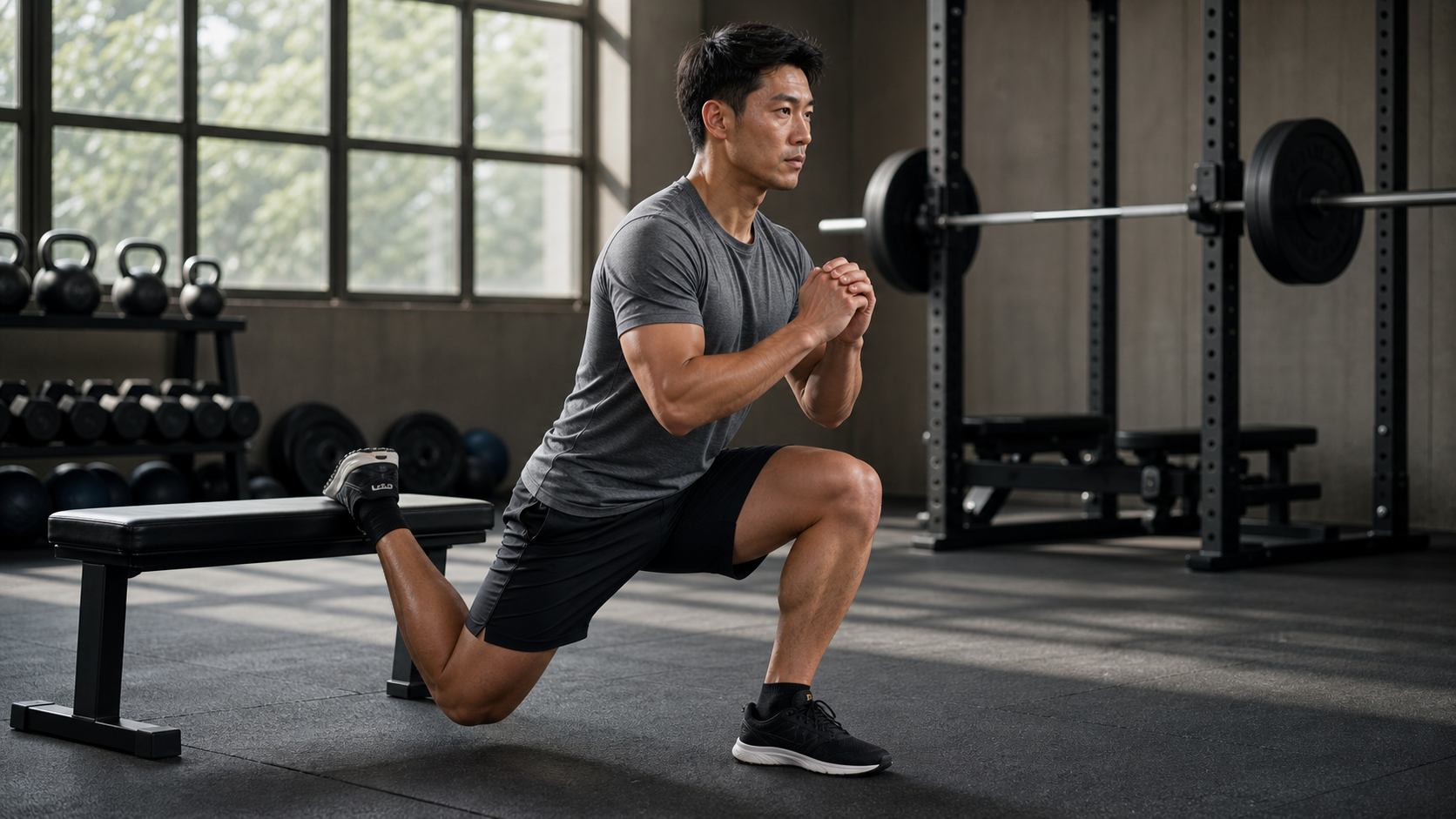
The Bulgarian Split Squat requires the rear leg to be elevated on a bench, with the front leg bearing most of the body weight, closely resembling the push-off action after foot strike in running. Studies indicate that this movement can significantly improve propulsion in the later phase of running.
2. Correcting left-right imbalances
Many runners habitually compensate with their stronger leg over time, increasing the risk of injury. Single-leg squats can directly identify and correct differences between the two sides, balancing strength in both legs and reducing the risk of sports injuries.
3. Strengthening the gluteus medius and frontal-plane stability
When standing on one leg, the gluteus medius must work hard to maintain pelvic levelness and prevent the contralateral pelvis from dropping (Trendelenburg sign). This is exactly consistent with the function of the gluteus medius during running.
Practical Recommendations
For runners with different training goals, here are specific programming suggestions:
- Beginners or those new to weight training: Start with double-leg squats to build foundational strength, then introduce single-leg variations once familiar with the movement patterns.
- Intermediate to advanced runners: Use single-leg squats (Bulgarian Split Squat) as the primary movement, with double-leg squats as a supplementary or loading-enhancement tool.
- Runners with a history of injury: Prioritize single-leg training to assess and correct left-right imbalances.
- Suggested ratio: In weekly strength training, single-leg movements should account for 60–70% of total squat volume.
A common progression sequence for single-leg squats:
- Lunge (static) → Walking lunge
- Bulgarian Split Squat (bodyweight) → Add dumbbells
- Single-leg squat (assisted) → Full Pistol Squat
Conclusion
Both double-leg squats and single-leg squats have their own training value, and smart runners should not choose just one. In the early stages of training, double-leg squats help build a strength foundation; as ability improves, gradually increasing the proportion of single-leg movements allows strength training to truly transfer to the track. Remember, running is a single-leg sport, and your training should reflect that reality as much as possible.
Related Reading
- How Squats and Lunges Help Runners Build Strength
- Strength Training Plans for Road Runners: How Squats and Deadlifts Improve Running Performance
- Single-Leg and Asymmetric Load Training: Correcting Left-Right Imbalances and Functional Transfer in Endurance Athletes
- Why Single-Leg Training (Bulgarian Split Squat) Is Especially Important for Endurance Athletes
滑雪新手們慘摔學習全紀錄(請開字幕),滑雪好好玩 | Snowboard + Ski | 岩原 スキー場 | 滑雪APP使用 | GoPro Max
6 年前
一日北高常見問題大集合 | 攻略 | 路線 | 訓練 | 補給 | 自行車 單車 | 一日雙城 | 雙塔 | TWB北高360 | 屁股痛
6 年前
白沙屯媽祖進香在家走!UREVO 坡度自調走步機 / 可連接訓練遊戲APP MyWhoosh / 邊看直播邊走起來 / CT Yeh
11 個月前
iPhone內建一秒變長腿🤣 車友必備#cycling
2 年前
CT 喇低賽) 武嶺牽車 才是王道 西進牽車四小時內秘訣 攝手位置 如何判斷 防抽筋小秘訣
7 年前
#公路車 #Fitting 靠人工智慧APP 幫你調整單車
6 年前
靠單車減肥35公斤 心得分享與整理
7 年前
Fitting訓練兩用功率車 ! Thinkrider ST900 完整實測!/ 坡度升降 / 鄰居測試/ smart bike/公路車/ CT Yeh
2 年前