Introduction
In Taiwan, the vast majority of runners lead a lifestyle characterized by prolonged sitting—working at an office desk, commuting on the MRT, and resting on the sofa. This modern lifestyle keeps the hip flexors in a shortened position for extended periods, which in turn affects pelvic stability and stride efficiency during running.
The hip flexor group primarily includes the iliopsoas, rectus femoris, and tensor fasciae latae (TFL), which are responsible for lifting the thigh forward during the swing phase of running. When these muscles become overly tight or weak, it not only affects cadence and stride length but is also a major contributor to iliotibial band syndrome, runner’s knee, and lower back pain.
The Impact of Tight and Weak Hip Flexors
Many people assume that “tight” and “weak” are opposite states, but in the hip flexors, the two often coexist. Muscles that remain in a shortened position for long periods develop “adaptive shortening,” and because they are rarely exerted through a full range of motion, their strength also becomes insufficient.
The impact of hip flexor problems on running:
- Increased anterior pelvic tilt, adding stress to the lower back
- The gluteus maximus becomes inhibited and struggles to generate full power, reducing push-off strength
- Restricted stride length, especially insufficient hip extension after push-off from the rear leg
- Increased forward trunk lean while running, reducing energy efficiency
| Hip Flexor Condition | Common Symptoms | Affected Running Areas |
|---|---|---|
| Tight | Tightness in the front of the hip, restricted stride | Push-off motion, pelvic stability |
| Weak | Difficulty lifting the leg, reduced cadence | Swing phase, acceleration capacity |
| Both coexisting | Forward-leaning running posture, lower back soreness | Overall running efficiency |
Assessment Method: Thomas Test
Before training, you can use the Thomas Test to self-assess your hip flexor condition:
- Sit on the edge of a bed, lean back until lying flat, with both legs hanging off the edge
- Hug one knee toward your chest with both hands
- Observe the state of the other leg:
- The other thigh rests flat against the bed surface → Normal
- The thigh lifts off the bed → Tight iliopsoas
- The lower leg rotates outward → Tight TFL
Specific Strengthening and Stretching Exercises
Stretching exercises (perform daily):
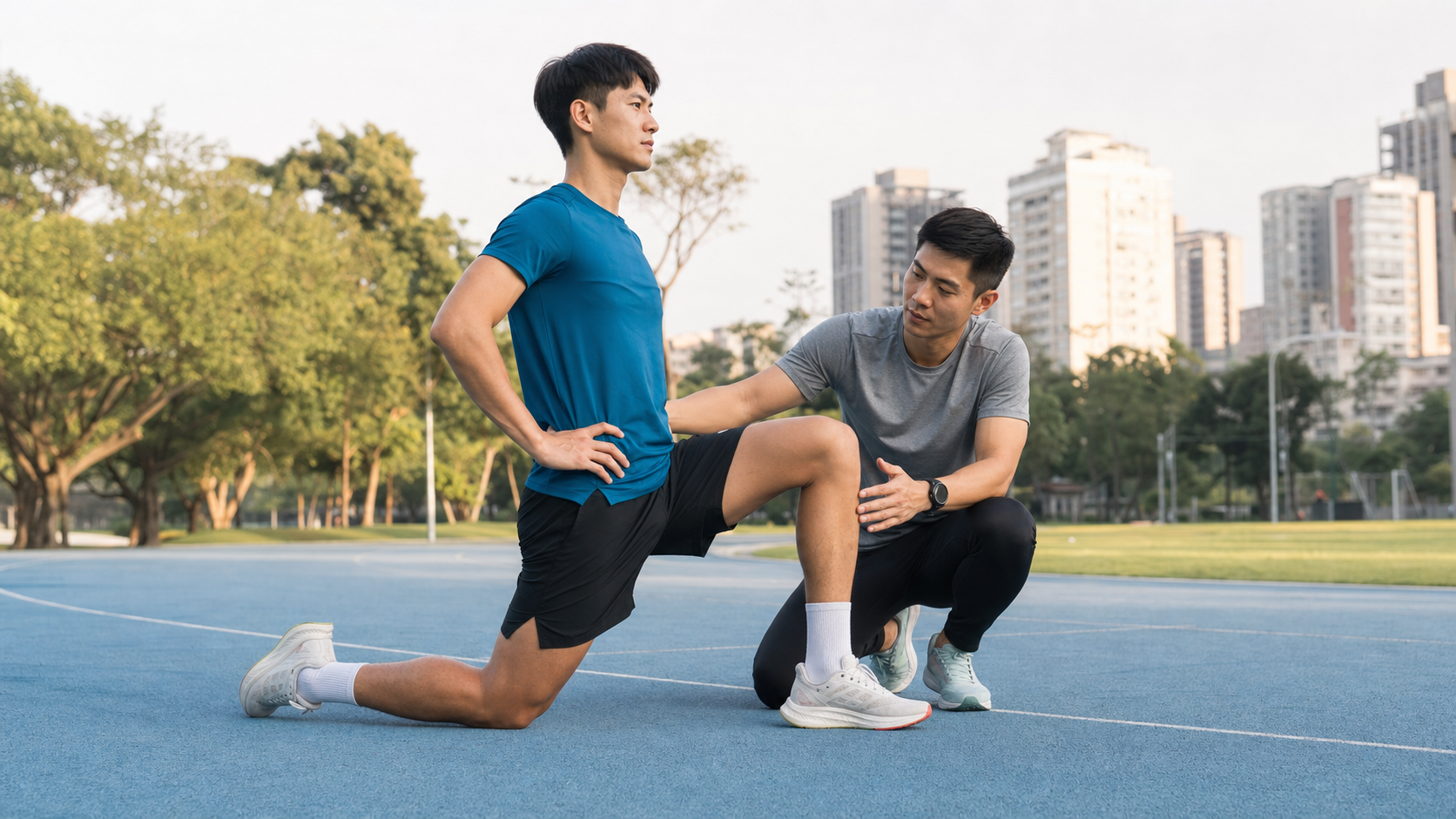
- Lunge hip flexor stretch: Back knee on the ground, front foot planted firmly, push the pelvis forward, feel the stretch at the front of the rear thigh’s hip, hold for 30 seconds
- Couch stretch: Rear shin against the wall, knee close to the corner, this is a deep stretch targeting the rectus femoris
- Lizard pose stretch: Front foot planted outside the hands, emphasizing hip opening and rotation
Strengthening exercises (2–3 times per week):
- Hanging knee raises: Hang from a pull-up bar with both hands, slowly raise the knees to abdominal height, primarily strengthening the iliopsoas
- Standing band hip flexion: Attach a resistance band to the ankle, lift the leg while standing, simulating the swing phase of running
- Prone hip extension: Lie face down, lift one leg and hold for 3 seconds, simultaneously strengthening the glutes and improving hip flexor flexibility
Practical Recommendations
Suggested daily arrangements for Taiwanese runners:
- Office-worker runners: Every 60 minutes of sitting, stand up and do 1 minute of hip flexor activity (lunges or standing leg kicks back)
- Pre-run warm-up: Add 10 dynamic lunges and leg circles to awaken hip flexor mobility
- Post-run cool-down: Hold static stretches targeting the hip flexors for at least 30–60 seconds
- Weekly scheduling: Schedule strengthening work after running sessions or on dedicated strength days to avoid compromising running quality
Indicators for observing training results:
- Whether you feel a longer stride and more powerful push-off while running
- Whether your lower back feels less tight after long runs
- Whether the angle in the Thomas Test shows improvement
Conclusion
Although the hip flexors are not as conspicuous as the quadriceps or glutes, they are an indispensable part of the running kinetic chain. Under the sedentary lifestyle of modern runners, it is even more essential to proactively stretch overly tight hip flexors and supplement strength with targeted training, so that you can maintain good form, prevent injuries, and continue improving running efficiency over the long term.
Related Reading
- Runner’s Hip Flexor Training: The Relationship Between Leg Lifts and Stride Improvement
- Runners with Tight Hip Flexors: Causes, Assessment, and Stretching Prescriptions
- Tight Hip Flexors While Running: Causes, Effects, and Complete Stretching Methods
- Stretching and Strength Combinations for Overly Tight Hip Flexors: Unlocking the Invisible Shackles of Sedentary Runners
一日北高/長距離團騎 常見問題補充篇 / 組團或跟團的眉角 / 壯車友容易被瘦車友慢性拉爆 / 原來屁股痛可能是這個原因...? / 風場配速法 / 公路車 / CT Yeh
2 年前
一日北高常見問題大集合 | 攻略 | 路線 | 訓練 | 補給 | 自行車 單車 | 一日雙城 | 雙塔 | TWB北高360 | 屁股痛
6 年前
CT 喇低賽) 單車 比賽總是沒照片? 攝影師的觀點大公開 姿勢就是力量! 請加速1.25倍收看
7 年前
iPhone內建一秒變長腿🤣 車友必備#cycling
2 年前
實景訓練台) 彰化經典百K 高強度喵團 90分鐘 跟著一起練功 2019 Indoor workout Changhua Classic 100 Taiwan
7 年前
[教學] Premiere 影片 手震 修正 教學 防抖 單眼 影像 GoPro 穩定 Video Stabilization
8 年前
2019 柯P 超越北高 第一集團實錄 (11小時實錄請參考另一部影片) 一日雙城 一日北高 NeverStop Taiwan Long Distance Cycling Challenge
7 年前
Never Stop 西進武嶺 前後雙機 完整全程錄影 訓練台 實境
8 年前