Introduction
In Taiwan’s road running community, Achilles tendinopathy is an injury that almost every runner dreads. It is characterized by severe pain when stepping on the ground upon waking in the morning, stiffness in the Achilles tendon after running, and in severe cases, an inability to walk normally. What’s even more frustrating is that this injury often improves with rest but flares up again as soon as you resume running, creating a vicious cycle.
The key to preventing Achilles tendon issues lies in fundamentally strengthening the calf muscle group (gastrocnemius and soleus) and the stabilizing structures around the ankle joint. Understanding the function of these muscle groups is essential to designing effective preventive training.
The Biomechanical Causes of Achilles Tendinopathy
The Achilles tendon connects the calf muscles to the heel bone. It is one of the strongest tendons in the human body, yet it endures tremendous loads. During running, each foot strike subjects the tendon to tension equivalent to 6–8 times body weight.
Key risk factors:
- A sharp increase in training volume over a short period (exceeding the 10% weekly increment rule)
- Insufficient calf muscle strength to adequately absorb impact forces
- Restricted ankle dorsiflexion range of motion (overly tight calves)
- Excessive foot pronation while running (overpronated foot type)
- Abruptly switching running shoes (e.g., to zero-drop or minimalist shoes)
| Tendinopathy Type | Pain Location | Common Causes |
|---|---|---|
| Mid-portion tendinopathy | 2–6 cm along the mid-tendon | Training overload, insufficient strength |
| Insertional tendinopathy | At the heel bone attachment | Excessive ankle dorsiflexion, flat feet |
Scientifically Validated Eccentric Training
In 1984, Scandinavian research first confirmed that “eccentric heel drops” could effectively treat Achilles tendinopathy, and numerous subsequent studies have also confirmed their preventive effects. Eccentric training (muscle contraction while lengthening) provides a unique stimulus for tendon remodeling.
The classic Alfredson Protocol:
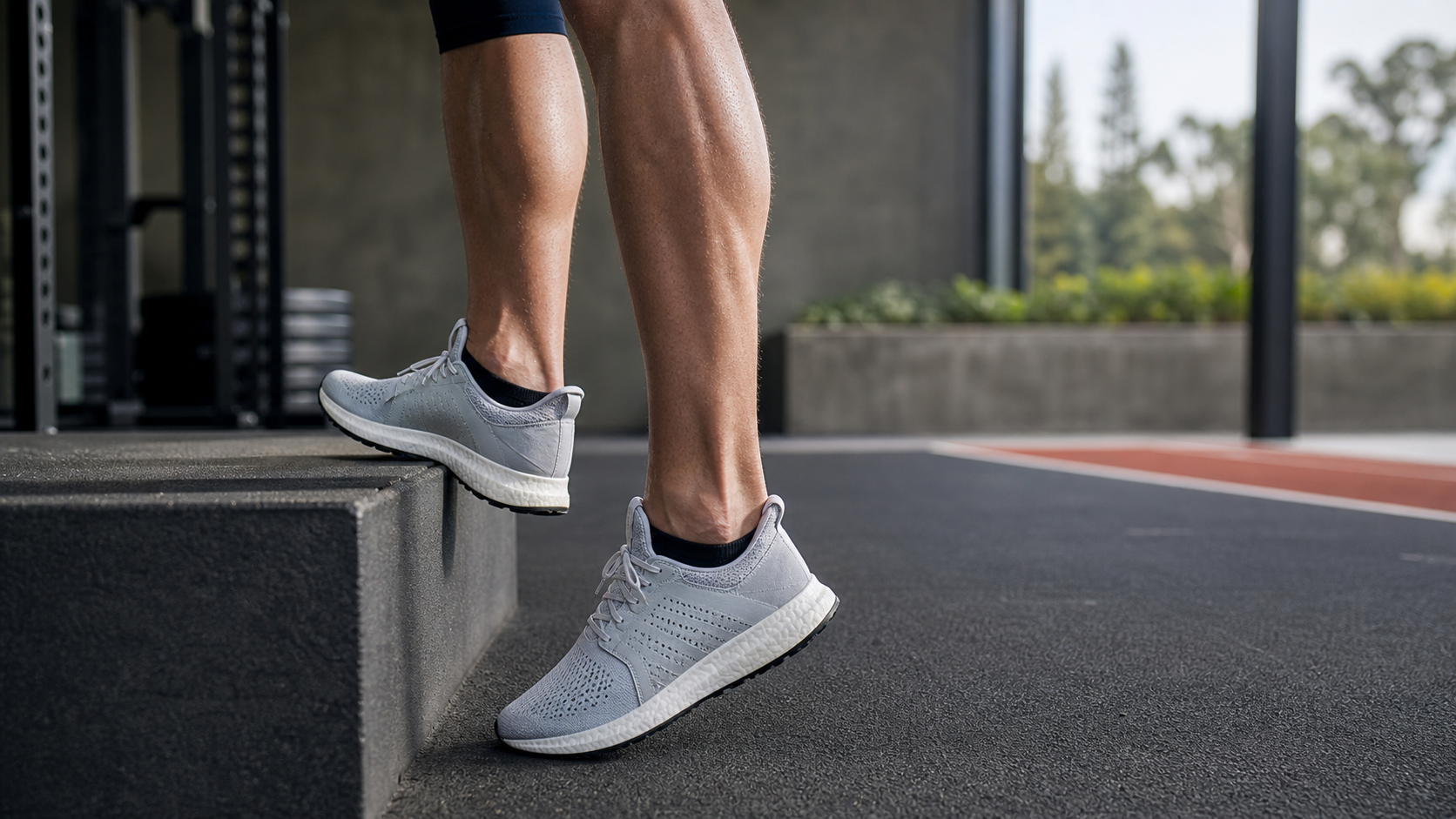
- Stand on the edge of a step with the balls of your feet firmly planted
- Rise up on both toes (concentric)
- Lift the healthy leg (or use both legs if both are affected)
- Slowly lower the heel of the affected leg below the step (eccentric, about 3 seconds)
- Perform 15 repetitions per set, 3 sets per day, for 12 consecutive weeks
This exercise comes in a “straight knee version” (primarily targeting the gastrocnemius) and a “bent knee version” (primarily targeting the soleus), and both should be practiced.
Advanced training exercises:
- Single-leg calf raise: Bodyweight or weighted, 12–15 reps per set
- Jump rope: Low-impact jumping rope is an excellent tool for training calf elasticity and Achilles tendon strength
- Walking on tiptoes: Builds calf endurance while strengthening the foot arch
Ankle Stability Training
Ankle joint stability is crucial for preventing ankle sprains and reducing compensatory shock absorption during running:
- BOSU ball single-leg stance: 30–60 seconds per side; close your eyes to increase difficulty
- Ankle CARs (Controlled Articular Rotations): Standing or seated, move the ankle through its maximum range of motion in a circular pattern to improve ankle mobility
- Resistance band ankle training: 15 reps in each of four directions (dorsiflexion, plantarflexion, eversion, inversion) to comprehensively strengthen the muscles around the ankle
- Box jump landing control: Trains the ankle’s shock-absorbing ability upon landing, thereby reducing stress on the Achilles tendon
Practical Recommendations
For runners looking to prevent Achilles tendon issues:
- Daily habits: Before getting out of bed each morning, perform 20 active ankle circles while still in bed to stimulate blood circulation around the ankle
- Pre-run warm-up: Use dynamic calf stretches (lunges, wall push stretches) instead of static stretching to activate calf function
- Training frequency: Perform eccentric calf training 3–4 times per week, ideally after running
- When increasing mileage: Follow the “10% rule” — increase weekly mileage by no more than 10% over the previous week
- Shoe selection: Runners with a history of Achilles tendon issues should avoid abruptly switching to minimalist or zero-drop shoes
Conclusion
Achilles tendinopathy is preventable. Through systematic eccentric calf training and ankle strengthening exercises, combined with sensible mileage management, most runners can avoid this frustrating injury. If you don’t currently have any tendon issues, you should start building these training habits now — prevention is always easier than treatment. Calf strength and elasticity are the foundation that allows you to keep enjoying running for years to come.
Related Reading
一日北高/長距離團騎 常見問題補充篇 / 組團或跟團的眉角 / 壯車友容易被瘦車友慢性拉爆 / 原來屁股痛可能是這個原因...? / 風場配速法 / 公路車 / CT Yeh
2 年前
iPhone內建一秒變長腿🤣 車友必備#cycling
2 年前
一日北高常見問題大集合 | 攻略 | 路線 | 訓練 | 補給 | 自行車 單車 | 一日雙城 | 雙塔 | TWB北高360 | 屁股痛
6 年前
摔車後補裝備: 好市多新款單車安全帽& Specialized Romin 北高整路屁股都不痛的坐墊 | 一千元居然有MIPS | CT Yeh | 公路車
4 年前
Never Stop 西進武嶺 前後雙機 完整全程錄影 訓練台 實境
8 年前
西進武嶺 免費訓練分析服務 Intervals | 練不夠還是練過頭?你哪一種類型選手?AI模型告訴你! | 備戰神器 | 公路車 訓練 | CT Yeh
4 年前
單車 一日北高 ( 雙城 ) 肥宅雙人瘋狂行 紀錄片 REACTO
10 年前
CT 喇低賽) 武嶺牽車 才是王道 西進牽車四小時內秘訣 攝手位置 如何判斷 防抽筋小秘訣
7 年前