Introduction
Have you ever observed the running form of elite Kenyan runners? Their strides are light, their landings are springy, and every step seems to “borrow” force from the ground to propel themselves forward. This running efficiency largely comes from their muscle-tendon system’s ability to effectively store and release elastic potential energy—and plyometric training is the best tool for developing this capacity.
Plyometric training utilizes the principle of the Stretch-Shortening Cycle (SSC): muscles contract immediately after a rapid stretch, much like a spring that rebounds after being compressed, generating explosive power far beyond what a simple muscle contraction can produce. For road runners, this means covering the same distance faster and more efficiently with the same amount of energy.
The Scientific Basis of Plyometrics for Road Running
Multiple studies have confirmed the positive effects of plyometric training on road running performance:
- Improved Running Economy: Research shows that 8–12 weeks of plyometric training can improve running economy by 4–8%, meaning less oxygen is consumed at the same speed
- Enhanced Tendon Elasticity: Increased stiffness of the Achilles tendon allows for greater storage of elastic potential energy, released during the push-off phase of each stride
- Reduced Ground Contact Time: Training shortens ground contact time, increases cadence, and improves overall running efficiency
| Training Benefit | Improvement | Time Required |
|---|---|---|
| Running Economy | 4–8% | 8–12 weeks |
| 5K Performance | 2–3% | 8 weeks |
| Ground Contact Time | 5–10% reduction | 6 weeks |
| Jump Height | 8–15% | 8 weeks |
Types and Applications of Plyometric Training
Plyometric training is categorized into three levels of impact—low, medium, and high—and road runners should progress gradually:
Low Impact (Beginners, first 4 weeks):
- Jump Rope (both feet): The most fundamental plyometric exercise, improving ankle stiffness and calf elasticity, 3–5 minutes per session
- High Knees in Place: Emphasizes rapid ankle pawing action, mimicking running mechanics
- Standing Long Jump (landing control): Focuses on landing shock absorption and control, training knee and ankle cushioning capacity
Medium Impact (Intermediate, weeks 5–8):
- Single-Leg Jump Rope: Challenges the reactive strength and stability of a single ankle joint
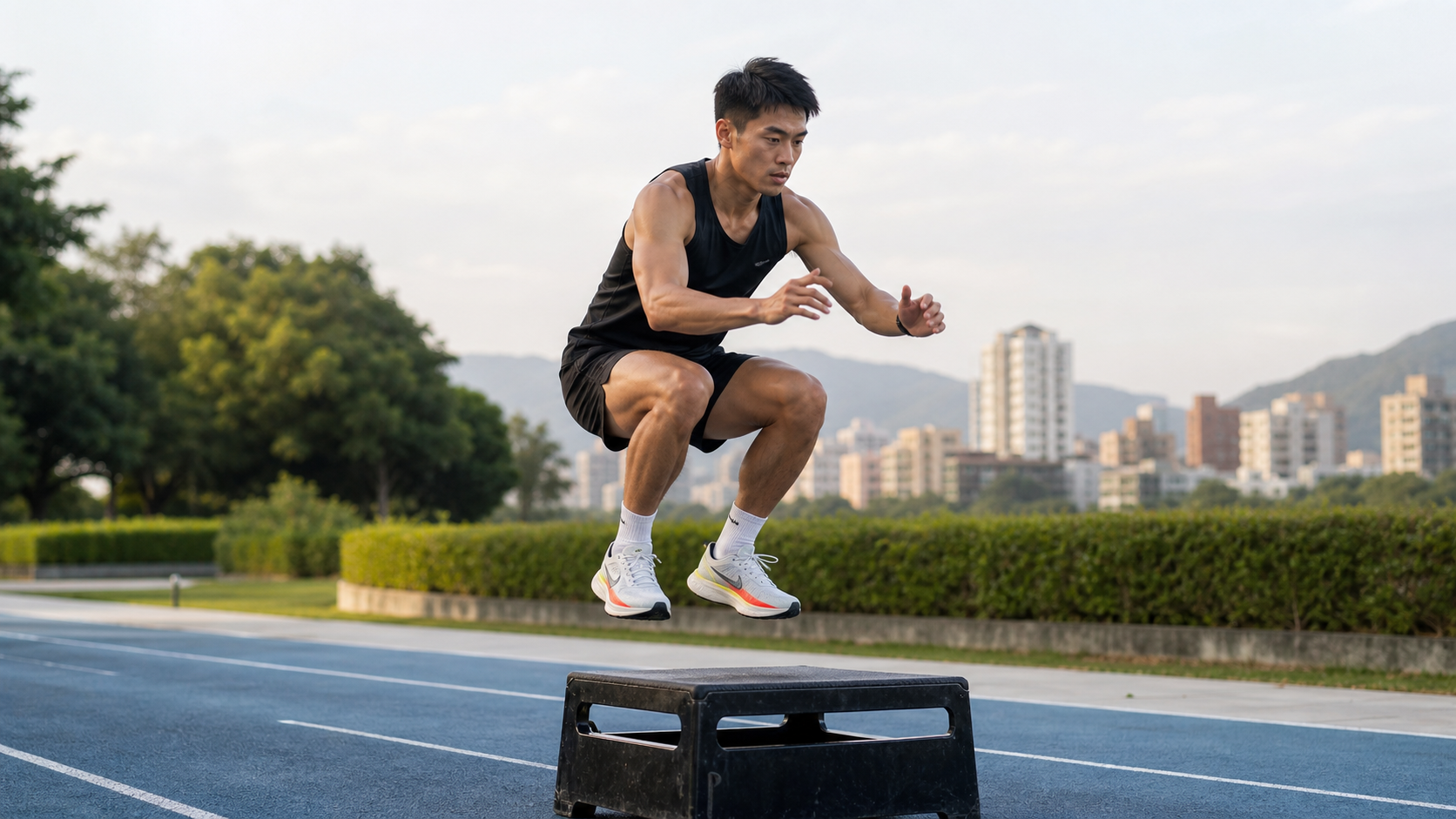
- Box Jump: Jumping onto a 40–60cm box, emphasizing explosive power initiation
- Bounding: Exaggerated running movements, emphasizing push-off and flight distance with each step
High Impact (Competitive level, from week 9 onward):
- Depth Jump: Jumping down from a box and immediately rebounding upward, maximizing SSC benefits
- Continuous Single-Leg Hops: Challenging single-leg explosive power and dynamic stability
How to Safely Integrate Plyometrics into Running Training
Plyometric training is not low-intensity, and improper scheduling can increase the risk of injury. Here are safety recommendations:
- Build a Strength Foundation First: Before starting plyometrics, you should be able to complete 10 single-leg squats and 15 single-leg calf raises
- Schedule on Easy Days: Plyometrics should not be performed before or after high-intensity long runs; it is recommended to place them on easy recovery days
- Control Weekly Volume: Initially, no more than 2 sessions per week, 15–20 minutes each, with no more than 4 sets per exercise
- Choose the Right Surface: Prioritize grass or rubber tracks, and avoid high-impact movements on hard surfaces
Practical Recommendations
Integration recommendations for plyometric training based on different runner goals:
- 5K/10K Runners: Focus on high-intensity plyometrics to improve cadence and explosive power, 2 sessions per week, paired with speed training days
- Marathon Runners: Prioritize low-to-medium impact movements, focusing on running economy and tendon elasticity, 1–2 sessions per week
- Ultramarathon Runners: Focus primarily on jump rope and bounding, with lower training volume to avoid additional fatigue accumulation
A simple introductory plan:
- Jump rope 3 minutes × 3 sets (90 seconds rest)
- Standing long jumps × 6 reps × 3 sets
- Bounding 20 meters × 4 reps
Conclusion
Plyometric training is not exclusive to sprinters—it offers significant benefits for road runners as well. By systematically training the elasticity and explosive power of the muscle-tendon system, your running will become more economical and efficient. Start with jump rope, progressively introduce plyometric movements, and within a few months, you will feel that “spring” upon landing—which is the tangible sensation of improved running efficiency.
Related Reading
- The Application of Plyometrics in Road Running: A Guide to Enhancing Tendon Elasticity
- What Runners Must Know: Plyometric Training to Boost Explosive Power and Efficiency
- Plyometric Training to Improve Running Economy: A Complete Guide from Science to Practice
- How Plyometrics Improves Running Economy: Landing, Rebound, and Tendon Stiffness
實景訓練台) 彰化經典百K 高強度喵團 90分鐘 跟著一起練功 2019 Indoor workout Changhua Classic 100 Taiwan
7 年前
西進武嶺 免費訓練分析服務 Intervals | 練不夠還是練過頭?你哪一種類型選手?AI模型告訴你! | 備戰神器 | 公路車 訓練 | CT Yeh
4 年前
一個測試有沒有認真練車的方法😂 #公路車
10 個月前
3D 列印車褲墊 / 舒適改善? / 無痕 x 分區壓縮 / ATK & Decider系列 / JE22黑科技 / #公路車 #CTYEH
11 個月前
#公路車 #Fitting 靠人工智慧APP 幫你調整單車
6 年前
CT暗黑廚房) 車友必備 宇宙無敵鮮蚵湯 幫助訓練恢復 天然食補 好市多 超肥鮮蚵 破PR
7 年前
Fitting訓練兩用功率車 ! Thinkrider ST900 完整實測!/ 坡度升降 / 鄰居測試/ smart bike/公路車/ CT Yeh
2 年前
Live) 備戰2019彰化經典百K 賽前攻略 (已完賽請看新影片
7 年前