Introduction
In Taiwan’s running community, flexibility training is often undervalued—or even overlooked—as a training component. Many runners do a token hamstring stretch before a run and head straight home to shower afterward, believing stretching is “optional.” However, when flexibility deficits accumulate to a certain point, they will force you to stop running in the form of injury—and by then, regret is too late.
For runners, flexibility in three key body areas matters most: the hip joint, the hamstrings (posterior thigh muscles), and the calves. Tightness in these three areas can explain the vast majority of the most common injuries and running form problems runners face.
Hip Joint Flexibility: The Foundation of Stride Length and Pelvic Stability
The hip joint is the central hub of the running motion. Insufficient hip mobility directly limits stride length and forces the lower back to compensate, increasing stress on the lumbar spine.
Common symptoms of tight hips:
- “Shuffling” with short strides while running; unable to open up the stride
- Lower back pain or tightness after long runs
- Feeling a pulling sensation in the front of the hip during lunge squats
Key stretches:
-
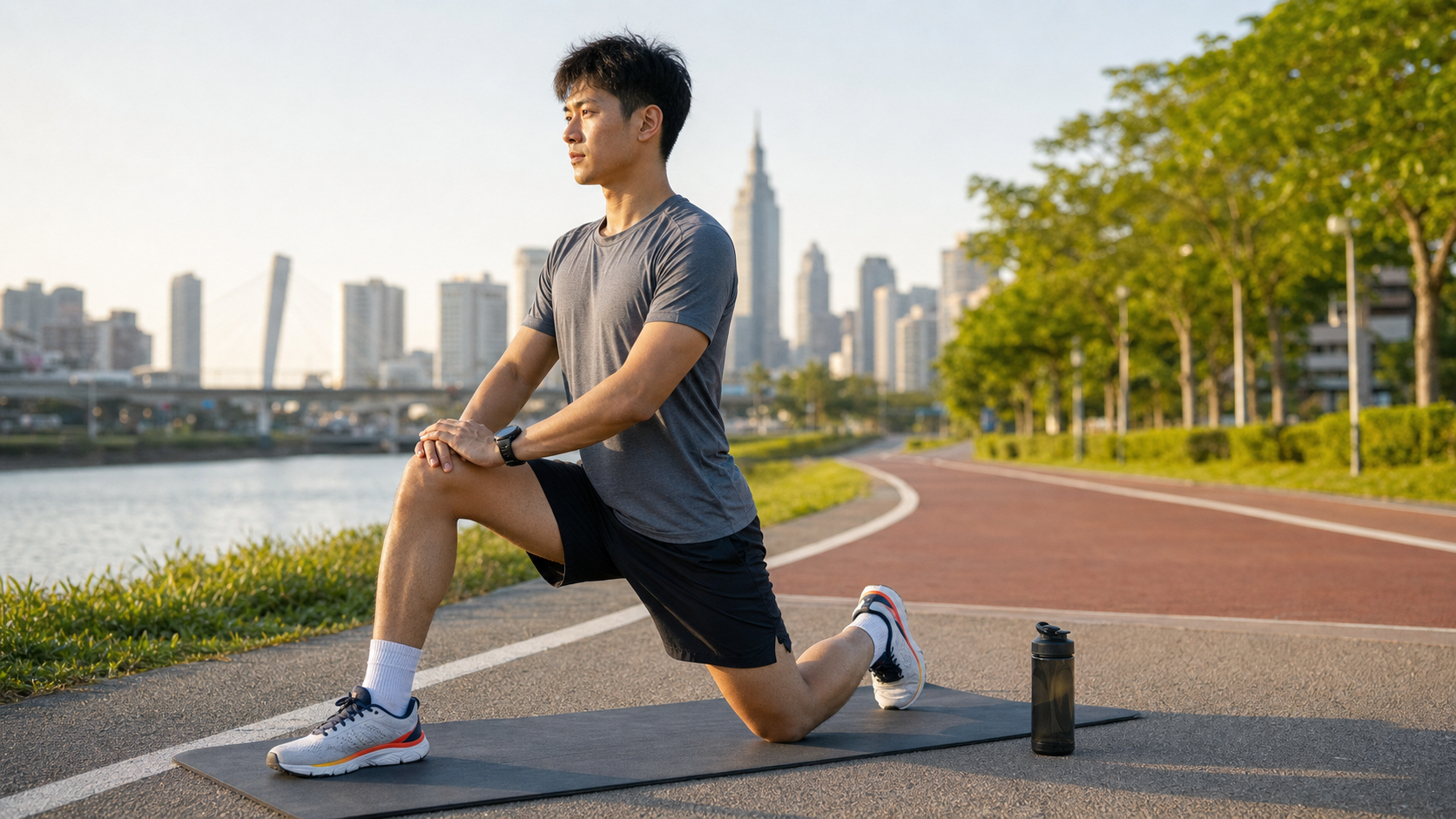
Kneeling Hip Flexor Stretch: With your rear knee on the ground and your front leg bent at 90 degrees, push your pelvis forward to feel a stretch in the front of the rear hip. Hold for 30–45 seconds, 2–3 sets per side. This is a stretch runners should do every day.
-
Lizard Stretch: Starting from a lunge position, place your front foot outside your hands and extend your rear leg as straight as possible. You can shift your body forward or rotate inward, adjusting based on where you feel tightness. Hold for 30–60 seconds.
-
Supine 90/90 Hip Rotation: Lie on your back with your legs positioned at 90/90 degrees (front leg at 90 degrees, rear leg at 90 degrees), alternating the switch to each side to train hip rotational mobility.
Hamstring Flexibility: Impact on Stride and Lower Back Health
The hamstrings connect the sit bones to the shin bones. When they are overly tight, they not only limit the forward swing of the leg during running but also cause posterior pelvic tilt, which in turn affects the alignment of the entire spine.
| Hamstring Tightness Level | Test Movement | Impact |
|---|---|---|
| Mild tightness | Standing forward fold, fingertips 10–15cm from the floor | Slightly limited stride |
| Moderate tightness | Fingertips 20–30cm from the floor | Posterior pelvic tilt, lower back soreness |
| Severe tightness | Fingertips more than 30cm from the floor | Significantly limited stride, lower back pain |
Key stretches:
-
Supine Single-Leg Raise Stretch: Lie on your back with one knee bent and foot on the floor. Raise the other leg, hook a towel or resistance band around the ball of your foot, and slowly pull the leg toward your body until you feel a stretch in the back of the thigh. Hold for 30–45 seconds.
-
Standing Hamstring Stretch: Place one foot on a low step with the ankle flexed, then slowly lean your body forward while keeping your back flat (do not hunch or round your back). This ensures you are actually stretching the hamstrings rather than the lumbar spine.
-
Dynamic Hamstring Stretch (Leg Swing): Standing, swing one leg straight forward and backward to increase range of motion without excessive pulling. This is suitable for pre-run warm-up.
Calf Flexibility: Protecting the Achilles Tendon and Plantar Fascia
The calf is composed of the gastrocnemius and soleus muscles. Excessive tightness restricts ankle dorsiflexion (the ability to bend the foot upward toward the shin), which in turn affects landing shock absorption and increases stress on the Achilles tendon and plantar fascia.
Key stretches:
-
Wall Lunge Calf Stretch (Gastrocnemius): Facing a wall, place your front foot close to the wall, keep your rear leg straight with the heel on the ground, and push your body forward to feel a stretch in the upper portion of the rear calf. Hold for 30 seconds.
-
Wall Lunge with Bent Knee Calf Stretch (Soleus): Same as above, but with a slight bend in the rear knee. This targets the soleus (the deeper muscle) more specifically.
-
Step Heel Drop Achilles Stretch: Place the ball of your foot on a step and slowly lower your heel downward to stretch the calf and Achilles tendon.
Practical Recommendations
Runners are advised to follow the principle of “dynamic stretching before a run, static stretching after a run”:
Pre-run (dynamic, 5–8 minutes):
- Leg swings forward and backward (hamstrings) × 15 reps
- Side lunge (hip joint) × 10 reps
- Dynamic calf raises to activate the calves × 15 reps
Post-run (static, 10–15 minutes):
- Kneeling hip flexor stretch × 45 seconds (each side)
- Supine hamstring stretch × 45 seconds (each side)
- Wall calf stretch (gastrocnemius + soleus) × 30 seconds (each side)
Conclusion
The payoff from flexibility training is not immediate—it is a long-term investment. Ten-plus minutes of stretching each day requires 4–8 weeks of consistency before noticeable improvements in range of motion appear, but once established, the benefits for running economy and injury prevention are lasting. Treat stretching as an inseparable part of your running plan, not an optional add-on, and your body will reward you with a longer running career.
Related Reading
- Hip Flexor Training for Runners: The Key Muscle Group for Preventing Running Injuries
- Hip Strengthening for Runners: Unlocking the Key to Speed and Endurance
- Runners with Tight Hip Flexors: Causes, Assessment, and Stretching Prescriptions
- Hip Flexor Training for Runners: The Relationship Between Leg Drive and Stride Improvement
西進武嶺 免費訓練分析服務 Intervals | 練不夠還是練過頭?你哪一種類型選手?AI模型告訴你! | 備戰神器 | 公路車 訓練 | CT Yeh
4 年前
一日北高/長距離團騎 常見問題補充篇 / 組團或跟團的眉角 / 壯車友容易被瘦車友慢性拉爆 / 原來屁股痛可能是這個原因...? / 風場配速法 / 公路車 / CT Yeh
2 年前
實景訓練台) 彰化經典百K 高強度喵團 90分鐘 跟著一起練功 2019 Indoor workout Changhua Classic 100 Taiwan
7 年前
[教學] Premiere 影片 手震 修正 教學 防抖 單眼 影像 GoPro 穩定 Video Stabilization
8 年前
Never Stop 西進武嶺 前後雙機 完整全程錄影 訓練台 實境
8 年前
白沙屯媽祖進香在家走!UREVO 坡度自調走步機 / 可連接訓練遊戲APP MyWhoosh / 邊看直播邊走起來 / CT Yeh
11 個月前
大禹嶺 到 武嶺牌樓 全程前後實況錄影 | 北進武嶺 | 東進武嶺 | KOM | 訓練台 | 坡度分析 | Taiwan KOM Last 10 km HARD | 公路車
6 年前
CT 喇低賽) 武嶺牽車 才是王道 西進牽車四小時內秘訣 攝手位置 如何判斷 防抽筋小秘訣
7 年前