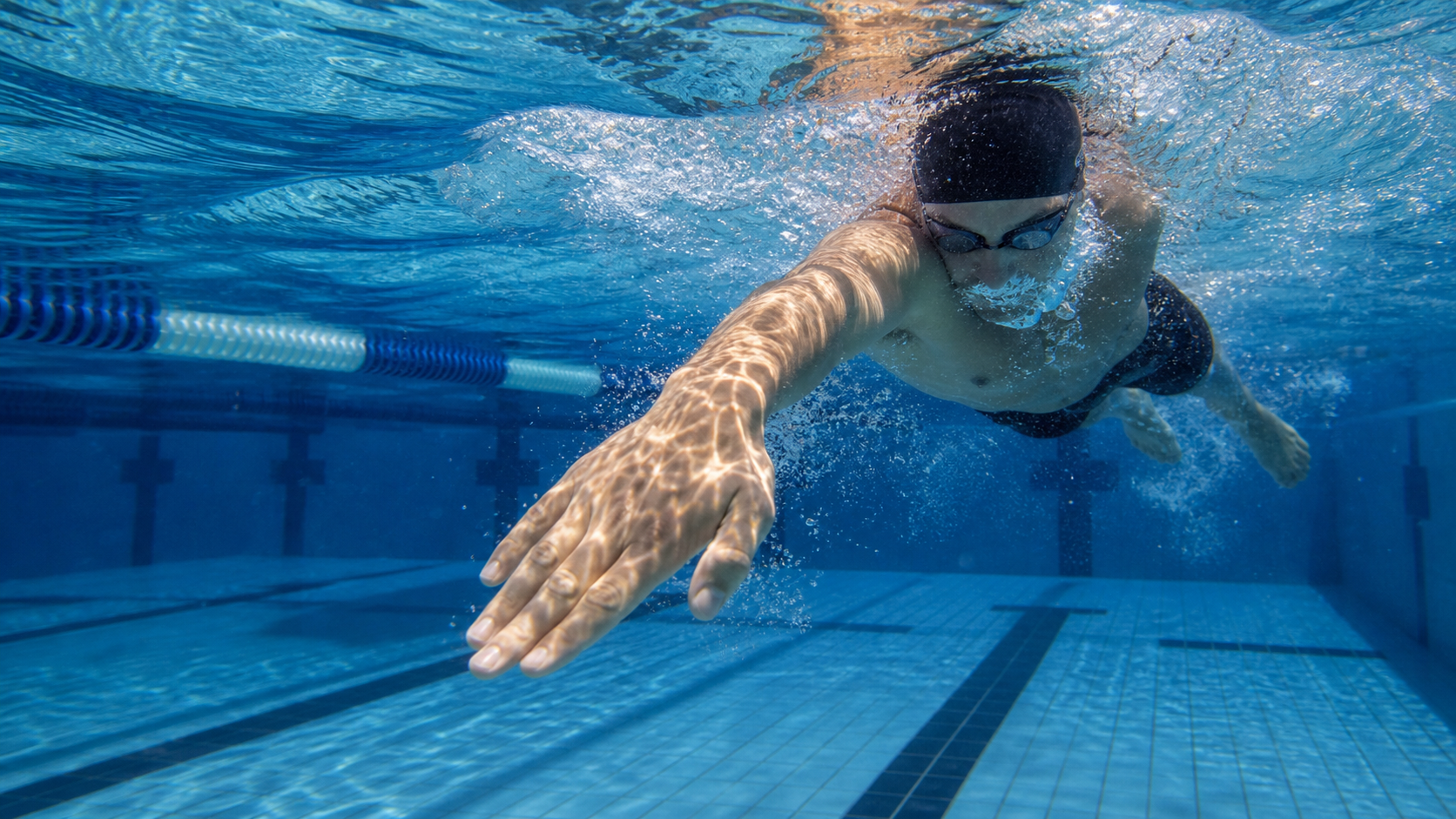
Introduction
“Pull harder” is the first piece of advice many beginner swimmers receive, but elite swimming coaches know that raw strength alone is not the key to swimming fast. The gap between world-class athletes and amateur swimmers lies more in the efficiency of propulsion mechanics—with the same muscular output, the correct use of palm area and stroke angle can produce vastly different propulsive results. This is precisely the most fascinating application of fluid dynamics in swimming.
Two Mechanisms of Propulsion
Drag Propulsion
The most intuitive way to generate propulsion in swimming: the palm pushes water backward perpendicular to the flow direction, producing a reaction force that drives the body forward. Like paddling, the larger the palm area and the faster the push, the stronger the propulsive force. This was the primary model in early swimming biomechanics research.
However, pure drag propulsion has a fundamental limitation: when the hand’s push speed approaches or even exceeds the body’s forward speed, efficiency drops sharply—the palm is essentially “pushing stationary water,” resulting in extremely low energy utilization.
Lift Propulsion
In the 1970s, researchers discovered that a significant proportion of swimming propulsion comes from the lift principle, similar to the mechanism that generates lift on an airplane wing. When the palm cuts through the water at a certain angle (angle of attack), the pressure difference between the back of the hand and the palm side creates lift perpendicular to the direction of movement, and the horizontal component of this force becomes forward thrust.
The key advantage of lift propulsion is that the hand’s movement speed does not need to exceed the body’s forward speed, and thrust can be sustained over a longer path. Elite swimmers’ stroke trajectories exhibit complex S-shaped or elliptical curves precisely to maximize lift propulsion efficiency.
| Propulsion Type | Principle | Optimal Conditions | Application |
|---|---|---|---|
| Drag Propulsion | Palm pushes water backward facing the flow | Large palm, high push speed | Breaststroke pull, underwater start phase |
| Lift Propulsion | Palm cuts water creating pressure difference | Precise angle of attack (30–45°) | Primary propulsion in freestyle and butterfly |
| Mixed Propulsion | Combination of both | Dynamic adjustment | Actual competitive swimming |
Physiology of Palm Area and Angle of Attack
Importance of Palm Area
Research shows a significant correlation between swimmers’ palm area and 100-meter performance (r = 0.68). When fingers are spread approximately 15–20 degrees, the effective propulsive surface area can increase by about 9% compared to closed fingers, because the gaps between fingers cause water to flow around in a specific manner, actually increasing overall drag area. This counterintuitive conclusion was confirmed by American researchers in 2007 through fluid simulation.
Optimal Angle of Attack
Biomechanical research suggests that the optimal angle of attack for freestyle pulling is approximately 30–45 degrees, at which the ratio of lift coefficient (CL) to drag coefficient (CD) is optimal. If the angle of attack is too small (palm nearly parallel to the water flow), insufficient thrust is generated; if too large (palm perpendicular to the flow), it degenerates into pure drag propulsion with reduced efficiency.
Mechanical Significance of the “High Elbow Catch”
Modern swimming training emphasizes the “high elbow catch”—after the hand enters the water, the elbow remains high while the palm quickly adjusts to the optimal angle of attack perpendicular to the forward direction. This allows the stroke to enter an efficient propulsion phase from the moment of entry, rather than wasting path length on inefficient entry preparation movements. The high elbow catch requires strong serratus anterior and rotator cuff muscles, making it a core focus of advanced technical training.
Practical Recommendations
- Stroke Path Drills: Use a kick board to isolate the upper body, and observe the stroke trajectory at slow speed with a mirror or underwater camera to confirm the hand path follows an S-curve rather than a straight push
- High Elbow Training: Use resistance bands to simulate the pulling motion, focusing on the entry position with the “forearm perpendicular to the water surface,” performing 3 sets × 15 reps of dry-land simulation before each training session
- Finger Spread Test: At the same pace, swim 50 meters with fingers closed versus slightly spread (about 15 degrees) to feel the speed difference; Taiwanese researchers suggest that fingers naturally spreading slightly after fatiguing training yields better efficiency
- Short Stroke Drill: Deliberately shorten the stroke length to force each pull to complete propulsion within the efficient angle of attack range, avoiding over-pushing into the low-efficiency zone past the thigh
- Use of Paddles: Large paddles can increase effective propulsive surface area by 30–50%; after overload training, removing them allows the brain to experience the tactile feedback of “naturally large palms”
Conclusion
The mechanics of swimming propulsion are far more complex than “pulling backward hard.” The synergistic effect of lift and drag, the refined use of palm area, and the dynamic adjustment of angle of attack together form the scientific foundation of efficient propulsion. For Taiwanese swimmers, who enjoy ample pool training volume in the hot climate, combining correct mechanical concepts with technical training can often significantly improve performance without increasing training volume. Technical refinement will always be the direction with the highest return on investment in swimming improvement.
Related Reading
- The Propulsive Efficiency of Kicking: The Dual Role of Kicking in Propulsion and Drag
- The Fluid Dynamics of Swimming: Application of Bernoulli’s Principle in Stroke Propulsion
- Dry-Land Explosive Power for Swimmers: A Complete Guide to Band Pull Simulations and Shoulder Power Training
- Freestyle Hand Entry Angle: Differences in Propulsion Between 45-Degree and Vertical Entry
CT 喇低賽) 武嶺牽車 才是王道 西進牽車四小時內秘訣 攝手位置 如何判斷 防抽筋小秘訣
7 年前
戰略) Zwift Race 如何咬在第一集團 如何評估自己要開多少推力 (請開1.5倍速看)
7 年前
西進武嶺 自製新版AI配速表產生器 x 賽前攻略 抱佛腳! 沒有功率計也可以產生配速表嗎?有什麼其他眉角賽前要注意的呢? | 西進武嶺 / 東進武嶺 KOM 攻略 | 公路車 | CT Yeh
4 年前
多機位拍片神器 DJI Action 2 拍出速度張力感 | 類空拍機視角 4陣列麥克風超強降風噪 實測! | 公路車 | CT Yeh
3 年前
西進武嶺 8000名單車友數據分析 PART1 | 從新手到高手數量/瓦數/推力比/FTP推力比/功率計使用率 大解析 | 公路車 | CTYeh
5 年前
一起升級!海鷗盃LSD團練...JJSC Zone2招待 騎到手抖 / 公路車 / CT Yeh
1 天前
西進武嶺 免費訓練分析服務 Intervals | 練不夠還是練過頭?你哪一種類型選手?AI模型告訴你! | 備戰神器 | 公路車 訓練 | CT Yeh
4 年前
3D 列印車褲墊 / 舒適改善? / 無痕 x 分區壓縮 / ATK & Decider系列 / JE22黑科技 / #公路車 #CTYEH
11 個月前