Introduction
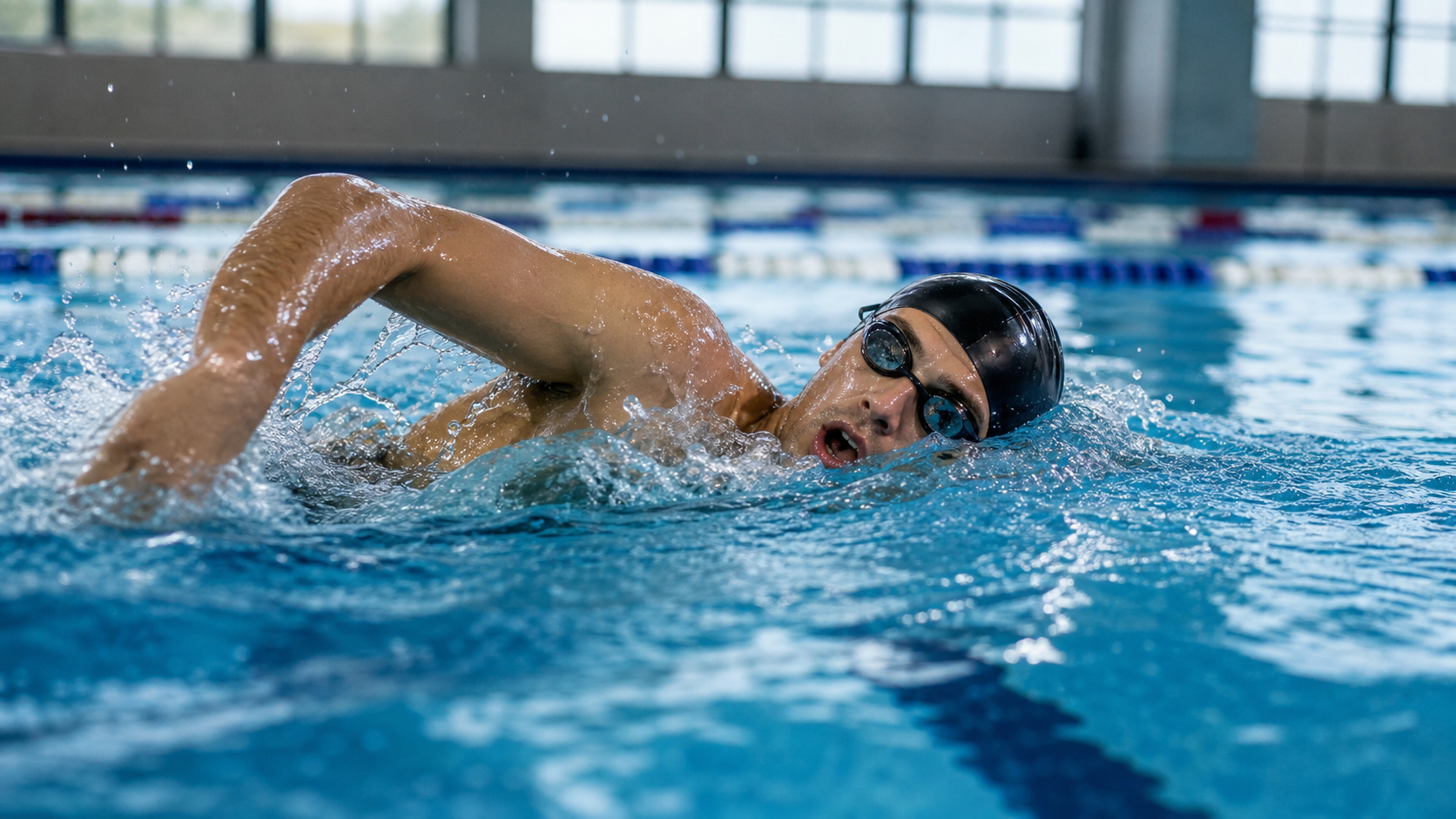
Among all endurance sports, swimming has the most unique breathing pattern: you cannot breathe at will, and every breath requires precise timing and coordination. A flawed breathing rhythm can ruin the entire tempo of your swimming technique. This limitation, however, also presents a unique training opportunity—swimming is one of the most effective sports for developing breathing efficiency and high CO₂ tolerance, and these benefits can even transfer to performance in other endurance sports.
The Physiological Uniqueness of Swimming Respiration
Hydrostatic Pressure and Respiratory Muscle Load
Hydrostatic pressure exerts inward force on the ribcage. At a depth of 30 cm below the water surface, this pressure is approximately 0.03 atm, meaning the inspiratory muscles (primarily the diaphragm and intercostal muscles) must overcome an additional 3–5% of resistance to complete an inhalation.
This has a limited impact on healthy swimmers, but for beginners with weaker respiratory function or for asthma sufferers, this extra load can significantly affect breathing efficiency. Long-term swimming training strengthens the inspiratory muscles; research shows that elite swimmers have a Maximal Inspiratory Pressure (MIP) 40–60% higher than non-athletes of the same age.
CO₂ Threshold and Respiratory Drive
The primary driver of normal breathing is not hypoxia (low O₂), but hypercapnia (high CO₂). When blood CO₂ levels rise, the medullary respiratory center sends out a strong signal to breathe. The forced breathing rhythm in swimming (e.g., breathing only every third stroke) allows the body to habituate to a higher CO₂ tolerance threshold, reducing the urge to breathe and enhancing the ability to delay breathing during high-intensity effort.
Lung Volume Metrics
| Metric | Definition | Elite Swimmers | General Healthy Adults |
|---|---|---|---|
| Total Lung Capacity (TLC) | Total air volume in the lungs after maximal inhalation | 7.5–8.5 L | 5.5–6.5 L |
| Vital Capacity (VC) | Air volume from maximal exhalation to maximal inhalation | 6.0–7.5 L | 4.0–5.0 L |
| FEV₁ | Forced expiratory volume in one second | 5.0–6.5 L | 3.5–4.5 L |
| Residual Volume (RV) | Air remaining after maximal exhalation | 1.2–1.5 L | 1.0–1.5 L |
Elite swimmers often have vital capacities far exceeding the average. This is partly attributable to genetics (tall stature, deeper ribcage), but it is also, to a considerable degree, an adaptation resulting from long-term swimming training.
The Physiological Benefits of Breath-Holding Training
The Spleen Contraction Effect
A lesser-known physiological adaptation from long-term breath-holding training: repeated hypoxic stimuli cause the spleen to contract during breath-holds, releasing stored red blood cells into the circulatory system, temporarily increasing the blood’s oxygen-carrying capacity. This is one reason freedivers have superior oxygen-carrying capacity, and it also explains why swimmers have better tolerance in hypoxic conditions than land-based athletes.
Hypoxic Training Effects
Restricting breathing frequency (e.g., breathing only every fifth stroke) creates mild hypoxic stimuli, promoting the following adaptations:
- Increased erythropoietin (EPO) secretion, promoting red blood cell production
- Elevated myoglobin concentration in muscles, increasing muscular oxygen storage
- Increased mitochondrial density, improving aerobic metabolic efficiency
The Impact of Breathing Rhythm on Technique
Hyperventilation (e.g., breathing on every stroke) disrupts the body’s rotation rhythm, increases lateral drag, and reduces stroke efficiency. Research shows that freestyle swimmers swimming with a “breathe every 3 strokes” rhythm are approximately 1.5–2% faster than those breathing every 2 strokes. Even with slightly reduced muscular oxygen supply, the gain in technical efficiency still prevails.
Practical Recommendations
- Progressive breath-restriction training: Beginners should start with “breathing every 2 strokes,” then progress to 3 and 5 strokes once stable. Maintain each level for at least 2 weeks to allow the body to adapt, avoiding breath-holding panic from progressing too quickly
- Pyramid breathing sets: Perform pyramid training for breathing rhythm—1 x 25m (breathe every 2 strokes), 2 x 25m (breathe every 3 strokes), 3 x 25m (breathe every 5 strokes), then work back down. This addresses both technical training and hypoxic adaptation
- Respiratory muscle strengthening: Use a respiratory training device (e.g., POWERbreathe) for 30 resisted inhalations daily. Research shows a 1–3% improvement in swimming performance after 6 weeks
- Bilateral breathing: Taiwanese swimmers accustomed to unilateral breathing should systematically train bilateral breathing ability (practice first in low-intensity sets) to establish a symmetrical stroke rhythm and body rotation
- Respect the safety limits of breath-holding training: Breath-holding swimming must be conducted under the supervision of a lifeguard or a partner. Strictly avoid solo deep breath-holding training in open water to prevent the danger of Shallow Water Blackout
Conclusion
The respiratory physiology of swimming is a composite discipline combining fluid dynamics, neural control, and metabolic adaptation. In Taiwan’s swimming teaching tradition, breathing technique is often regarded as something that “comes naturally,” but scientific research tells us: systematic breathing training yields quantifiable physiological adaptations, from expanded lung capacity to improved CO₂ tolerance, all of which translate directly into better swimming performance. Treating breathing training as an independent training component, rather than merely an accessory to technical movements, is a crucial mindset shift for improving swimming efficiency.
Related Reading
- The Science of Swimming Breathing Technique: Breath-Holding Training and CO₂ Tolerance
- The Physiology of Swimming Respiration: The Relationship Between Breathing Rhythm and Blood Oxygen Saturation
- Transfer of Swimming Breathing Training: The Effect of Swimming Breathing on Running Respiratory Rhythm
- Swimming as Respiratory System Training: Vital Capacity and Asthma Improvement
#公路車 #Vo2Max #最大攝氧量 測驗 體驗 | 心肺測試
6 年前
實景訓練台) 彰化經典百K 高強度喵團 90分鐘 跟著一起練功 2019 Indoor workout Changhua Classic 100 Taiwan
7 年前
福隆鐵人團練隨拍
8 年前
CT暗黑廚房) 車友必備 宇宙無敵鮮蚵湯 幫助訓練恢復 天然食補 好市多 超肥鮮蚵 破PR
7 年前
一起升級!海鷗盃LSD團練...JJSC Zone2招待 騎到手抖 / 公路車 / CT Yeh
1 天前
[教學] Premiere 影片 手震 修正 教學 防抖 單眼 影像 GoPro 穩定 Video Stabilization
8 年前
西進武嶺 免費訓練分析服務 Intervals | 練不夠還是練過頭?你哪一種類型選手?AI模型告訴你! | 備戰神器 | 公路車 訓練 | CT Yeh
4 年前
教學) 如何做出專業 慢動作 影片 Slow Motion 120fps GoPro 7 ActionCam AX700 A99II
7 年前