Introduction
“Yesterday’s ride was exhausting—should I rest today or ride easy?” This is a decision every serious cyclist faces. Relying on feel is often inaccurate—when training motivation is high, you risk overtraining; when your form is low, you risk over-resting. The emergence of biofeedback tools has shifted this decision from subjective perception to objective data. Heart rate variability (HRV) and lactate testing are currently the two most scientifically validated and most practical biofeedback systems for Taiwanese cyclists.
The Principles and Application of Heart Rate Variability (HRV)
HRV measures the tiny variations (in milliseconds) between consecutive heartbeats. Intuitively, a person with a “regular” heartbeat actually has poorer recovery—under the regulation of the autonomic nervous system, a healthy heart should show subtle fluctuations in each heartbeat interval, and these fluctuations represent the flexibility of the autonomic nervous system.
| HRV Metric | Meaning | Training Application |
|---|---|---|
| rMSSD (Root Mean Square of Successive Differences) | Direct indicator of parasympathetic activity | Most commonly used for daily training decisions |
| SDNN (Standard Deviation of NN Intervals) | Overall autonomic nervous system activity | Reflects overall recovery status |
| LF/HF Ratio | Sympathetic/parasympathetic balance | Stress state assessment |
Practical Application Logic:
- HRV ≥ 5% above personal baseline: Good recovery, high-intensity training can be scheduled
- HRV within ±5% of baseline: Normal, train according to plan
- HRV 5–10% below baseline: Mild fatigue, reduce intensity, consider Zone 1–2
- HRV > 10% below baseline: Significant fatigue, schedule complete rest or active recovery
The Precision of Lactate Testing
Lactate is a byproduct of glycolytic metabolism, and blood lactate concentration directly reflects the ratio of aerobic to anaerobic system usage:
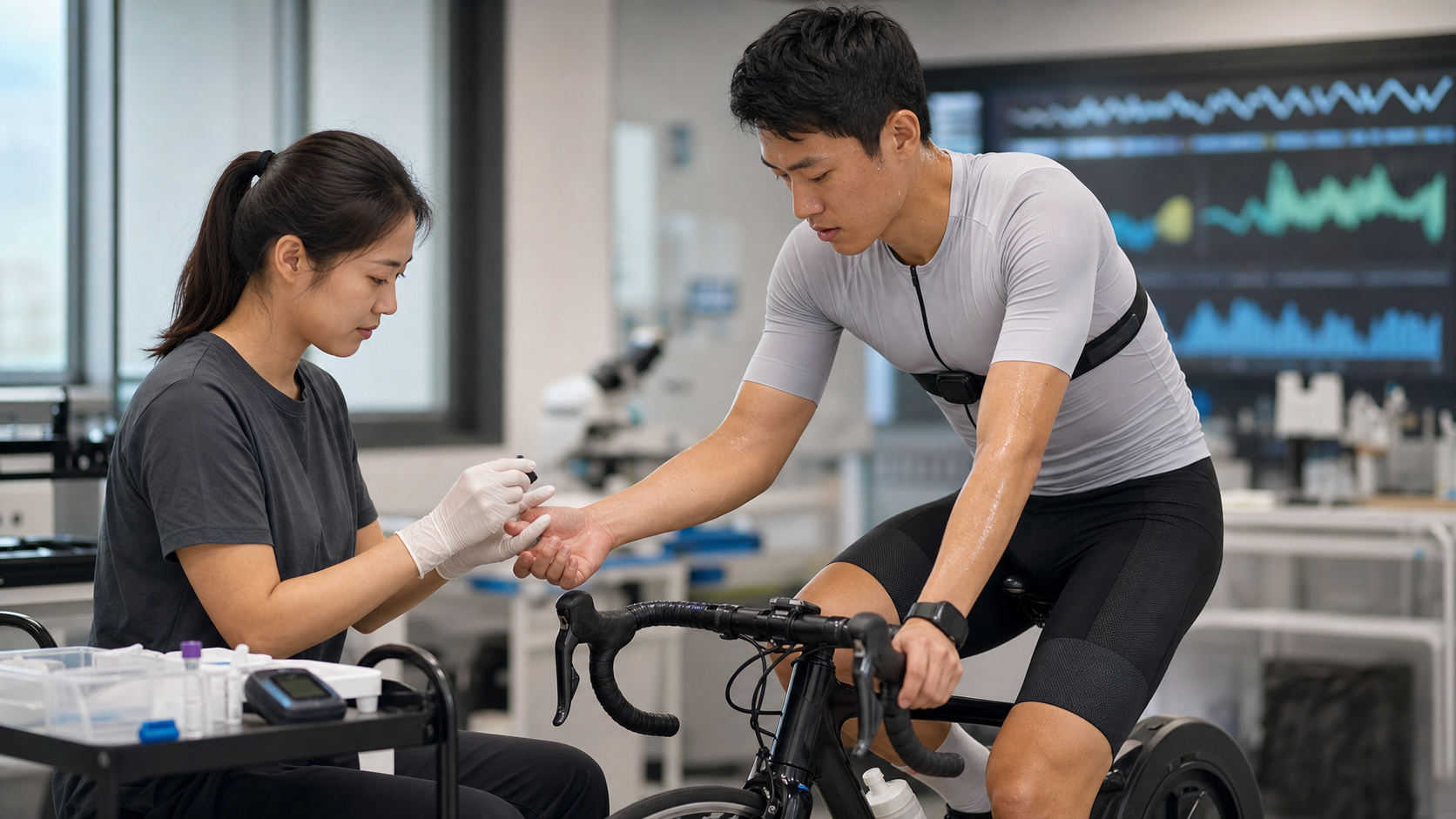
Lactate Step Test Protocol:
- Increase power every 5 minutes (e.g., 25W per step), take a fingertip blood sample at the end of each step
- Plot the power-lactate curve
- Identify two key points:
- LT1 (Aerobic Threshold): The point where lactate begins to rise steadily, corresponding to the upper limit of Zone 2 (approximately 2 mmol/L)
- LT2 (Anaerobic Threshold / FTP): The point where lactate rises sharply, corresponding to FTP intensity (approximately 4 mmol/L)
| Lactate Concentration | Training Zone | Meaning |
|---|---|---|
| < 2 mmol/L | Zone 1–2 | Pure aerobic, fat metabolism dominant, highly sustainable |
| 2–4 mmol/L | Zone 3–4 | Mixed metabolism, lactate production = clearance |
| > 4 mmol/L | Zone 5+ | Anaerobic dominant, rapid lactate accumulation |
Compared with power meter testing (such as the 20-minute FTP test), the advantages of lactate testing are:
- Directly measures metabolic state, unaffected by training status, weather, or motivation fluctuations
- Can precisely distinguish LT1 and LT2, ensuring Zone 2 training truly falls within the optimal fat metabolism range
- Can track aerobic adaptation progress (LT1 and LT2 power increases with training)
Integrated Application of HRV and Lactate
Combining the two forms a complete training decision-making system:
- Daily morning HRV measurement: Determines “what intensity of training is appropriate today”
- Monthly lactate test: Calibrates training zones and evaluates aerobic base progress
- Long-term trend analysis: If baseline HRV continues to decline while LT1 power stagnates, it indicates the training plan needs adjustment
Practical Recommendations
- Morning HRV measurement tools: Elite HRV, HRV4Training (mobile apps, measurable in 30 seconds); Polar H10 paired with an app is the most accurate; measure at the same time every day, lying supine for 2–3 minutes of quiet rest after waking
- Establish your personal HRV baseline: Measure continuously for 4 weeks, calculate the mean and standard deviation—this is your “normal value”
- Getting started with lactate testing: Blood lactate meters (such as Lactate Scout, Lactate Pro) are available for purchase in Taiwan; the test strips only require a fingertip prick—painless and simple; test every 6–8 weeks
- Low-cost alternative to lactate testing: If you don’t have a lactate meter, use the “talk test” to roughly estimate LT1 (the highest intensity at which you can comfortably speak a full sentence); Garmin/Wahoo FTP tests can roughly estimate LT2
- Training log integration: Record HRV, lactate data, training volume, sleep, and subjective feelings in the same log (such as TrainingPeaks, Intervals.icu) to identify personal patterns
Conclusion
Biofeedback tools move training decisions from art toward science. HRV tells you daily “how hard to push today,” and lactate testing tells you monthly “how much your engine’s efficiency has improved.” In an environment where Taiwanese cyclists have a high proportion of self-directed training and lack coach guidance, these two tools are the best “self-coaching” resources. Data cannot replace feeling, but feeling paired with data is the strongest training wisdom.
Related Reading
- The Application of Heart Rate Variability (HRV) in Cycling Training Monitoring
- Heart Rate Variability (HRV) Monitoring: The Application of Autonomic Nervous System Balance Index in Training Monitoring
- The Application of Heart Rate Variability (HRV) in Cycling Training: Morning HRV Guiding Daily Training Intensity
- Heart Rate Variability (HRV) Monitoring in Cycling Training: Understanding Your Body’s Recovery Status
西進武嶺 免費訓練分析服務 Intervals | 練不夠還是練過頭?你哪一種類型選手?AI模型告訴你! | 備戰神器 | 公路車 訓練 | CT Yeh
4 年前
#公路車 #Vo2Max #最大攝氧量 測驗 體驗 | 心肺測試
6 年前
2026 車錶排行榜!誰是最多車友正在使用?練家子最愛哪款?🏆 (2萬名車友數據) / 公路車 / CT Yeh
5 個月前
單車AI教練!全新 ChatGPT4o 幫你分析訓練成果!排武嶺課表,分析騎車姿勢! 太神了! / 公路車 / CT Yeh / feat. 緯緯
2 年前
2025 自行車錶排行榜 兩萬車友大數據 / Garmin Bryton 排名會大洗牌嗎? / 全新的碼表前身分析 /公路車 / CT Yeh
1 年前
Rouvy 元宇宙運動世界! 用VR 騎遍全台灣單車路線 武嶺 中社路 風櫃嘴
5 年前
Stages功率計 和 智騎 X7 Pro 訓練檯同時騎兩個 Rouvy 角色會一起進終點嗎?最後來點數據分析 | 公路車
5 年前
超開放的自行車錶!可以玩遊戲裝APP!?/ SRAM合併的 Hammerhead Karoo深入開箱!/ 即時爬坡偵測 / 全球導航地圖 / Garmin Bryton / CT Yeh
1 年前