Introduction
Some swimmers had water leak into their goggles at the 50m mark of a national championship, finishing the rest of the race half-blind. Others had racing suits so tight they affected breathing, throwing their entire breathing rhythm off. These aren’t fitness issues—they’re gear management problems.
The fine-tuning of competitive swimming equipment is a severely overlooked discipline. The selection and adjustment of racing apparel, protective gear, and vision equipment have a direct and quantifiable impact on race performance.
Racing Suit Selection and Adjustment
Suit Types and Speed Effects
| Suit Type | Applicable Gender | Characteristics | Suitable Competition Level |
|---|---|---|---|
| Racing Jammer | Male | Compresses thighs, reduces drag | City/county level and above |
| Racing Brief | Male | Maximum mobility | Training/Youth |
| Racing Kneeskin | Female | Above-knee one-piece compression | City/county level and above |
| High-Tech Racing Suit (Techsuit) | Male/Female | Polyurethane/rubber material, maximum drag reduction | National/International meets |
Racing Suit Compression Adjustment Points
A racing suit should be “tight but not restrictive to breathing.” Fitting test standards:
- Noticeable compression around the waist when standing, but deep breathing is not restricted
- Even compression on the legs, with no single point of excessive tightness or pinching
- Squatting motion is unrestricted (ensures proper starting block stance)
- Arm raise test: no pulling at the shoulders
High-Tech Suit (Techsuit) Wearing Process:
- Ensure the body is completely dry (wearing it wet carries higher risk)
- Start from the feet, slowly work the suit up in segments (smoothing out wrinkles at each stage)
- Allow 15–20 minutes for putting it on (longer for the first time)
- Avoid snagging the material with fingernails (trim nails, use plastic bags as an aid)
Suit Lifespan Management
- High-tech suits (polyurethane-based): Strength drops significantly after a single race; recommend replacing every 2–3 races
- Standard racing suits (nylon/spandex): Rinse with fresh water after each use, avoid direct sunlight; can last 50–80 uses
- Pre-race testing: Do a full fitting test at least 2–3 weeks before the competition—never try a suit on for the first time on race day
Goggle Selection, Adjustment, and Fit
Goggle Type Selection
| Type | Field of View | Fit Quality | Best Use Case |
|---|---|---|---|
| Small-frame racing goggles | Narrow | Highest | Short-course sprinting |
| Medium-frame all-purpose goggles | Medium | High | Training + racing |
| Large-frame goggles | Wide | Medium | Long-distance, triathlon |
Fit Adjustment Steps
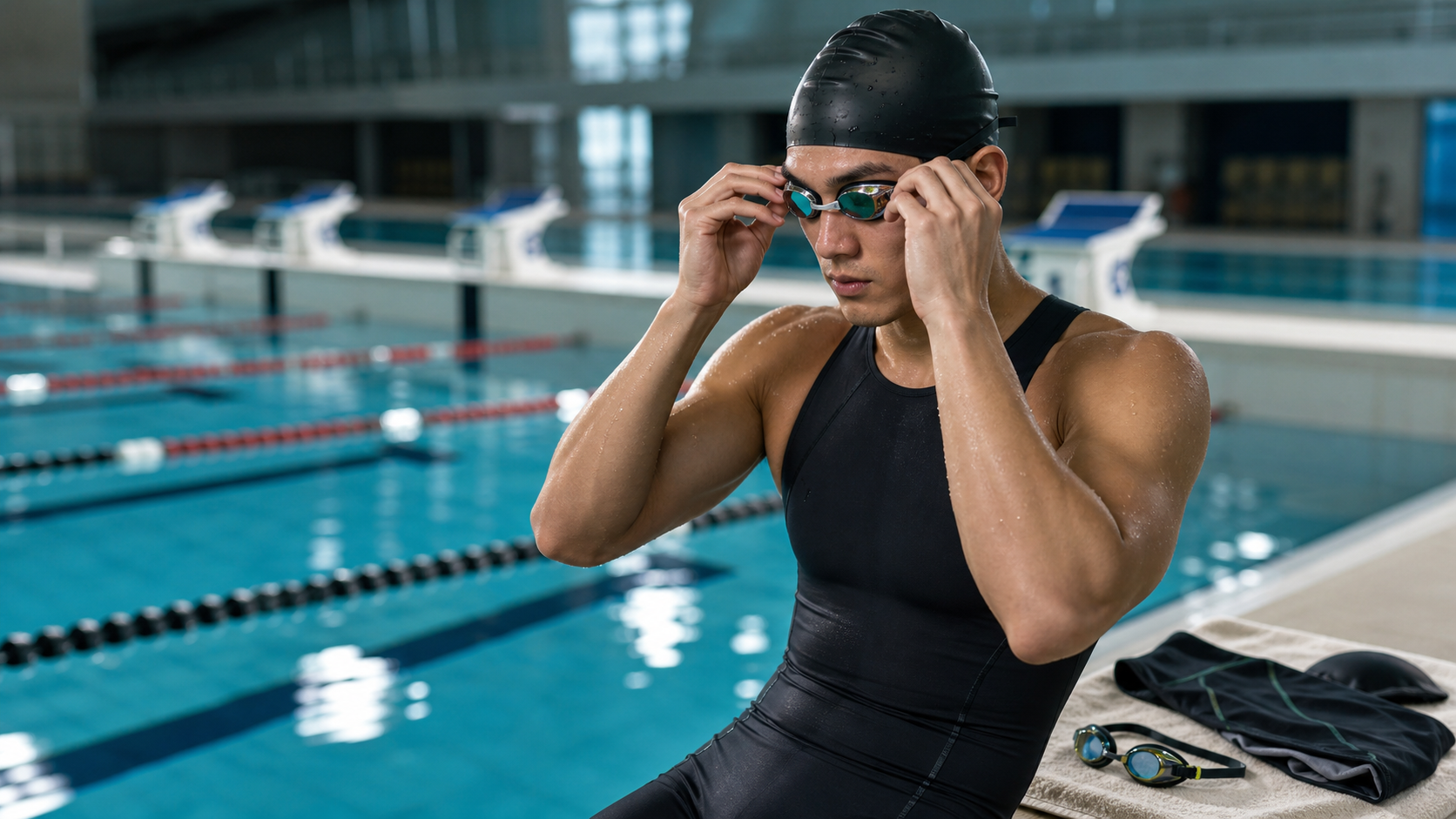
Poor fit is the main cause of goggle leakage. The correct adjustment process:
- Choose a frame that suits your face shape (Asian face shapes are advised to pick designs with a flatter nose bridge)
- Press the goggles lightly against the eye sockets without the strap and let them naturally suction for 3–5 seconds; if the suction holds, the frame shape is suitable
- Put the strap on and adjust tension: after tightening, there should be slight pressure above the ears but no pain
- Water test: shake your head several times in the water to confirm no leakage
Anti-Fog Treatment
Anti-fog treatment before a race is fundamental:
- Use anti-fog spray: apply before each use, let sit for 30 seconds, then rinse with fresh water
- Avoid touching the inside of the lenses with your fingers (finger oils are the main cause of fogging)
- Don’t use saliva as an anti-fog (it leaves organic residue that accelerates fogging)
Other Competition Gear Details
- Swim caps: Racers usually wear two caps (silicone + fabric) to keep goggle straps from slipping; make sure the ears are fully covered
- Nose clips: Swimmers who use nose clips need to use them consistently in training well in advance to avoid discomfort on race day
- Starting block grip feel: Confirm the starting block’s non-slip pad suits your foot shape, and practice repeatedly on the same type of block in training
Practical Advice
- Start wearing your racing suit during training 1 month before the competition to adapt to the compression and range of motion
- Always carry a spare pair of goggles: goggle failure on race day is a common disaster
- Replace goggle straps every six months: rubber loses elasticity as it ages and can slip off during races
- Create a gear checklist: go through it item by item the day before the race to avoid forgetting anything
- Ask teammates or coaches about gear experience: different face shapes and preferences call for different optimal choices
Conclusion
Gear management is one of the “highest return on investment” aspects of competitive swimming—it doesn’t require extensive training time, only care and preparation, to avoid performance losses caused by equipment issues. Starting today, elevate race gear preparation to the same level of importance as training.
Related Reading
- The Impact of Swimsuit Choice on Performance: The Second Difference Between Racing and Training Suits
- The Technology of Racing Suits: A Guide to Compression Levels, Materials, and Fit Selection
- Competitive Considerations in Swimsuit Selection: Analyzing the Drag and Pressure Benefits of Tech Suits
- The Science of Goggles, Caps, and Accessories: Engineering Trade-offs in Visibility, Field of View, and Anti-Fog
3D 列印車褲墊 / 舒適改善? / 無痕 x 分區壓縮 / ATK & Decider系列 / JE22黑科技 / #公路車 #CTYEH
11 個月前
西進武嶺 自製新版AI配速表產生器 x 賽前攻略 抱佛腳! 沒有功率計也可以產生配速表嗎?有什麼其他眉角賽前要注意的呢? | 西進武嶺 / 東進武嶺 KOM 攻略 | 公路車 | CT Yeh
4 年前
#公路車 #Fitting 靠人工智慧APP 幫你調整單車
6 年前
[教學] Premiere 影片 手震 修正 教學 防抖 單眼 影像 GoPro 穩定 Video Stabilization
8 年前
FTL 與 SYB 車隊專訪 西進武嶺 實用攻略分享! 2小時 如何練?!你不知道的眉角!新手準備武嶺必看 EP1 | 實力派女車友 | 精華版 | 公路車 | CTYeh
4 年前
松運深水池拍攝 作品 防寒衣品牌
8 年前
一日北高/長距離團騎 常見問題補充篇 / 組團或跟團的眉角 / 壯車友容易被瘦車友慢性拉爆 / 原來屁股痛可能是這個原因...? / 風場配速法 / 公路車 / CT Yeh
2 年前
CT 喇低賽) 單車 比賽總是沒照片? 攝影師的觀點大公開 姿勢就是力量! 請加速1.25倍收看
7 年前