Introduction
The proportion of female runners in Taiwan’s road-running community has been rising year by year, but many people do not know that female runners, due to differences in physiological structure, have different injury patterns and training needs compared to male runners. Research consistently shows that female runners have significantly higher rates of anterior knee pain (patellofemoral pain syndrome) and anterior cruciate ligament injuries than male runners.
These differences mainly stem from the fact that women have a wider pelvis, which leads to a larger femoral neck angle (Q-angle), in turn making the knee more prone to valgus collapse (Knee Valgus) during the running gait. Strength training designed around these characteristics can effectively reduce injury risk while improving running efficiency.
Biomechanical Characteristics of Female Runners
Q-Angle and Knee Valgus Issues
The Q-angle is the angle measured from the anterior superior iliac spine (the bony prominence at the front of the pelvis) to the center of the patella, and then to the tibial tuberosity. The average Q-angle in women is approximately 17–18 degrees, significantly higher than the 12–14 degrees seen in men. The larger the Q-angle, the more the knee tends to cave inward upon landing while running, increasing stress on the iliotibial band, patella, and lateral meniscus.
Hormonal Influence
Estrogen increases ligament elasticity. Around ovulation in the menstrual cycle (when estrogen levels peak), ligament laxity increases and joint stability relatively decreases. Research shows that the incidence of anterior cruciate ligament injuries in women rises markedly during specific phases of the menstrual cycle.
| Specific Risks for Female Runners | Causes | Prevention Focus |
|---|---|---|
| Patellofemoral pain | Large Q-angle, weak glutes | Strengthen gluteus medius and quadriceps |
| Anterior cruciate ligament injury | Hormones, knee valgus | Landing technique, glute and leg strength |
| Tibial stress fracture | Bone density, training overload | Manage running volume, calcium intake |
| Pelvic instability | Weak gluteus medius | Pelvic stability training |
Pelvic Stability Training
Pelvic stability is one of the most important training goals for female runners. Pelvic instability not only affects running form but is also a common source of knee pain and lower back pain.
Core Pelvic Stability Exercises:
- Bridge (Advanced Progression): Once the basic glute bridge is mastered, progress to the Single-Leg Bridge, focusing on keeping the pelvis level without tilting. 12 reps per side × 3 sets
- Side Plank: Strengthens the quadratus lumborum and obliques to maintain lateral pelvic stability. An advanced version can add hip abduction of the top leg
- Dead Bug: Slowly lower opposite arm and leg while keeping the lower back pressed into the floor throughout, training pelvic stability control during limb movement
Targeted Strengthening for Knock-Knees
For runners prone to knee valgus, the training focus is on strengthening the hip external rotators and abductors while improving landing mechanics:
Gluteus Medius Strengthening (Most Critical):
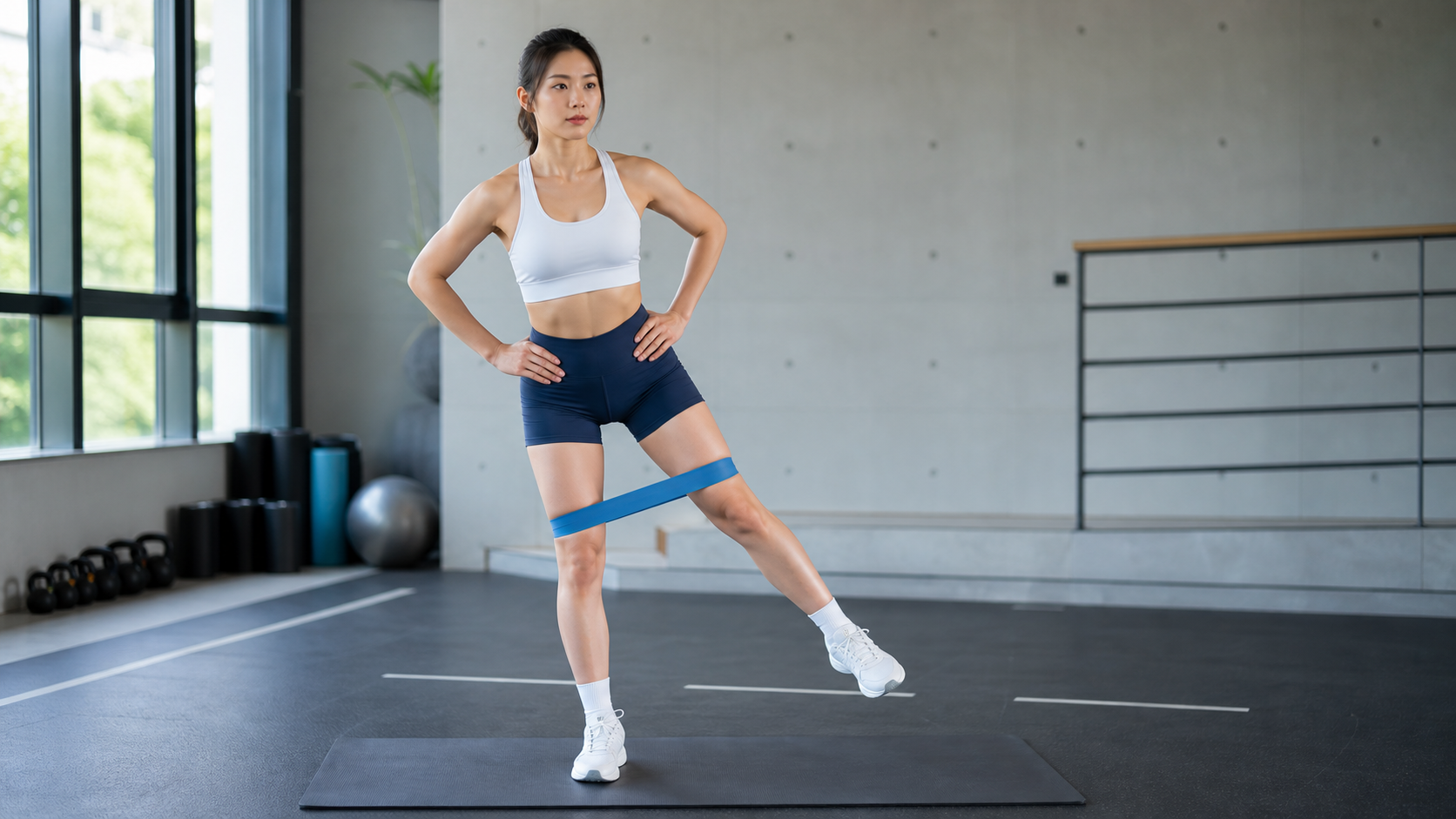
- Banded Clamshell: Lie on your side with a resistance band around the knees, abduct the top thigh. 20 reps per side × 3 sets
- Banded Lateral Walks: Place a resistance band around the knees, and when moving sideways, be careful not to let the knees cave inward
- Standing Banded Hip External Rotation: Anchor a resistance band and perform hip external rotation while standing to strengthen the external rotators
Landing Mechanics Training:
- Squat in front of a mirror: Observe whether the knees track over the toes; correct immediately if they cave inward
- Single-leg landing practice: Jump down from a height of 10–15cm, consciously keeping the knee directly above the second toe upon landing
- Slow-motion lunges: Perform lunges slowly while applying an inward pulling resistance to the knee with a resistance band, training the strength to resist knee valgus
The Importance of Foot Strengthening
Flat feet (overpronation) are more common among female runners, and arch collapse directly increases the degree of knee valgus. Foot strengthening training should not be overlooked:
- Towel Curls: Barefoot, use your toes to gather a towel on the floor, strengthening the intrinsic muscles of the foot
- Short Foot Exercise: While standing, without curling the toes, attempt to “shorten” the forefoot toward the heel to strengthen arch support
- Single-leg stance: Stand barefoot on an unstable surface to improve overall ankle and foot stability
Practical Recommendations
Suggested weekly plan for female runners in Taiwan:
- 2–3 glute activation sessions per week: Even brief 10-minute clamshell and bridge sessions yield significant results over the long term
- Pay attention to the menstrual cycle: Around ovulation (approximately days 12–16 of the cycle) is when joints are most vulnerable; avoid high-impact plyometric training
- Shoe selection: Female runners with pronounced flat feet are advised to choose running shoes with dynamic stability features and to consult a foot specialist
- No need to avoid strength training: Weight training will not make female runners “bulky”; moderate strength training is the best strategy for preventing osteoporosis
Conclusion
The physiological characteristics of female runners are not a weakness, but rather differences that require targeted training. Through pelvic stability training, gluteus medius strengthening, and landing mechanics correction, the common knee pain issues faced by most female runners can be effectively prevented. Understanding your own body and training your weaknesses is the smart running strategy.
Related Reading
- Pelvic Stability Training for Female Runners: Gluteus Medius Strengthening to Prevent Knee Injuries
- Stress Fractures in Female Runners: Why Women Are at Higher Risk
- Bone Density and Stress Fractures in Female Runners: Prevention Starts Now
- Knee Problems in Female Runners: The Link Between Patellar Maltracking and Gluteal Strength
一日北高/長距離團騎 常見問題補充篇 / 組團或跟團的眉角 / 壯車友容易被瘦車友慢性拉爆 / 原來屁股痛可能是這個原因...? / 風場配速法 / 公路車 / CT Yeh
2 年前
西進武嶺 自製新版AI配速表產生器 x 賽前攻略 抱佛腳! 沒有功率計也可以產生配速表嗎?有什麼其他眉角賽前要注意的呢? | 西進武嶺 / 東進武嶺 KOM 攻略 | 公路車 | CT Yeh
4 年前
大禹嶺 到 武嶺牌樓 全程前後實況錄影 | 北進武嶺 | 東進武嶺 | KOM | 訓練台 | 坡度分析 | Taiwan KOM Last 10 km HARD | 公路車
6 年前
西進武嶺 免費訓練分析服務 Intervals | 練不夠還是練過頭?你哪一種類型選手?AI模型告訴你! | 備戰神器 | 公路車 訓練 | CT Yeh
4 年前
FTL 與 SYB 車隊專訪 西進武嶺 實用攻略分享! 2小時 如何練?!你不知道的眉角!新手準備武嶺必看 EP1 | 實力派女車友 | 精華版 | 公路車 | CTYeh
4 年前
一日北高常見問題大集合 | 攻略 | 路線 | 訓練 | 補給 | 自行車 單車 | 一日雙城 | 雙塔 | TWB北高360 | 屁股痛
6 年前
Never Stop 西進武嶺 前後雙機 完整全程錄影 訓練台 實境
8 年前
2025 崇越盃「西進武嶺」CT挑戰直播測試 / 公路車 / CT Yeh
1 年前