Introduction
“The higher the VO₂max, the better the endurance” — this golden rule of exercise physiology has strong predictive power in running, but in swimming, the situation is far more complex than this formula suggests. Research has found that the correlation between swimmers’ VO₂max and swimming performance (r = 0.6–0.7) is significantly lower than the correlation between running VO₂max and long-distance running performance (r = 0.8–0.9). This gap reveals what makes swimming unique: factors such as technical efficiency, stroke mechanics, and body position in the water play a greater role in determining swimming performance than in any other endurance sport.
Characteristics of Swimming-Specific VO₂max
Swimming VO₂max vs. Running VO₂max
An important and often overlooked fact: the same individual’s swimming maximal oxygen uptake (VO₂max swim) is 6–11% lower than their running maximal oxygen uptake (VO₂max run). Reasons include:
- Muscle mass differences: Swimming primarily engages the upper body and core musculature, with less total muscle mass recruited compared to whole-body running
- Horizontal body position effect: The supine position reduces the gravitational load on the heart when pumping blood to the head, decreasing the maximal effort required from the heart
- Ventilatory constraints: Forced breathing rhythms limit the achievement of maximal oxygen uptake
- Diving reflex: A mild diving reflex suppresses maximal heart rate, limiting peak cardiac output
Therefore, VO₂max measured from running cannot be directly used to assess swimming aerobic capacity; swimming-specific testing is required.
Methods for Measuring Swimming VO₂max
A commonly used incremental swim test:
- Starting speed is set at 75% of the athlete’s best 1500-meter race pace
- Speed increases by approximately 0.05 m/s every 200 meters
- Continues until exhaustion
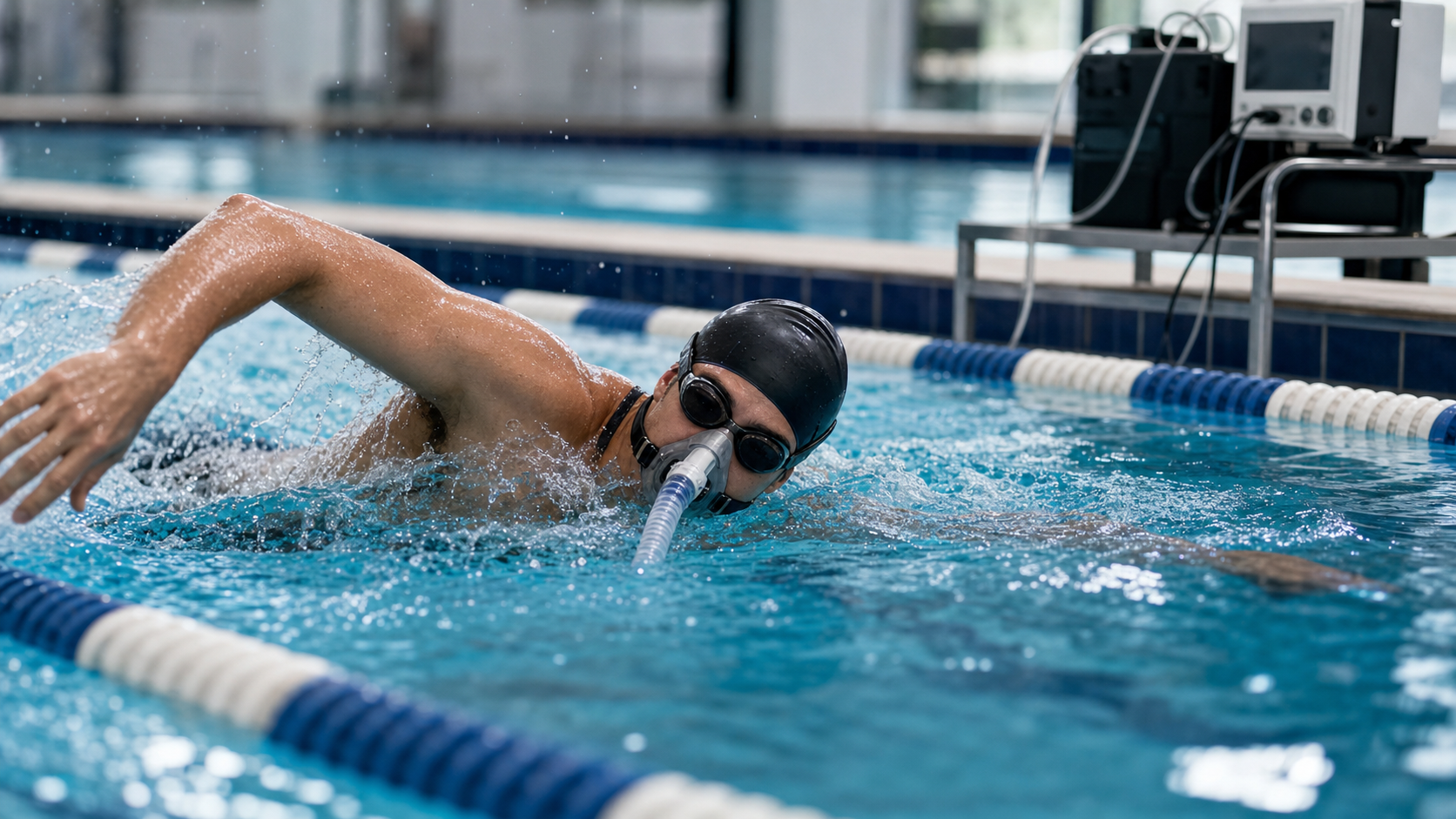
- Oxygen uptake is measured directly using a portable metabolic gas analyzer (e.g., a specially designed swimming face mask for the K4b2 Cosmed)
If gas analysis equipment is unavailable, indirect estimation can be used: extrapolating VO₂max via the linear relationship between heart rate and swimming speed, with accuracy within ±8%.
Multi-Level Factors Affecting Swimming Aerobic Capacity
Lactate Threshold Velocity (LTV)
Research shows that among elite swimmers, LTV has stronger predictive power for long-distance performance (400–1500 meters) (r = 0.82–0.87) than VO₂max. The reasons are:
- Race pace typically falls near LTV, not at the speed corresponding to VO₂max
- Improving LTV directly means aerobic metabolism can be sustained at faster speeds
- VO₂max represents “maximum engine capacity,” while LTV represents “engine efficiency”
Swimming Economy
Swimming economy refers to oxygen uptake at a given speed, analogous to “running economy” in running, and is a direct physiological indicator of technical efficiency. For two athletes with identical technique, the one with better swimming economy swims faster at the same aerobic capacity.
Research shows that elite swimmers have 20–35% better swimming economy than recreational athletes, which partially explains why recreational athletes with high VO₂max still perform far worse than elite swimmers.
The Triangular Framework of Swimming Speed
| Factor | Meaning | Predictive Power for Performance |
|---|---|---|
| VO₂max | Maximal aerobic power | Moderate (r=0.6–0.7) |
| Lactate threshold velocity | Aerobic endurance efficiency | High (r=0.82–0.87) |
| Swimming economy | Technical-metabolic conversion efficiency | High (r=0.7–0.8) |
| Strength-power | Anaerobic power | Moderate (sprint events r=0.65–0.75) |
Trainability of VO₂max
Swimming-specific VO₂max is not a fixed genetic ceiling; the extent of improvement through training varies by individual:
- Beginners to advanced athletes: 6 months of systematic training can improve it by 15–25%
- Advanced to elite: 2–5% improvement per year, primarily through VO₂max interval training
- Elite athletes: VO₂max is already near the genetic ceiling, with diminishing returns; at this stage, greater emphasis should be placed on improving LTV and swimming economy
Most Effective Training Modes for Improving Swimming VO₂max
High-Intensity Interval Training (HIIT):
- 6–10 sets × 200 meters, with 30–45 seconds rest between sets
- Intensity: at the pace corresponding to swimming VO₂max (95–100% of T-pace)
- 2 sessions per week, complemented by sufficient aerobic base volume
Practical Recommendations
- Prioritize swimming-specific lactate threshold testing: More practical than VO₂max testing; perform a monthly T-pace test (average speed of a 30-minute maximal effort swim) to track improvements in lactate threshold velocity
- Design a three-tier training structure of aerobic base-threshold-VO₂max: Use an intensity distribution of “80% low intensity + 10% lactate threshold + 10% high-intensity VO₂max” (80/10/10), which extensive research confirms yields the greatest adaptive benefits across most training phases
- Do not neglect technical training in favor of aerobic training: Even with extremely high VO₂max, swimmers with poor swimming economy cannot fully convert aerobic capacity into performance; 20–30% of weekly training volume should be technique-oriented
- Application of cross-training for aerobic maintenance: During injury, use running or cycling to maintain aerobic adaptations; although the transfer to swimming-specific VO₂max is limited (approximately 50–60%), it can significantly shorten re-adaptation time after rehabilitation
- Track “T-pace” long-term as the core indicator of training effectiveness: Rather than chasing VO₂max test numbers, regularly test best pace over 400–800 meters monthly; this indicator directly integrates the combined progress of VO₂max, LTV, and swimming economy
Conclusion
The story of VO₂max in swimming tells us that in technique-dominated sports, “how big the engine is” matters far less than “how efficient the engine is and how well the system is integrated.” Taiwanese swimmers and coaches should develop a more comprehensive concept of aerobic capacity — VO₂max is the ceiling, lactate threshold is the floor, and swimming economy is the staircase connecting the two. Only by improving all three in synergy can swimmers achieve a comprehensive breakthrough in aerobic capacity, making every meter swum faster, more efficient, and more sustainable.
Related Reading
- Swimming Aerobic Cardiopulmonary Assessment: Methods for Estimating Swimming-Specific VO2max
- Cardiopulmonary Adaptations in Swimming: Research on the Magnitude of VO2max Improvement from Regular Swimming
- Practical Applications of VO2max in Road Running: The Relationship Between Maximal Oxygen Uptake and Race Pace
- Swimming VO2max Training: Training Benefits of 50–200m High-Intensity Intervals
#公路車 #Vo2Max #最大攝氧量 測驗 體驗 | 心肺測試
6 年前
再快都跟的上!? 單車跟隨攝影機之王 HOVERAir X1 PROMAX 全面實測 / 唯一!8K畫質&自行車專用模式和跟蹤信標&前後避障 / DJI Neo 可參考/ 公路車 / CT Yeh
1 年前
live) 超越北高 之一日北高12小時 策略
7 年前
多機位拍片神器 DJI Action 2 拍出速度張力感 | 類空拍機視角 4陣列麥克風超強降風噪 實測! | 公路車 | CT Yeh
3 年前
戰略) Zwift Race 如何咬在第一集團 如何評估自己要開多少推力 (請開1.5倍速看)
7 年前
戀戀197 血脈噴張 多視角剪輯版 最艱難的市民競賽組 M30 M35 參賽記錄 請開字幕 4K高畫質 #公路車
6 年前
西進武嶺 免費訓練分析服務 Intervals | 練不夠還是練過頭?你哪一種類型選手?AI模型告訴你! | 備戰神器 | 公路車 訓練 | CT Yeh
4 年前
實景訓練台) 彰化經典百K 高強度喵團 90分鐘 跟著一起練功 2019 Indoor workout Changhua Classic 100 Taiwan
7 年前