Introduction
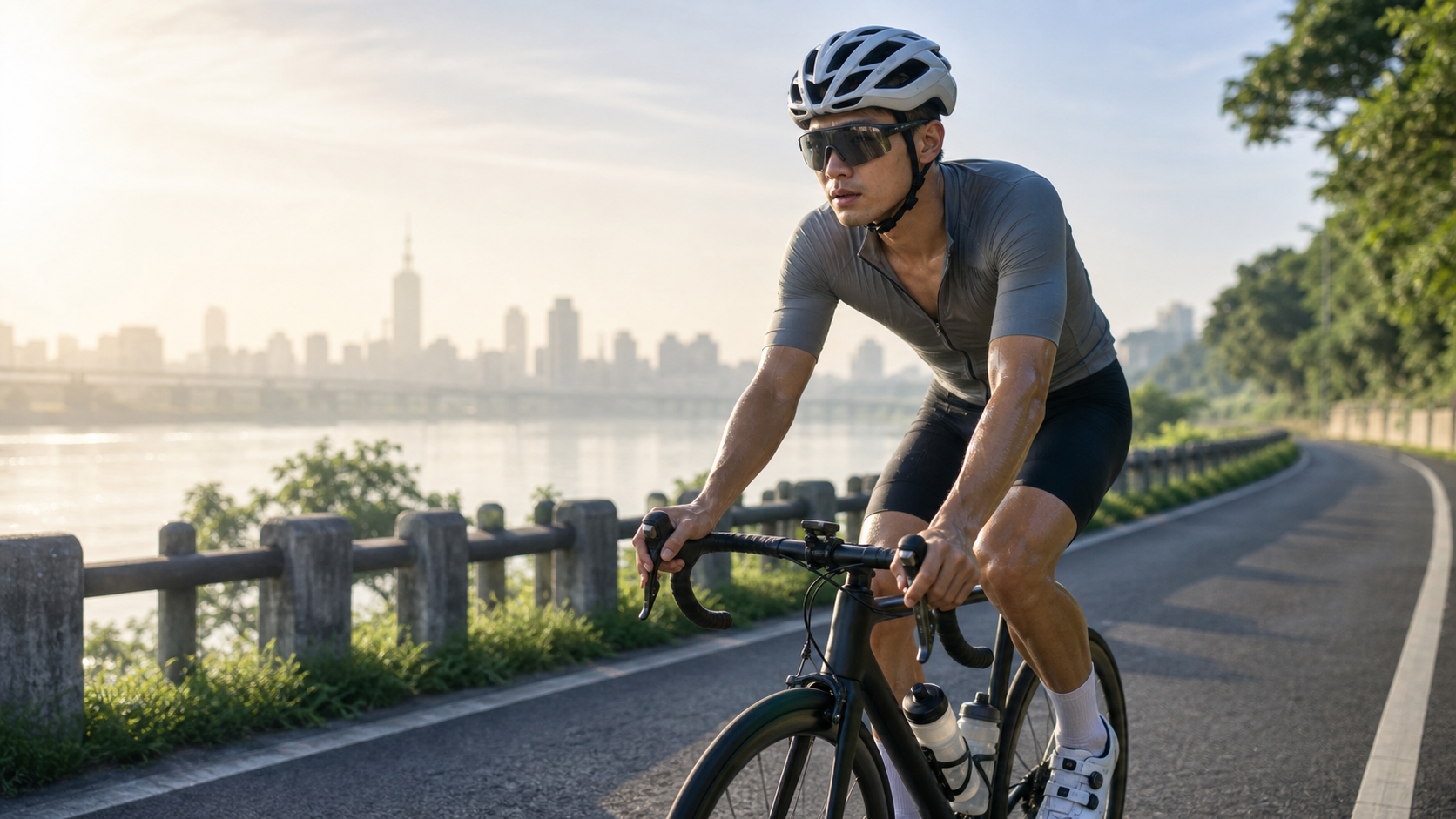
At 7 a.m. on a July morning in Taipei, the temperature has already approached 32°C, with humidity at 85%. Many cyclists choose to escape into air-conditioned rooms or postpone their training until the cooler autumn weather arrives. However, modern sports science has revealed a counterintuitive fact: heat-environment training under controlled conditions can produce physiological adaptations comparable to those of altitude training. Taiwan’s summer can actually be a training advantage, not just an obstacle.
The Impact of Hot Environments on Athletic Performance
When riding in high temperatures, the body faces a “dual competition”:
- Muscles need blood to deliver oxygen and energy
- Skin needs blood to carry away heat (thermoregulation)
With limited cardiac output, the competition between the two triggers the following responses:
| Physiological Response | Mechanism | Impact on Performance |
|---|---|---|
| Increased heart rate | Compensates for reduced stroke volume | Higher heart rate at the same power output |
| Decreased plasma volume | Heavy sweating | Reduced cardiac output |
| Elevated core temperature | Heat accumulation | Central nervous system sends fatigue signals |
| Reduced muscle blood flow | Skin blood flow takes priority | Decreased power output |
| Reduced lactate clearance rate | Muscle temperature too high | Fatigue sets in faster |
Research shows that riding in a 35°C environment results in a heart rate approximately 10–15 bpm higher than at 20°C for the same power output, with performance declining by 10–20%.
The Physiological Mechanisms of Heat Acclimatization
The body can “learn” to function more efficiently in hot environments, a process known as Heat Acclimatization.
Key Heat Acclimatization Effects
- Increased plasma volume (fastest, most important): After 5–10 days of heat training, plasma volume can increase by 10–15%, equivalent to a “natural blood expansion,” enhancing cardiac output
- Lowered sweating threshold: Sweating begins sooner, improving cooling efficiency
- Reduced electrolyte concentration in sweat: Enhanced sodium retention mechanisms, reducing electrolyte loss
- Elevated core temperature operating threshold: Fatigue signals are only triggered at higher temperatures
- Improved skin blood flow efficiency: Lower skin blood flow demand for the same cooling effect, leaving more blood for the muscles
Taiwan Summer Heat Acclimatization Training Protocol
Standard Protocol for Building Heat Acclimatization
- Duration: 10–14 consecutive days
- Training time per session: 60–90 minutes
- Intensity: Zone 2 (low-to-moderate intensity), with the focus on heat exposure rather than high-intensity training
Taiwan Summer Heat Training Options:
| Method | Characteristics | Suitable For |
|---|---|---|
| Outdoor morning ride (7–9 a.m.) | Fresh air, controllable intensity | Those accustomed to morning training |
| Outdoor midday ride (12–2 p.m.) | Maximum heat stimulus, also higher risk | Advanced riders, carrying plenty of water |
| Indoor trainer (air conditioning off) | Safest, controllable environment | Everyone, especially recommended |
| Trainer after a hot bath | Rapid temperature elevation | Those with limited time |
Indoor trainer with the air conditioning off is the safest and most controllable method of heat acclimatization: keep the room temperature at 30–35°C, perform a 60–90 minute Zone 2 workout, 3–4 times per week, for 2 weeks.
Safety Guidelines
- Replenish 200–300ml of electrolyte-containing fluids every 20–30 minutes
- Stop immediately if symptoms such as dizziness, nausea, or cessation of sweating occur
- Do not schedule high-intensity training during the heat acclimatization period, allowing the body to focus on heat adaptation
- Riders taking certain medications (diuretics, beta-blockers) should consult a physician
Practical Recommendations
- Heat acclimatization effects gradually fade within 2–3 weeks after leaving the hot environment; if you have a target race in cooler climates, there is no need to start heat training too far in advance
- Use power (watts) as the intensity metric for summer training rather than heart rate, since heart rate is naturally elevated in hot environments
- Electrolyte replenishment is crucial: sodium loss in sweat is approximately 500–1000mg per hour, and drinking plain water alone may lead to hyponatremia
- After riding in hot conditions, cold water immersion can significantly accelerate the lowering of core temperature and shorten recovery time
- If you need to race in a hot climate abroad, training in Taiwan’s summer heat for 2 weeks beforehand is itself the best heat acclimatization preparation
Conclusion
Taiwan’s summer heat is a challenge, but even more so an opportunity. By mastering the scientific principles of heat acclimatization and training in hot environments in a safe, systematic manner, you are not just fighting the weather—you are leveraging Taiwan’s climatic characteristics to build a physiological advantage for yourself. When the cool autumn racing season arrives, all those summer sweat sessions will translate into greater speed.
Related Reading
- Heat Acclimatization Training: Strategies for Improving Performance in Taiwan’s Summer Heat
- Heat Acclimatization Training: Physiological Strategies to Boost Cycling Performance in Taiwan’s Summer
- Heat Acclimatization Training for Cyclists: Improving Performance in Taiwan’s Summer Swelter
- Heat Stress and Core Temperature Management for Cyclists: The Physiological Challenges of Summer Riding in Taiwan
單車 一日北高 ( 雙城 ) 肥宅雙人瘋狂行 紀錄片 REACTO
10 年前
CT暗黑廚房) 車友必備 宇宙無敵鮮蚵湯 幫助訓練恢復 天然食補 好市多 超肥鮮蚵 破PR
7 年前
本週北高前練習,連同天比的226們也來⋯鐵車真的太猛了 #cycling #北高
2 年前
一日北高常見問題大集合 | 攻略 | 路線 | 訓練 | 補給 | 自行車 單車 | 一日雙城 | 雙塔 | TWB北高360 | 屁股痛
6 年前
2023自行車展!與環台賽選手一同表演賽 / 全自動AI Fitting?/ TIME新車發表/神秘充電桌等 精華分享 VLOG | CT Yeh | 公路車
3 年前
2019 夏季KOM 5小 完賽心得 準備攻略 東進武嶺 夏季登山王之路 Taiwan KOM Challenge
7 年前
大武山後門26%歡樂陡坡!JJSC南台灣單車行Day2 / 被颱風追著跑 / 公路車 / CT Yeh
2 年前
彰化經典百K 多視角衝刺實錄 | 范老師高鐵 NEKO's Fun Eva | 公路車
5 年前