Introduction
In Taiwan’s road running community, “VO2max” is often regarded as the gold standard indicator of a runner’s ability, but seasoned runners and exercise physiology researchers know that Running Economy (RE) is the true key factor in predicting race performance. Running economy refers to the amount of oxygen required to sustain running at a given speed—the less oxygen consumed, the more efficient and economical your body is.
If two runners have the same VO2max, the one with better running economy often finishes far ahead in a marathon. This is like two cars with the same engine but vastly different fuel efficiency due to different fuel system designs. Understanding the science of running economy is the first step toward breaking your personal best (PB).
What is Running Economy?
Running economy is typically expressed in milliliters of oxygen consumed per kilogram of body weight per kilometer (mL/kg/km). The lower the value, the higher the efficiency.
Research shows that elite East African distance runners (such as Kenyan and Ethiopian runners) dominate marathons partly because of their exceptional running economy—at the same speed, they conserve about 5–10% more energy than average runners.
| Runner Type | Typical VO2max (mL/kg/min) | Running Economy | Actual Performance |
|---|---|---|---|
| World-class marathoner | 70–80 | Excellent (low oxygen consumption) | Under 2 hours |
| Elite amateur | 60–70 | Good | 2:30–3:00 |
| Average amateur runner | 50–60 | Average | 3:30–4:30 |
| Beginner runner | 40–55 | Needs improvement | 4:30 and above |
Key Factors Affecting Running Economy
1. Biomechanics and Running Form
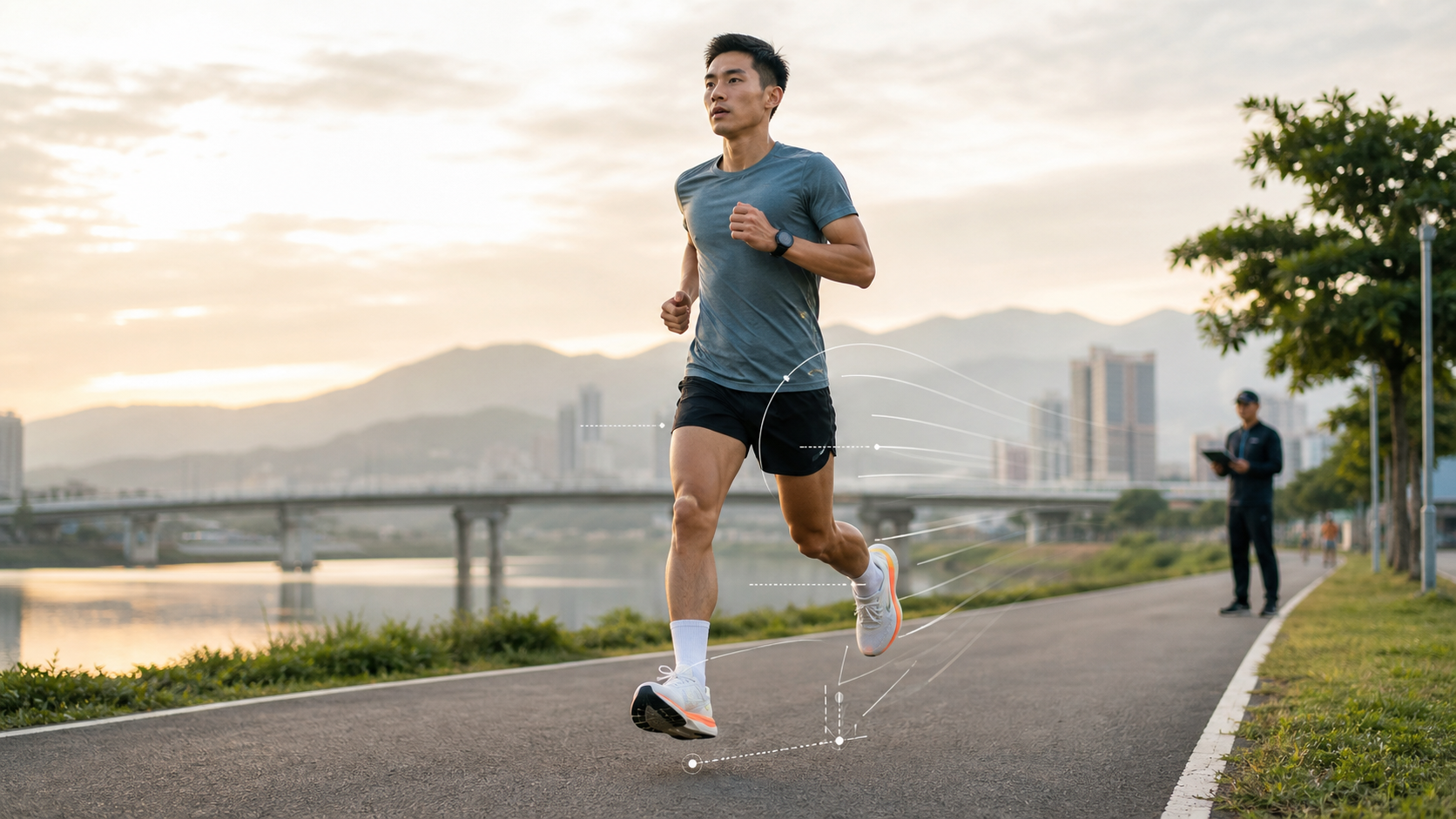
Running form has a direct impact on energy expenditure. Research highlights the following points as most critical to running economy:
- Cadence: Most studies recommend a cadence of approximately 170–180 steps per minute. A cadence that is too low is often accompanied by excessive vertical oscillation, wasting energy.
- Vertical Oscillation: The smaller the up-and-down movement of the center of mass, the higher the energy utilization. World-class runners typically have a vertical oscillation of 5–8 cm.
- Ground Contact Time: The shorter the time each foot spends in contact with the ground, the more efficient the conversion of elastic energy.
- Arm Swing: Arms should swing forward and backward rather than crossing laterally. Excessive lateral movement creates rotational torque and increases energy expenditure.
2. Storage and Release of Elastic Energy in Tendons
Running is not purely muscular effort; it is an “elastic energy cycle.” The Achilles tendon stores elastic energy when the foot strikes the ground and releases it during push-off, functioning like a spring. In well-trained runners, elastic energy from tendons can account for more than 40% of total running energy, significantly reducing the active work required from muscles.
3. Muscle Fiber Composition and Mitochondrial Density
Slow-twitch fibers (Type I Muscle Fibers) have far greater oxidative efficiency than fast-twitch fibers (Type II). Long-term endurance training increases the proportion of slow-twitch fibers and mitochondrial density, making aerobic metabolism more efficient at the same speed.
4. Body Weight and Body Composition
Every additional kilogram of body weight requires more energy at the same speed. Research estimates that for every 1% reduction in body weight, marathon performance improves by approximately 0.7%. However, this does not mean unlimited weight loss—excessively low body fat can affect hormone secretion and muscle recovery capacity.
How to Train to Improve Running Economy?
The Key Role of Strength Training
Multiple studies (including a series by Norwegian scientists) show that targeted strength training can significantly improve running economy. In particular:
- Squats and Leg Presses: Strengthen the quadriceps and gluteus maximus
- Calf Raises: Increase Achilles tendon stiffness, improving elastic energy return
- Single-leg Deadlifts: Improve landing stability and reduce energy leakage
It is recommended to perform these 2 times per week, focusing on low repetitions with high intensity (4–6 RM), with an emphasis on neuromuscular adaptation rather than muscle hypertrophy.
Hill Training
Uphill training strengthens the push-off muscles, while downhill training improves the legs’ ability to absorb impact elastically. Taiwanese runners can take advantage of terrain such as Yangmingshan and Elephant Mountain, incorporating hill training into their weekly schedule.
Tempo Runs and Marathon-Pace Runs
Long-term training near the lactate threshold improves the oxidative efficiency of slow-twitch fibers, thereby enhancing running economy. Scheduling one 30–60 minute tempo run per week (at an intensity that feels “comfortably hard”) is the most practical approach.
Practical Recommendations
Here are training strategies Taiwanese runners can apply immediately:
- Calculate your cadence: Use a metronome app on your phone set to 170–180 BPM, deliberately practice increasing your cadence, adjusting by only 5 steps per minute at a time to adapt gradually
- Mirror running: Set up a side-view video recording next to the treadmill to observe your vertical oscillation and arm swing
- Add strength training: Perform lower-body weight training 2 times per week, with particular emphasis on calf and glute strengthening
- Accumulate easy mileage: 80% of training should be in the easy zone (conversational pace), allowing slow-twitch fibers to adapt to working efficiently over long durations
- Test carbon-plated shoes: Modern carbon-plated shoes can mechanically improve running economy by approximately 2–4% and can be used on race day
Conclusion
Running economy is an indicator that can be continuously improved through training, and the results often come faster and are more pronounced than improvements in VO2max. For Taiwanese runners with a solid training foundation, shifting the focus from “running more” to “running more efficiently” is often the pivotal turning point for breaking PBs. Starting today, consider recording a video of your running to analyze your form, and add weekly strength training to your routine—your next PB may be hidden in these details.
Related Reading
#公路車 #Vo2Max #最大攝氧量 測驗 體驗 | 心肺測試
6 年前
如果Pogačar騎西進武嶺可以多快?會破2嗎?各種情況深度推估探討 / 公路車 / CT Yeh
2 年前
拍單車比賽能賺多少?一日Phomi攝影師實境測試| #公路車 | CT Yeh | 用科學分析賺錢!
3 年前
西進武嶺 免費訓練分析服務 Intervals | 練不夠還是練過頭?你哪一種類型選手?AI模型告訴你! | 備戰神器 | 公路車 訓練 | CT Yeh
4 年前
多機位拍片神器 DJI Action 2 拍出速度張力感 | 類空拍機視角 4陣列麥克風超強降風噪 實測! | 公路車 | CT Yeh
3 年前
CT 喇低賽) 單車 比賽總是沒照片? 攝影師的觀點大公開 姿勢就是力量! 請加速1.25倍收看
7 年前
戰略) Zwift Race 如何咬在第一集團 如何評估自己要開多少推力 (請開1.5倍速看)
7 年前
#公路車 #Fitting 靠人工智慧APP 幫你調整單車
6 年前