Introduction
Stepping into a swimming pool, your body immediately feels a completely different kind of resistance—water is about 800 times denser than air, and its viscosity coefficient is more than 55 times that of air. For many swimming enthusiasts in Taiwan, the answer to “why does swimming faster make me more tired” lies at the intersection of fluid mechanics and exercise physiology. This article delves into the three major components of water resistance and how streamlining technique can effectively reduce energy expenditure.
The Three Major Components of Water Resistance
Form Drag
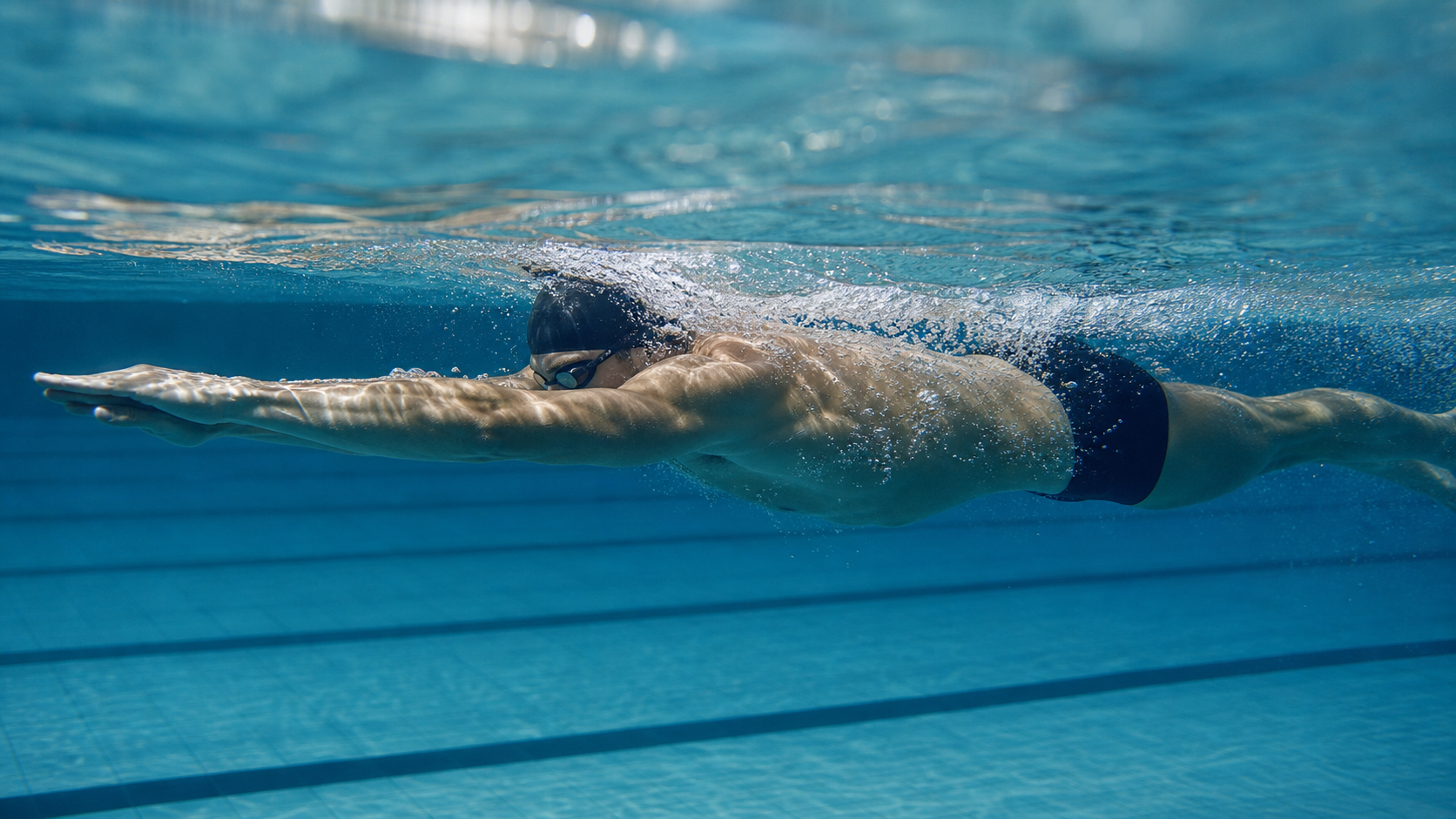
Form drag, also known as pressure drag, is the largest source of resistance in swimming, accounting for approximately 60–80% of total drag. When the body moves through water, the larger the frontal surface area, the higher the pressure differential between front and back, and the stronger the resistance. Research shows that a 10-degree body rotation can increase form drag by about 15–20%. This is precisely why coaches repeatedly emphasize “maintaining a horizontal body position”—a hip drop of just 5 cm is equivalent to strapping a resistance plate to your chest.
Skin Friction
The friction generated by water molecules adhering to the skin or swimsuit surface accounts for approximately 20–30% of total drag. The higher the velocity, the more skin friction grows—by the square of speed. This is the scientific basis for competitive swimwear using low-friction-coefficient materials such as polyurethane. At major domestic competitions in Taiwan, athletes can be seen wearing high-end racing suits, and laboratory data shows they can reduce surface friction by approximately 7–10%.
Wave Drag
When swimming at the surface, the body’s forward motion creates a bow wave that consumes significant additional energy. Wave drag rises sharply as speed approaches the “critical velocity” (Froude number ≈ 0.4), which is why elite swimmers tend to lower their head entry slightly at high speeds to reduce surface disturbance.
Biomechanical Optimization of Streamlining Technique
| Technical Element | Drag Increase from Poor Posture | Improvement Method |
|---|---|---|
| Head Position | +20–30% (head raised too high) | Ears level with upper arms |
| Hip Sinking | +15–25% (hips dropping) | Engage core, kick actively |
| Hand Entry Angle | +10–15% (entry too wide) | Thumb-first entry, shoulder-width entry |
| Stiff Ankles | +8–12% (ankles too rigid) | Increase ankle joint flexibility |
Streamlining technique is not just about “looking good”—it directly reduces frontal area at the physical level. Elite swimmers have an average underwater cross-sectional area 12–18% smaller than that of average recreational swimmers. Translated into energy expenditure, this difference can amount to an 8–12% difference in total caloric cost over a 1500-meter swim.
Propulsive Efficiency
The energy saved through streamlining technique does not disappear—it is redistributed to propulsion. Propulsive efficiency (η) can be simplified as the ratio of effective propulsive power to total mechanical power. Top athletes achieve a propulsive efficiency of about 70–80%, while beginners often reach only 40–55%, because a large amount of energy is spent fighting the turbulence they create themselves.
The Calculation Perspective of Energy Expenditure
Swimming energy expenditure (unit: kcal/km) is directly affected by the magnitude of resistance:
- Freestyle (good technique): approximately 350–450 kcal/km
- Freestyle (poor technique): approximately 500–700 kcal/km
- Breaststroke (standard): approximately 600–800 kcal/km
In Taiwan’s swimming training circles, it is often said that “breaststroke burns the most fat.” From an energy expenditure perspective, this does make sense—breaststroke inherently has greater form drag. However, from a training-effectiveness standpoint, improving freestyle technique can actually achieve higher exercise intensity and better cardiorespiratory stimulation.
Practical Recommendations
- Video Analysis: Use an underwater camera or waterproof camera to record your swimming stroke once a month, and compare it against the ideal streamlined position to correct each element.
- Streamlined Glide Drills: Before each lap, add a 10–15 meter “streamlined glide” to feel the sensation of speed at minimal resistance.
- Ankle Flexibility Training: Perform 2 sets of ankle rotation and stretching exercises daily. When standing with a kickboard, confirm that the top of your foot can extend naturally (plantar flexion angle reaching 120° or more).
- Neutral Head Position Training: Use a rear-view mirror headgear or have a coach observe from poolside to ensure your forehead stays below the water surface, with your gaze directed downward at approximately 45°.
- Focus on Technique During Easy Swim: During low-intensity swimming, deliberately focus on whether your fingers are sealed together on each stroke and whether your kick originates below the hip line.
Conclusion
Water resistance is the fundamental limiting factor in swimming performance, but it is also the aspect most worth investing in to improve. Unlike running or cycling, the energy savings from technique in swimming far outweigh the contribution of fitness gains—especially in Taiwan’s summer open-water events or triathlon races, where good streamlining technique not only saves energy but also allows you to enter subsequent disciplines in better condition. Understanding the scientific principles, combined with deliberate technical practice, is the shortest path to improving swimming efficiency.
Related Reading
- The Science of Water Resistance in Swimming: How Streamlined Posture Reduces Drag
- The Science of Water Resistance in Swimming: The Ratio of Form Drag vs. Skin Friction and Drag Reduction Strategies
- The Science of Water Resistance: Why Swimming Consumes More Oxygen Than Running
- Swimming Drag Analysis: Wave Drag, Skin Friction, and Form Drag
3D 列印車褲墊 / 舒適改善? / 無痕 x 分區壓縮 / ATK & Decider系列 / JE22黑科技 / #公路車 #CTYEH
11 個月前
一日北高前的西濱集訓 | 跟著11小時軍團 | 300W踩不動的大逆風 | 輪車破風差幾瓦?
6 年前
2023桃園團體繞圈賽 / 海鷗繞圈賽 | 全程空拍數據版 | 公路車 | CT Yeh
2 年前
西進武嶺 8000名單車友數據分析 PART1 | 從新手到高手數量/瓦數/推力比/FTP推力比/功率計使用率 大解析 | 公路車 | CTYeh
5 年前
一日北高/長距離團騎 常見問題補充篇 / 組團或跟團的眉角 / 壯車友容易被瘦車友慢性拉爆 / 原來屁股痛可能是這個原因...? / 風場配速法 / 公路車 / CT Yeh
2 年前
西進武嶺 免費訓練分析服務 Intervals | 練不夠還是練過頭?你哪一種類型選手?AI模型告訴你! | 備戰神器 | 公路車 訓練 | CT Yeh
4 年前
一起升級!海鷗盃LSD團練...JJSC Zone2招待 騎到手抖 / 公路車 / CT Yeh
1 天前
水金九不厭五分 10度寒流冷到不願停!feat. 卡卡 / 公路車 / CT Yeh
6 個月前