Introduction
Anyone who trains in swimming knows that “butterfly is the most exhausting,” but do you know why? The answer isn’t just “the stroke is the hardest”—it’s also that butterfly, at a given speed, relies far more heavily on the anaerobic glycolytic system than freestyle at the same pace. Understanding the energy system characteristics of each stroke is the foundation for designing a scientific training plan—and it’s the key knowledge you need to maintain technical quality even when fatigued.
Review of the Three Energy Systems
The human body simultaneously uses three energy supply systems during exercise, with the ratio dynamically adjusting based on intensity and duration:
| Energy System | Primary Fuel | Duration | Characteristics |
|---|---|---|---|
| Phosphocreatine System (ATP-PCr) | Phosphocreatine | 0–10 seconds | Highest explosive power, no lactate |
| Glycolytic System (Anaerobic Glycolysis) | Muscle glycogen | 10–120 seconds | Rapid energy supply, produces lactate |
| Aerobic Oxidation System | Glycogen + Fat | 2 minutes and above | High efficiency, sustainable energy supply |
What makes swimming unique is that water resistance keeps relative speed far lower than running on land, yet the muscle contraction patterns—particularly the powerful pulling action of the stroke—can still massively recruit fast-twitch muscle fibers in a short period, causing lactate production rates that often exceed those of running training at the same heart rate.
Energy System Analysis by Stroke
Freestyle (Freestyle / Crawl)
Freestyle is the most energy-efficient stroke, with the lowest energy expenditure per unit distance among the four competitive strokes. This is attributed to:
- Body roll allows the left and right latissimus dorsi to work alternately, preventing any single muscle group from fatiguing too quickly
- The kick provides approximately 10–15% of propulsion, with the rest carried by the arms (butterfly is approximately 20–25%)
- Breathing timing can be flexibly arranged without forcibly disrupting stroke rhythm
Estimated energy sources for elite 100-meter freestyle swimmers (approximately 47 seconds): phosphocreatine system approximately 40%, anaerobic glycolysis approximately 35%, aerobic system approximately 25%.
Butterfly
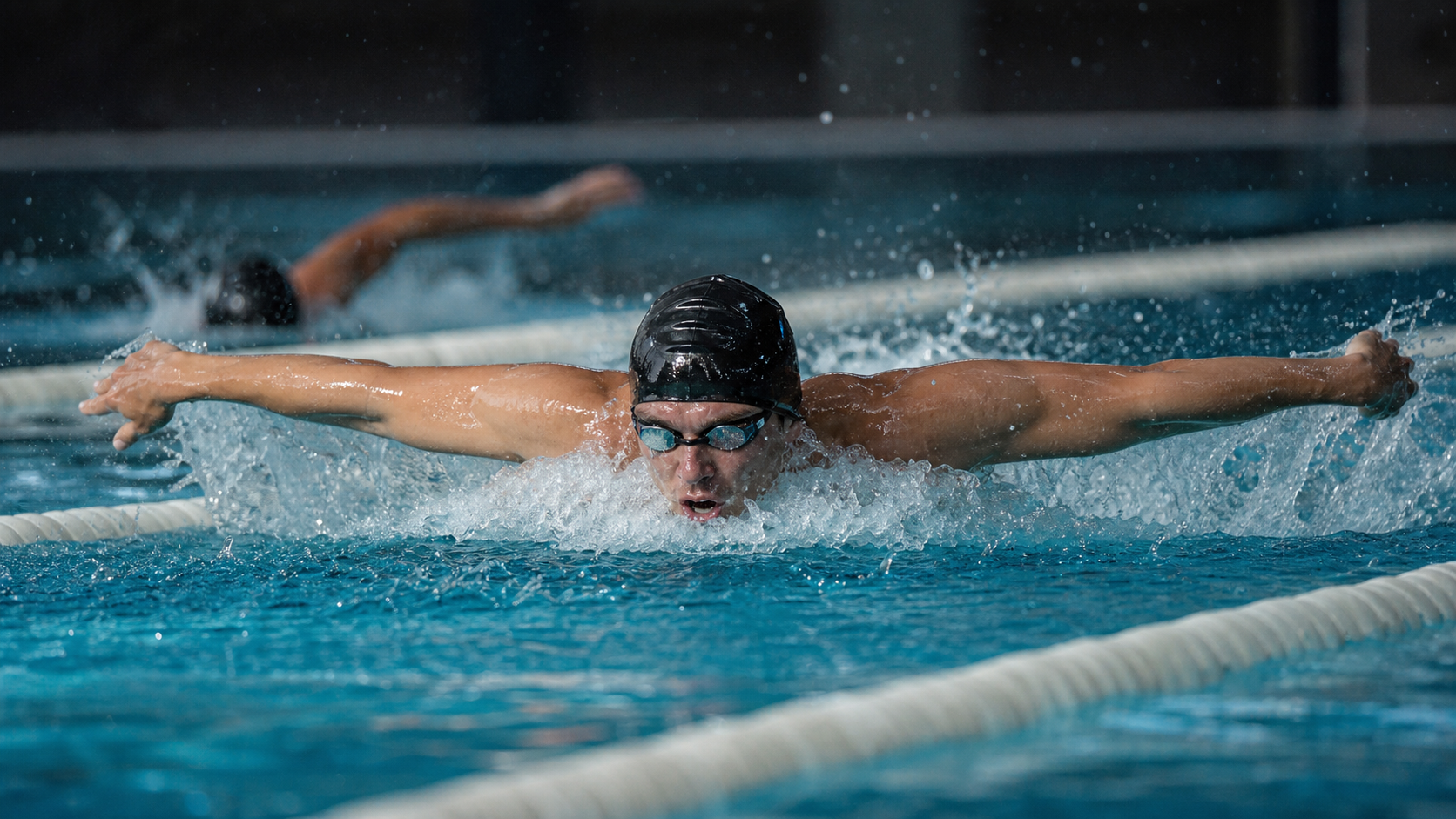
Butterfly has the highest reliance on the anaerobic glycolytic system among the four strokes. The simultaneous arm pull requires the pectoralis major and latissimus dorsi to produce high power output in every cycle. Research shows that at submaximal intensity (approximately 85% of maximum speed), blood lactate concentrations in butterfly are approximately 25–35% higher than in freestyle. Taiwanese swimmers training butterfly should pay special attention to:
- Technical breakdown often occurs after blood lactate exceeds 6–8 mmol/L
- The 200-meter butterfly is one of the events with the highest lactate tolerance demands
Breaststroke
The most distinctive feature of breaststroke is the “glide phase” within each stroke cycle, during which the muscles get a brief rest and the aerobic system takes over energy supply. Therefore, although breaststroke has the greatest overall drag, peak lactate concentrations are not as extreme as in butterfly. For long-distance breaststroke swimmers (400 meters and above), aerobic capacity is often more critical than explosive power.
Backstroke
Backstroke’s energy characteristics are the closest to freestyle, with the main difference being that the supine position limits maximum breathing capacity (abdominal muscles are affected by water pressure), slightly restricting aerobic energy supply at high intensities, resulting in overall performance slightly below freestyle.
Application of Lactate Threshold in Swimming Training
Lactate Threshold (LT) is a core indicator in aerobic training. The speed corresponding to LT in swimming is typically expressed as the “Critical Swimming Velocity” (CSV), calculated as follows:
CSV = (D₂ - D₁) ÷ (T₂ - T₁)
Where D₁ and D₂ are two distances, and T₁ and T₂ are the corresponding times (typically using best times for 200 meters and 400 meters).
Swimming near CSV (approximately 85–90% of maximum speed) is the most effective intensity for improving aerobic capacity. The “T-pace training” commonly used by Taiwanese coaches is essentially deliberate training targeting CSV.
Practical Recommendations
- Combine different strokes in training: Arrange “breaststroke recovery laps + butterfly/freestyle main sets” within a single session, using the breaststroke glide phase to reduce overall lactate accumulation.
- Time trials to establish personal baselines: Conduct 200-meter and 400-meter time trials each season to calculate your personal CSV as a basis for training pace.
- 48-hour recovery after high-lactate training: After high-intensity butterfly training, schedule aerobic easy swimming (<70% CSV) or rest the following day to avoid chronic fatigue accumulation.
- Beware the mistake of “switching to freestyle when fatigued from butterfly”: Swimming freestyle under high blood lactate still carries the fatigued neural patterns, which is detrimental to technical consolidation.
- Lactate clearance and active recovery: Add 50–100 meters of low-intensity easy swimming between training sets (rather than complete rest), which helps accelerate lactate metabolism.
Conclusion
Swimming is not just a competition of “swimming fast”—it is an art of precise energy system management. Different strokes rely on the three energy systems in vastly different proportions, and understanding these differences allows training plans to be not just “swimming a lot,” but “swimming smart.” For Taiwanese swimmers, triathletes, or fitness swimmers, integrating energy system knowledge into daily training decisions is the key step from working hard to training intelligently.
Related Reading
- Energy Systems in Swimming: Metabolic Characteristics of Different Distance Events
- Energy Metabolism in Swimming: The Ratio of Aerobic and Anaerobic Systems at Different Intensities
- Swimming Energy System Training: The Ratio of Phosphagen, Lactate, and Aerobic Systems
- The Lactate System in Swimming: Anaerobic Energy Metabolism in Short-Distance Sprinting
西進武嶺 免費訓練分析服務 Intervals | 練不夠還是練過頭?你哪一種類型選手?AI模型告訴你! | 備戰神器 | 公路車 訓練 | CT Yeh
4 年前
靠單車減肥35公斤 心得分享與整理
7 年前
CT暗黑廚房) 車友必備 宇宙無敵鮮蚵湯 幫助訓練恢復 天然食補 好市多 超肥鮮蚵 破PR
7 年前
Insta360/DJI做不到的!如何製作「騎士頭頂瓦數特效」單車影片?CycleDash 完整教學 / 超強批次影片數據疊加軟體
14 天前
RAMP FTP Test 直播 究竟能撐到幾瓦 訓練台 Gravat Zwift
6 年前
戰略) Zwift Race 如何咬在第一集團 如何評估自己要開多少推力 (請開1.5倍速看)
7 年前
福隆鐵人團練隨拍
8 年前
單車AI教練!全新 ChatGPT4o 幫你分析訓練成果!排武嶺課表,分析騎車姿勢! 太神了! / 公路車 / CT Yeh / feat. 緯緯
2 年前