Introduction
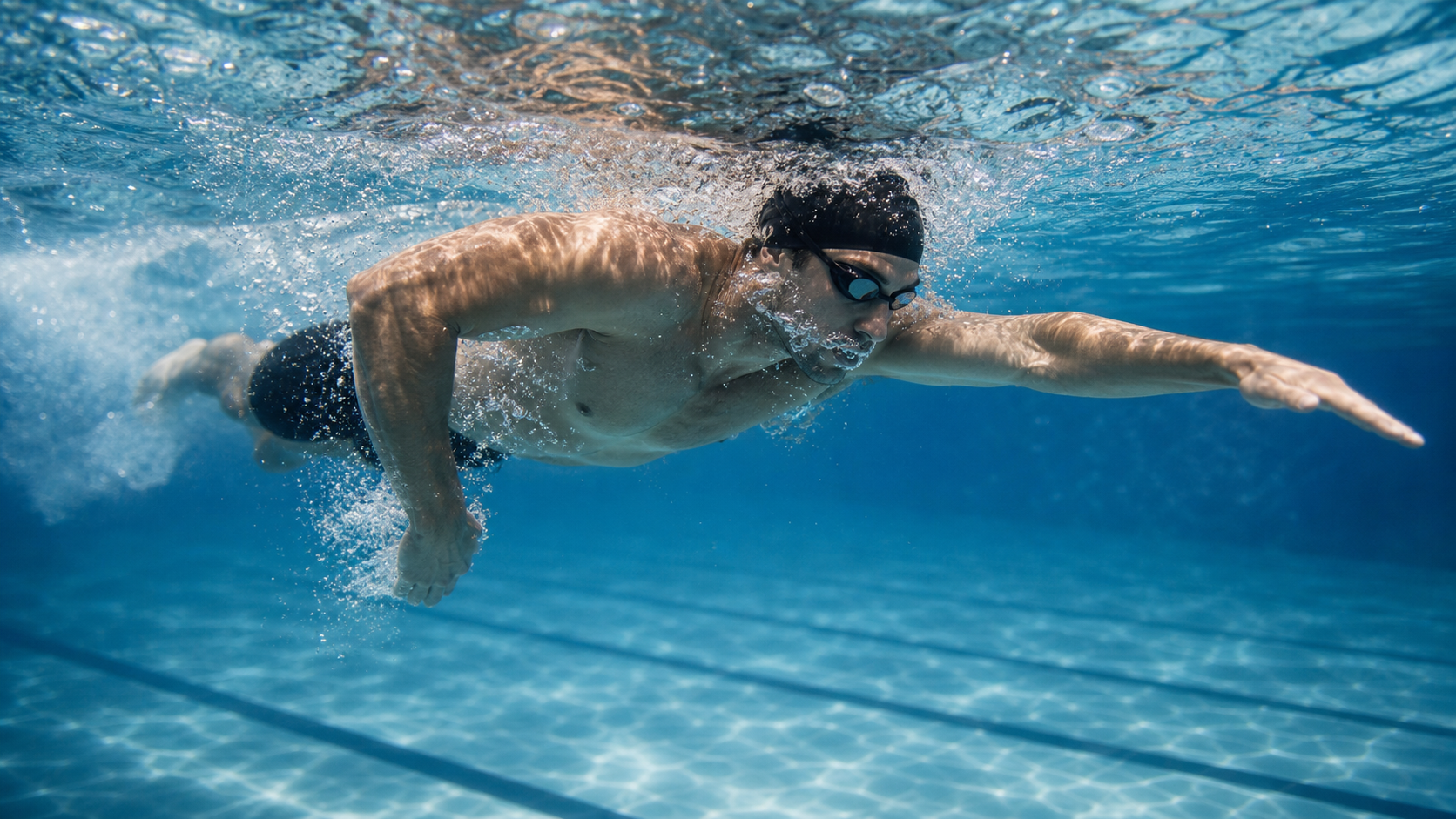
“Just stroke faster and you’ll be quicker, right?” This is the intuition of many beginners, but elite swimmers tell us the exact opposite—Olympic 100m freestyle gold medalists often have a stroke rate of only 50–55 strokes per minute, while amateur swimmers desperately “churn the water” yet can’t sustain it for 45 seconds. The key difference lies in the disparity of “Distance Per Stroke” (DPS). This article delves into the biomechanical core of freestyle technique from three perspectives: shoulder joint dynamics, hand path, and body roll.
Core Metrics of Stroke Efficiency
Swimming speed can be broken down into the following formula:
Speed (m/s) = Stroke Rate (cycles/s) × Distance Per Stroke (m/cycle)
There are two ways to increase speed: increase stroke rate or increase DPS. Research shows that the most common “ceiling” for beginner and intermediate swimmers is insufficient DPS, not inadequate stroke rate. Elite swimmers can achieve a DPS of 2.0–2.5 meters per stroke, while beginners often only manage 1.2–1.5 meters per stroke.
| Swimming Ability Level | Typical DPS (m/stroke) | Typical Stroke Rate (strokes/min) |
|---|---|---|
| Beginner | 1.0–1.4 | 65–80 |
| Intermediate | 1.5–1.8 | 55–65 |
| Advanced | 1.9–2.2 | 48–58 |
| Elite Athlete | 2.2–2.6 | 45–56 |
Biomechanics of the High Elbow Catch
The high elbow catch (also known as the vertical forearm technique) is the core innovation of modern freestyle, rooted in the “airfoil lift theory” of fluid dynamics:
- Forearm vertical after entry: After the arm extends, the wrist actively presses down, bringing the forearm perpendicular to the water surface as quickly as possible (the “catch” action). At this point, the forearm area is maximized, creating the largest propulsive surface.
- Elbow maintained high: During the pull phase, the elbow joint remains higher than the wrist at all times, preventing the shoulder from “cutting” downward too early and ensuring the forearm continuously applies force to the water.
- Accelerating pull: In the latter half of the propulsive phase (Propulsive Phase II), the forearm and upper arm rapidly push backward, with hand speed accelerating from the relatively slower catch speed to maximum speed. This “acceleration pattern” generates higher peak propulsion than a constant-speed pull throughout.
Research indicates that the high elbow catch can improve propulsive efficiency by approximately 12–18% compared to the traditional “S-shaped pull,” with even more pronounced effects in long-distance swimming.
Mechanical Function of Body Roll
Body roll is not merely an aesthetic movement; it serves clear biomechanical functions:
- Extends stroke length: When the body rolls to the right side, the right arm can reach 8–12 cm further forward, effectively adding more propulsive distance to each stroke.
- Engages large muscle groups: The rolling motion brings the latissimus dorsi (the body’s largest propulsive muscle group) into the pull phase, which is 30–40% more efficient than relying purely on the smaller shoulder muscles.
- Reduces shoulder joint stress: Body roll allows the arm to move in a near-sagittal plane, reducing the risk of shoulder impingement—the most common chronic injury in Taiwan’s swimming training injury statistics.
The ideal body roll angle varies by individual; research suggests a range of approximately 40–50 degrees (measured from the front). Too much increases lateral drag, while too little forfeits the advantages of rolling.
Kicking Technique and Propulsive Contribution
Kicking contributes approximately 10–15% of propulsion in freestyle (up to 20% in sprint distances), with its primary functions being:
- Maintaining body position: Prevents the hips from sinking, reducing form drag.
- Coordinating stroke rhythm: The six-beat kick enhances the rhythm of body roll and suits sprint swimmers; distance swimmers typically adopt a two-beat kick to conserve energy.
The key to effective kicking is “driving from the hips,” rather than the knee-bending “bicycle pedal” style of kicking. Research shows that incorrect kicking not only produces poor propulsion but also increases drag due to the larger cross-sectional area of the legs.
Practical Recommendations
- Daily DPS counting drill: Choose a 25-meter lane, count the number of strokes per lap, aim to “complete the distance with the fewest strokes,” and challenge yourself to reduce by 1 stroke each week.
- High elbow catch training aid: When practicing with hand paddles, deliberately focus on the sensation of the full forearm engaging the water. Add 4×50 meters of high elbow drills to each session.
- Side-angle video analysis: Have someone film from the poolside or underwater from a side angle to confirm the elbow remains higher than the wrist at all times—this is the most commonly overlooked technical flaw.
- Body roll awareness training: One-arm drill is the best exercise for feeling body roll; deliberately sense the rise, fall, and rotation of the shoulders before each stroke.
- Kickboard leg training: Add 400–600 meters of kickboard training twice a week, ensuring the ankles are fully extended so the kick is powered from the hips.
Conclusion
Optimizing the biomechanics of freestyle technique is a long-term investment, but the returns are substantial: speed gains from technical improvement are often more significant and more durable than equal time spent on fitness training. Swimming enthusiasts in Taiwan, from fitness swimmers to competitive athletes, can all benefit from understanding the scientific principles of “stroke efficiency.” Remember, swimming “effortlessly” yet “fast” is the ultimate outcome of streamlined technique and efficient stroking working together.
Related Reading
- Research Review: Optimization of Distance Per Stroke (DPS) and Stroke Rate for Long-Distance Freestyle Efficiency—Frontiers in Sports Physiology Research Progress (Article 1134)
- Research Review: Optimization of Distance Per Stroke (DPS) and Stroke Rate for Long-Distance Freestyle Efficiency—Biomechanical Quantification Experiment Report (Article 102)
- Research Review: Optimization of Distance Per Stroke (DPS) and Stroke Rate for Long-Distance Freestyle Efficiency—Frontiers in Sports Physiology Research Progress (Article 603)
- Research Review: Optimization of Distance Per Stroke (DPS) and Stroke Rate for Long-Distance Freestyle Efficiency—Frontiers in Sports Physiology Research Progress (Article 519)
西進武嶺 免費訓練分析服務 Intervals | 練不夠還是練過頭?你哪一種類型選手?AI模型告訴你! | 備戰神器 | 公路車 訓練 | CT Yeh
4 年前
風櫃嘴 衝刺慢動作回放!
8 年前
CT 喇低賽) 武嶺牽車 才是王道 西進牽車四小時內秘訣 攝手位置 如何判斷 防抽筋小秘訣
7 年前
一起升級!海鷗盃LSD團練...JJSC Zone2招待 騎到手抖 / 公路車 / CT Yeh
2 天前
Live) 備戰2019彰化經典百K 賽前攻略 (已完賽請看新影片
7 年前
西進武嶺 自製新版AI配速表產生器 x 賽前攻略 抱佛腳! 沒有功率計也可以產生配速表嗎?有什麼其他眉角賽前要注意的呢? | 西進武嶺 / 東進武嶺 KOM 攻略 | 公路車 | CT Yeh
4 年前
教學) 如何做出專業 慢動作 影片 Slow Motion 120fps GoPro 7 ActionCam AX700 A99II
7 年前
3D 列印車褲墊 / 舒適改善? / 無痕 x 分區壓縮 / ATK & Decider系列 / JE22黑科技 / #公路車 #CTYEH
11 個月前