Introduction
In competitive swimming, the start, though lasting only a few seconds of the race, is a critical phase that determines race tempo and establishes a psychological advantage. The time difference in the start phase between elite and amateur swimmers often reaches 0.2–0.5 seconds. In short-distance events like the 50m freestyle, this gap is nearly equivalent to half a body length. For Taiwanese swimmers preparing for the National High School Athletic Games, University Sports Competitions, or international meets, systematically improving start technique can significantly enhance performance without additional aerobic expenditure.
The Physiological Mechanisms of Block Reaction Time
What is Reaction Time
Reaction Time (RT) refers to the interval between the starting gun (or buzzer) sounding and the swimmer’s feet completely leaving the block. FINA (now World Aquatics) rules stipulate that a start under 0.1 seconds is considered a false start, so swimmers must optimize their launch within a 0.10–0.25 second window.
Research indicates that the average reaction time of elite short-distance swimmers falls between 0.65–0.72 seconds (including neural transmission + muscle contraction + block departure time), while world-class swimmers have consistently achieved times within 0.60 seconds.
Factors Affecting Reaction Time
| Factor | Description | Trainability |
|---|---|---|
| Neural transmission speed | Sound stimulus → brain → spinal cord → muscle | Low (primarily innate) |
| Concentration level | Whether focus is locked onto the signal before the race | High |
| Crouch ready position | Level of muscle pre-tension | High |
| Sound frequency adaptation | Anticipatory response to the starting gun | Moderate |
| Fatigue state | Sleep deprivation or overtraining | Manageable |
Training Recommendations
- Pre-tension Training: In the crouch ready position, consciously maintain mild contraction (approximately 20–30% of maximum voluntary contraction) in the quadriceps and glutes to reduce the delay of muscles starting from zero.
- Sound Sensitivity Training: Use a training starting system or mobile app to simulate starting signals at different volumes, avoiding the cognitive delay when switching from “waiting mode” to “reaction mode.”
- Dry-land Training: Use box jumps, seated vertical jumps, and other exercises on land to enhance the efficiency of the rapid stretch-shortening cycle (SSC).
Flight Trajectory and Horizontal Velocity
The Physical Model of the Start
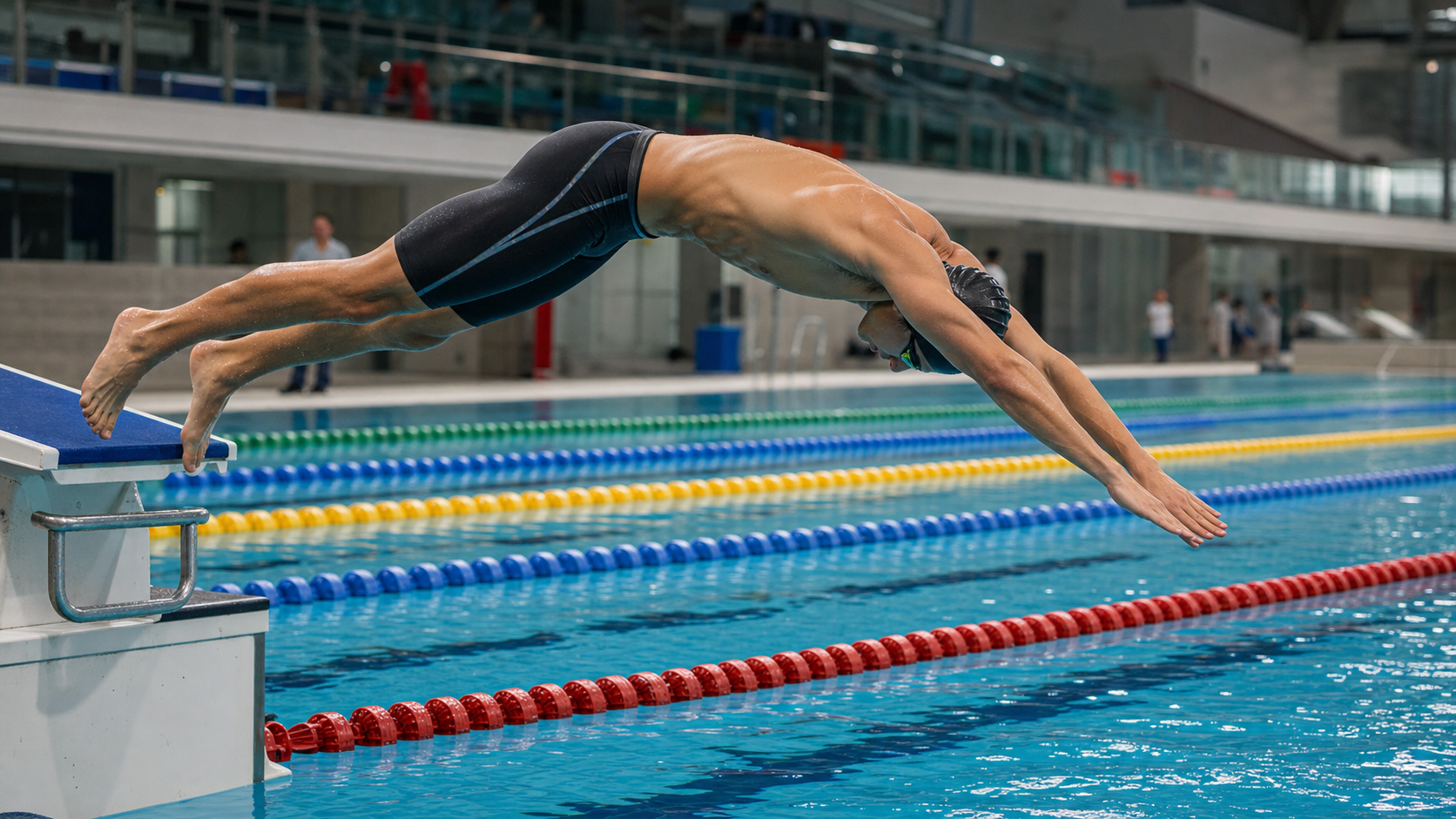
After leaving the block, the swimmer’s body becomes a projectile, with the entry point determined by both gravity and initial velocity. The ratio of horizontal to vertical velocity at takeoff determines the flight angle and entry distance.
Research shows that the optimal horizontal velocity is approximately 4.5–5.0 m/s (based on world-class 50m swimmers), while excessively pursuing a high flight arc actually sacrifices horizontal momentum, resulting in insufficient glide speed after entry.
Modern Grab Start vs. Track Start
- Grab Start: Both hands grip the front edge of the block, using upper body pulling force to assist the takeoff. Suitable for short-distance sprinters; demands relatively higher reaction time.
- Track Start (Bullet Start): One foot forward, one foot back, similar to a track and field start, with more direct leg drive. More common among distance swimmers or taller athletes.
Taiwanese coaches recommend: Beginners should first master the track start, then attempt the grab start to find the optimal style once core stability and lower limb explosive power reach adequate levels.
Optimizing Entry Angle
Ideal Entry Angle
An entry angle that is too steep (>40°) causes the chest and abdomen to slap the water surface, dissipating kinetic energy; an angle that is too shallow (<25°) results in insufficient glide depth, forcing the swimmer to begin stroking prematurely and losing the advantage of drag-free gliding. Research recommends an optimal entry angle of 30–38°. After entering the water, the body should maintain a streamlined position, with arms pressed against the ears, legs together, and toes pointed.
Gliding After Entry
Because water resistance is far lower than air resistance, swimmers should theoretically extend the underwater phase as long as possible. World Aquatics rules require the swimmer’s head to break the surface before the 15-meter mark, so maximizing speed retention within those 15 meters is a core challenge.
| Strategy | Description |
|---|---|
| Tight streamline | Hands stacked, elbows locked, abdomen pulled in to reduce form drag |
| Dolphin kick rhythm | 2–4 dolphin kicks after entry to accelerate, then transition to normal stroking |
| Timely surfacing | Surface immediately when speed drops below stroking speed to avoid ineffective gliding |
Practical Recommendations
- Video Analysis: Set up a side camera during training to review takeoff angle, flight arc, and entry posture in slow motion. Conduct a systematic review at least once a month.
- Reaction Time Logging: Use a starting block with timing capabilities (such as the training version of the Omega timing system) to track average reaction time weekly, aiming to progressively reduce RT to within 0.68 seconds.
- Core Strengthening: Maintaining streamline after entry requires strong core stability. Incorporate progressive plank variations (dynamic planks, TRX suspension) into the dry-land training program.
- Race Simulation: Include the full start sequence in regular training sessions to familiarize the nervous system with the complete movement pattern.
Conclusion
The swimming start is the convergence point of technique, power, and psychology. When preparing for high-intensity competitions, Taiwanese swimmers should not treat start training as an add-on but rather as a core competitive skill equally important as stroke technique. Through scientific biomechanical analysis, systematic dry-land supplementary training, and continuous video feedback, swimmers can achieve breakthrough improvements in the start phase without increasing training volume.
Related Reading
- Analysis of Swim Start Reaction Time: The Critical Impact of Block Technique on Performance
- Swim Start Technique: Details and Improvements for the Grab Start
- Starting Block Takeoff Technique: Reaction Time Comparison Between Track Start and Grab Start
- Explosive Swim Starts: Improving Start Performance Through Block Power Training
Live) 備戰2019彰化經典百K 賽前攻略 (已完賽請看新影片
7 年前
滑雪新手們慘摔學習全紀錄(請開字幕),滑雪好好玩 | Snowboard + Ski | 岩原 スキー場 | 滑雪APP使用 | GoPro Max
6 年前
CT 喇低賽) 武嶺牽車 才是王道 西進牽車四小時內秘訣 攝手位置 如何判斷 防抽筋小秘訣
7 年前
2024 彰化經典百K 參賽直播 / 黃亭茵集團 / 公路車 / CT Yeh
2 年前
西進武嶺 免費訓練分析服務 Intervals | 練不夠還是練過頭?你哪一種類型選手?AI模型告訴你! | 備戰神器 | 公路車 訓練 | CT Yeh
4 年前
戰略) Zwift Race 如何咬在第一集團 如何評估自己要開多少推力 (請開1.5倍速看)
7 年前
實景訓練台) 彰化經典百K 高強度喵團 90分鐘 跟著一起練功 2019 Indoor workout Changhua Classic 100 Taiwan
7 年前
備戰 戀戀197 賽前關門點分析 西濱團練 #公路車 4K高畫質
6 年前