The Science of Butterfly's Wave Motion: A Guide to Hip-Driven Technique and Rhythmic Coordination Training
Introduction
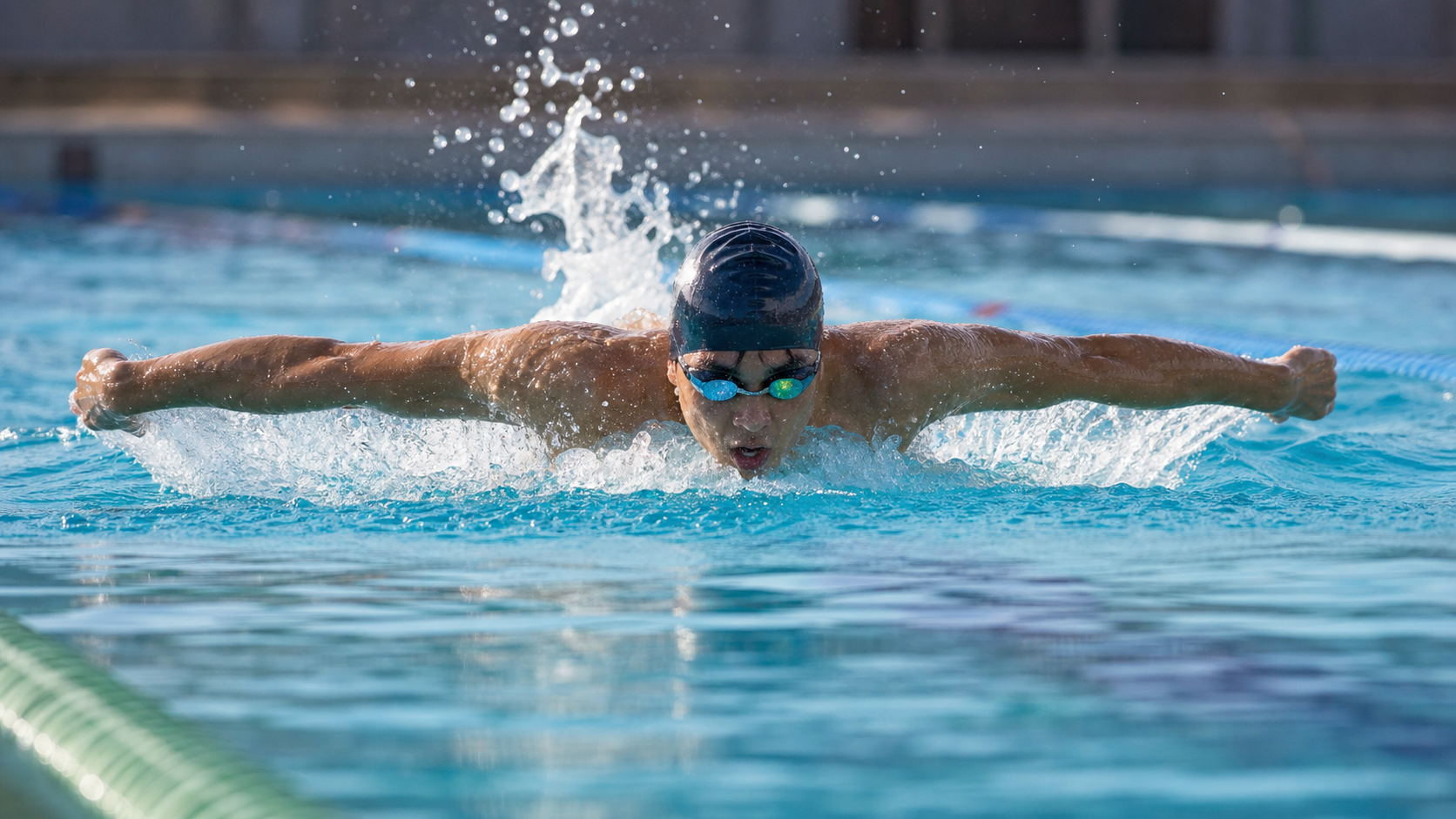
The Butterfly Stroke is widely recognized as the most technically demanding and physically exhausting of the four competitive strokes. Many swimmers, when first learning, feel like they are “fighting the water with every stroke” due to uncoordinated movements, leading to doubled fatigue. However, swimmers who truly master the essence of butterfly often describe it as “riding the waves”—the entire body moves in unison, and water resistance is transformed into propulsion. This fundamental difference comes from the correct use of hip-driven movement and precise whole-body rhythm coordination.
The Wave Dynamics of Butterfly
The Physical Nature of the Body Wave
The undulation of the butterfly stroke is not produced solely by the arms or legs, but rather a Kinetic Chain that transmits energy sequentially from the top of the head, through the chest and hips, down to the toes. In a correct butterfly wave, each body segment transfers energy in sequence:
- Head enters the water (pressing down) → drives the upper chest downward
- Chest presses down → hips naturally rise
- Hips drive downward → thighs lead the lower legs and ankles in a downward kick (first kick)
- Hands enter and extend to the furthest point → hips reach their highest point, preparing for the second kick
- Push phase completes and arms exit the water → coordinated with the powerful second kick for propulsion
| Kinetic Chain Segment | Function | Common Error |
|---|---|---|
| Head | Initiates the wave, controls rhythm | Lifting the head too high breaks the wave |
| Chest | Transfers energy to the hips | Excessive downward pressing creates drag |
| Hips | The “engine” of the wave | Rigid hips fail to drive the lower body |
| Knees | Transmit kicking power | Excessive bending (similar to pedaling a bicycle) |
| Ankles | Final thrust output | Stiff ankles result in lost propulsion |
The “Double-Peak” Hip Drive
Each butterfly arm cycle features a “2-Beat Kick”:
- First kick (entry kick): As both arms enter the water, the hips rise while the feet kick downward, maintaining body balance and assisting forward propulsion.
- Second kick (exit kick): As the push phase nears completion, a more powerful second kick coincides with the peak thrust of the arm push, creating a compound propulsive effect.
Research indicates that world-class butterfly swimmers generate approximately 1.5–2.0 times more thrust from the second kick than the first, making it the key to maximizing stroke efficiency.
Rhythm Coordination Training Methods
Why Rhythm Matters More Than Strength
Many swimmers new to butterfly attempt to swim with “brute force,” which leads to rapid fatigue without any improvement in speed. The essence of rhythm is allowing the body to transfer energy through the water with minimal resistance and maximum efficiency. When rhythm is correct, the same power input produces greater forward speed.
Suggested Training Progression
Phase 1: Dolphin Kick Awareness Training
- With both arms extended forward, perform a full-body Dolphin Kick slowly for 25 meters, feeling the coordination between hip undulation and ankle movement.
- Goal: Feel the sensation of “hips leading, legs following,” rather than the legs moving on their own.
Phase 2: Single-Arm Butterfly
- Keep one arm extended forward while the other performs the butterfly arm stroke, paired with a 2-beat kick.
- This drill helps you perceive the timing between arm entry and kick coordination while reducing movement complexity.
Phase 3: 3-Kick Butterfly
- Add a third kick to each arm cycle (2-1 rhythm), forcing the swimmer to extend the underwater glide and feel the streamlined body position in the water.
Phase 4: Full Butterfly Rhythm Sets
- 4 × 50 meters, focusing on one technical point per repeat (head press timing, hip rise amplitude, second kick explosiveness, overall wave consistency).
Common Problem Troubleshooting
| Problem Observed | Cause Analysis | Correction Method |
|---|---|---|
| Exhausted before swimming 25 meters | Incorrect rhythm, excessive drag | Return to dolphin kick breakdown drills |
| Body “bouncing” in place | Excessive hip displacement, loss of horizontal speed | Reduce hip vertical amplitude, emphasize horizontal thrust |
| Lifting head too high to breathe | Excessive neck extension | Expose only the mouth when inhaling, gaze at the water surface straight ahead |
| Difficulty recovering arms out of the water | Entry point too wide or insufficient shoulder flexibility | Ensure entry point is shoulder-width, increase shoulder stretching |
Practical Recommendations
- Schedule dedicated butterfly sessions weekly: Aim for at least 1–2 butterfly-focused training sessions per week, keeping total volume between 1000–1500 meters to avoid practicing incorrect movements while fatigued.
- Incorporate resistance band training: On land, use resistance bands to simulate the butterfly arm stroke, strengthening the rotator cuff and latissimus dorsi—an effective supplementary method for improving pull thrust.
- Use a small pull buoy: Large kickboards rely too heavily on buoyancy and neglect hip movement. It is recommended to use a small pull buoy or none at all, allowing the butterfly leg action to be practiced in a more natural state.
- Record side-view videos of yourself: The butterfly wave motion is clearest when viewed from the side of the pool. Have someone film you from the observation window or alongside the lane, and compare against standard technique videos to identify differences.
Conclusion
The beauty and efficiency of butterfly stem from whole-body rhythm consistency, and the core of this consistency is the hip-driven wave kinetic chain. For Taiwanese swimmers learning or improving their butterfly, the focus should be on “feeling the rhythm” rather than “chasing speed.” When the wave motion becomes natural and fluid, speed and endurance will improve on their own. Progressive, stage-by-stage training combined with scientific video analysis is the best path for Taiwanese swimmers to break through butterfly technique plateaus.
Related Reading
- The Wave Motion of Butterfly: Coordination Training for Hip Drive and Arm Synchronization
- Butterfly Wave Motion: Coordination Training for Chest and Hip Rise and Fall
- Excessive Lower Back Arch in Butterfly: Corrective Drills for Insufficient Hip Drive
- Butterfly Entry and Exit Rhythm: Balancing Streamline and Propulsion
[教學] Dashware 教學 如何製作有 速度 功率 心律的 騎車影片 Guages Video
8 年前
[教學] Premiere 影片 手震 修正 教學 防抖 單眼 影像 GoPro 穩定 Video Stabilization
8 年前
一起升級!海鷗盃LSD團練...JJSC Zone2招待 騎到手抖 / 公路車 / CT Yeh
2 天前
2025 海鷗團體繞圈賽 網路直播 超激烈裁判長視角 / EIPC 李廷威、Waypoint 等眾多高手競爭 / feat. 卡密兒主持 / 海鷗繞圈賽
9 個月前
西進武嶺 免費訓練分析服務 Intervals | 練不夠還是練過頭?你哪一種類型選手?AI模型告訴你! | 備戰神器 | 公路車 訓練 | CT Yeh
4 年前
CT 喇低賽) 武嶺牽車 才是王道 西進牽車四小時內秘訣 攝手位置 如何判斷 防抽筋小秘訣
7 年前
2023桃園團體繞圈賽 / 海鷗繞圈賽 | 全程空拍數據版 | 公路車 | CT Yeh
2 年前
Nepest NOVA 碳條輪組:輕量、空力、舒適一次滿足!/ 公路車 / CT Yeh
7 個月前