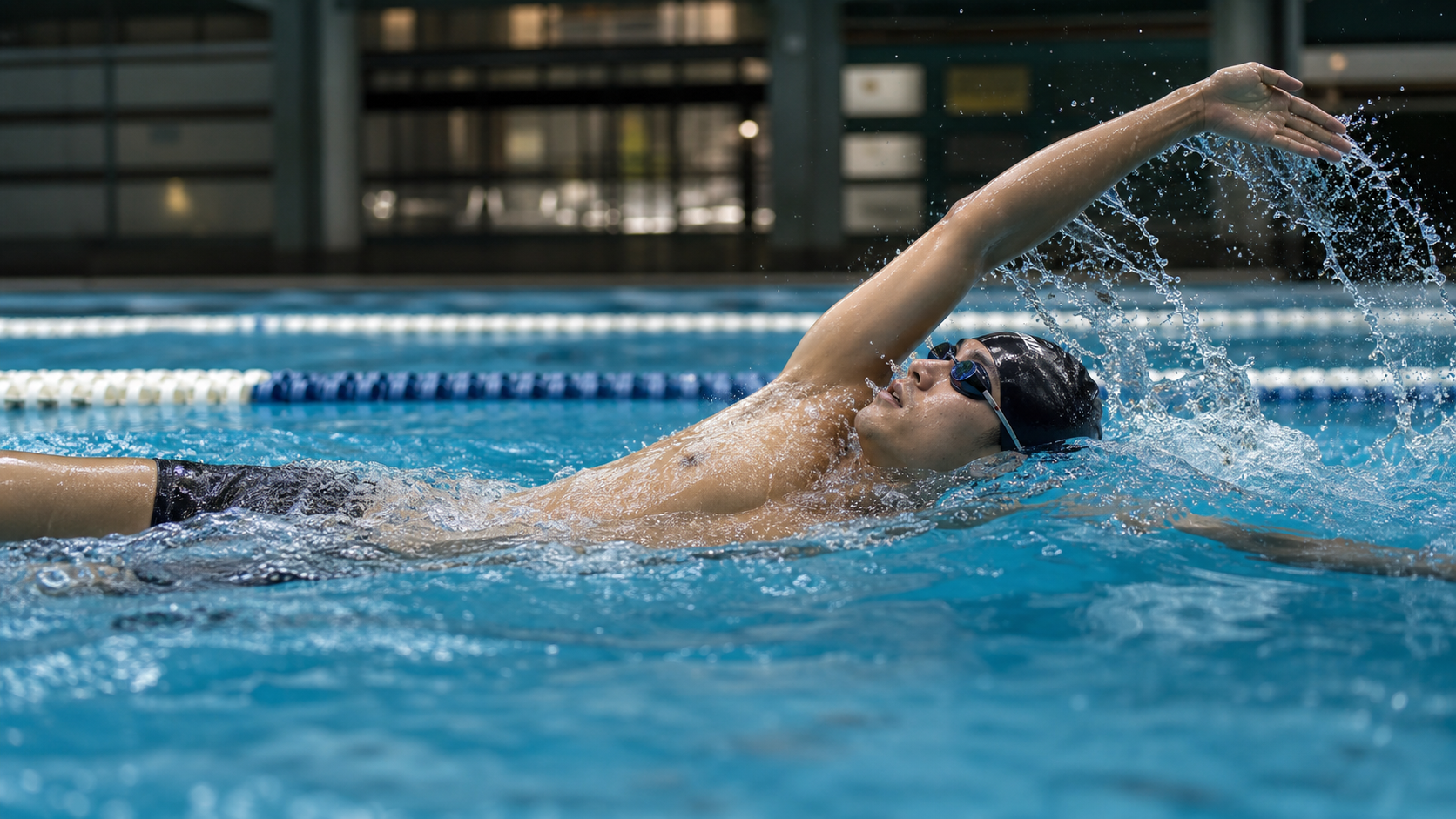
Introduction
Backstroke is the only one of the four competitive swimming strokes performed face-up. Swimmers must execute starts, turns, and sprints without seeing the bottom of the pool or the finish wall, which inherently demands exceptional spatial awareness. Additionally, backstroke shares many technical similarities with freestyle, but the inverted body position creates unique technical challenges—especially the control of the rotation axis, which is the most critical variable affecting stroke efficiency.
Mechanical Analysis of the Backstroke Rotation Axis
The Necessity of Body Rotation
Elite backstroke swimmers typically rotate their bodies 40–60° (with the midline as the zero point, rotating to each side). The functions of rotation include:
- Increasing stroke length: Torso rotation extends the reach of the stroke, effectively increasing distance per stroke.
- Allowing the arm to exit the water naturally: Rotation lifts the shoulder above the water surface, reducing drag during the recovery and lowering the risk of shoulder injury.
- Facilitating alternating arm movements: While one arm is pulling, the entry of the other arm is assisted by body rotation, creating continuous propulsion.
Position of the Rotation Axis
The rotation axis in backstroke should be a longitudinal midline running from the top of the head to the heels, like a rotational shaft passing through the center of the body. A common technical flaw is an offset rotation axis—swimmers rotating from the waist rather than the entire torso, causing the legs to deviate from the forward direction and increasing lateral drag.
| Rotation Quality | Body Characteristics | Common Consequences |
|---|---|---|
| Correct axis | Head-neck-shoulders-hips rotate in a straight line | Efficient stroke, low drag |
| Axis offset at waist | Upper body rotates, legs do not follow | Legs drift, snake-like swimming path |
| Insufficient rotation | Shoulders nearly parallel to water surface | Difficulty with arm recovery, high risk of shoulder injury |
| Excessive rotation | Body exceeds 70° | Loss of speed, difficulty maintaining rhythm |
Technical Details of Stroke Efficiency
Choosing the Entry Point
The hand entry point in backstroke should be in the direction of the shoulder line extension (approximately the 11 o’clock and 1 o’clock positions on a clock face), rather than directly overhead. An entry point too wide causes the stroke path to curve, while an entry point too narrow (such as crossing the midline) can lead to loss of body roll control.
The Catch and Pull Phases
Similar to freestyle, the catch phase in backstroke requires the forearm to be positioned vertically as quickly as possible to create an effective pulling surface. In the final phase of the pull: as the arm pushes past the thigh, accelerate the exit motion to quickly bring the arm over the water surface and back to the entry position, maintaining a high stroke rate.
Kicking Coordination
The flutter kick rhythm in backstroke should follow a 6-beat pattern (six kicks per stroke cycle). Each kick is driven from the hips, with a slight knee bend, using the ankles as the terminal point for generating propulsion. Kicking amplitude that is too large (exceeding 30 cm) increases water resistance, while too small an amplitude results in insufficient propulsion.
Unique Technical Challenges in Backstroke
Developing Spatial Awareness
Because swimmers cannot see ahead, backstroke swimmers rely on several cues to maintain a straight course:
- Ceiling light rows: Standard swimming pools in Taiwan (such as New Taipei City Tamsui Swimming Pool and NTU Indoor Pool) typically have ceiling lights aligned along the lane direction, which can serve as directional references.
- Flag distance perception: Backstroke flags are positioned 5 meters from the finish wall. Swimmers should build muscle memory during training for “how many strokes are needed after seeing the flags to reach the wall,” typically 3–5 strokes.
The Uniqueness of the Backstroke Start
The backstroke start is a “crouching in-water” jumping start that requires powerful lower-body explosiveness and core stability. The underwater backstroke dolphin kick after entry is a significant recent technical development; elite swimmers can maintain high-speed gliding with full-speed dolphin kicks within the regulated 15-meter limit.
Training Recommendations
| Training Focus | Training Method | Recommended Volume |
|---|---|---|
| Rotation axis control | Single-arm backstroke + axis awareness | 4×50m |
| Kicking efficiency | Timed backstroke kick (with board) | 8×25m |
| Stroke entry point | Use paddle aids to feel the position | 4×50m |
| Flag turn stroke counting | Deliberately count strokes each lap | Throughout the session |
Practical Advice
- Verify your entry point every session: Ask a coach to observe your hand entry angle from poolside, or use video recording to confirm you are entering at the correct “11 o’clock, 1 o’clock” position.
- Improve shoulder joint flexibility: The frequent recovery motion in backstroke places significant strain on the shoulder rotator cuff muscles. Ten minutes of shoulder joint stretching before and after each session is essential for injury prevention.
- Build the flag-counting habit: Starting from today’s training, deliberately count your strokes every time you approach the finish wall until it becomes an automatic response.
- Incorporate underwater dolphin kick training: If your goal is to improve competitive performance, dedicate at least two sessions per week to underwater dolphin kick efficiency, with an initial goal of completing 15 meters with quality technique.
Conclusion
Improving backstroke technique requires swimmers to overcome the instinctual discomfort of “not being able to see ahead” and to develop precise control over body rotation, spatial awareness, and stroke rhythm. When preparing for backstroke events, Taiwanese swimmers should prioritize rotation axis control as the foremost technical goal—when the axis is correct, all other technical details will naturally fall into place. Through systematic breakdown training and data tracking, backstroke can become a powerful weapon in your medley events.
Related Reading
- Backstroke Pulling Rhythm and Shoulder Rotation: The Overlooked Efficiency Code
- Backstroke Scapular Rotation Principles: Find Your Body Axis to Stop Swimming Snake-Like
- Backstroke Technique Improvement: Optimizing Body Roll and Hand Entry Angle
- Core of Backstroke Technique: The Triangular Relationship Between Body Roll, Straight-Arm Entry, and Steady Kicking
CT 喇低賽) 武嶺牽車 才是王道 西進牽車四小時內秘訣 攝手位置 如何判斷 防抽筋小秘訣
7 年前
Insta 360 One 超級防手震技術實測
7 年前
類空拍神器 Feiyu Pocket 2s (有優惠連結)三軸穩定 運動攝影機 開箱!比GoPro 還強的滑順視角!三小時長時間錄影 行車記錄器 | 環花東365實測 | 公路車 CT Yeh
4 年前
西進武嶺 自製新版AI配速表產生器 x 賽前攻略 抱佛腳! 沒有功率計也可以產生配速表嗎?有什麼其他眉角賽前要注意的呢? | 西進武嶺 / 東進武嶺 KOM 攻略 | 公路車 | CT Yeh
4 年前
抖肩舞 台灣x日本交流版 (台灣 vs 前橋) 赤城山登山賽 coincidance
8 年前
如何把 GoPro 影片 翻轉 批次 轉正?
6 年前
一起升級!海鷗盃LSD團練...JJSC Zone2招待 騎到手抖 / 公路車 / CT Yeh
1 天前
[教學] Premiere 影片 手震 修正 教學 防抖 單眼 影像 GoPro 穩定 Video Stabilization
8 年前