Introduction
In road running injury statistics, ankle sprains consistently rank near the top, especially on Taiwan’s trail courses or uneven surfaces. However, what more runners overlook is that ankle strength and flexibility directly affect running propulsion efficiency. A strong, flexible ankle not only prevents sprains but also enhances the push-off force of every stride, allowing you to run faster and more efficiently.
The ankle’s complex anatomical structure—comprising multiple ligaments, tendons, and two joint surfaces—makes it both robust and vulnerable. It is strong enough to withstand impact forces of 3–5 times body weight, yet fragile in that it requires precise neuromuscular control to maintain stability. This article will take a scientific approach to comprehensively strengthen this critical area.
Ankle Anatomy and Function in Running
The ankle joint plays multiple roles during running:
- Shock absorption: Absorbs 30–40% of impact force upon landing (the remainder is shared by the knees and hips)
- Energy storage: The Achilles Tendon is the body’s largest tendon, capable of storing and releasing substantial elastic energy
- Propulsion: The triceps surae (soleus + gastrocnemius) are the most important muscle group during the push-off phase of road running
- Stability: Maintains balance on uneven terrain, preventing ankle eversion (inversion sprains)
Common ankle weakness analysis:
| Problem | Cause | Impact |
|---|---|---|
| Ankle Instability | Ligament laxity or poor neuromuscular control | Recurrent sprains, energy leakage |
| Tight Achilles Tendon | Overly tight calf muscles, lack of eccentric training | Achilles tendinitis, plantar fasciitis |
| Limited Ankle Dorsiflexion | Tight gastrocnemius or restricted joint mobility | Knee forward-shift compensation, difficulty squatting |
| Weak Peroneal Muscles | Lack of lateral stability training | Significantly increased risk of inversion sprains |
Ankle Stability Training
Proprioception Training
Proprioception is the first line of defense against sprains, training the brain to rapidly receive and respond to ankle position signals:
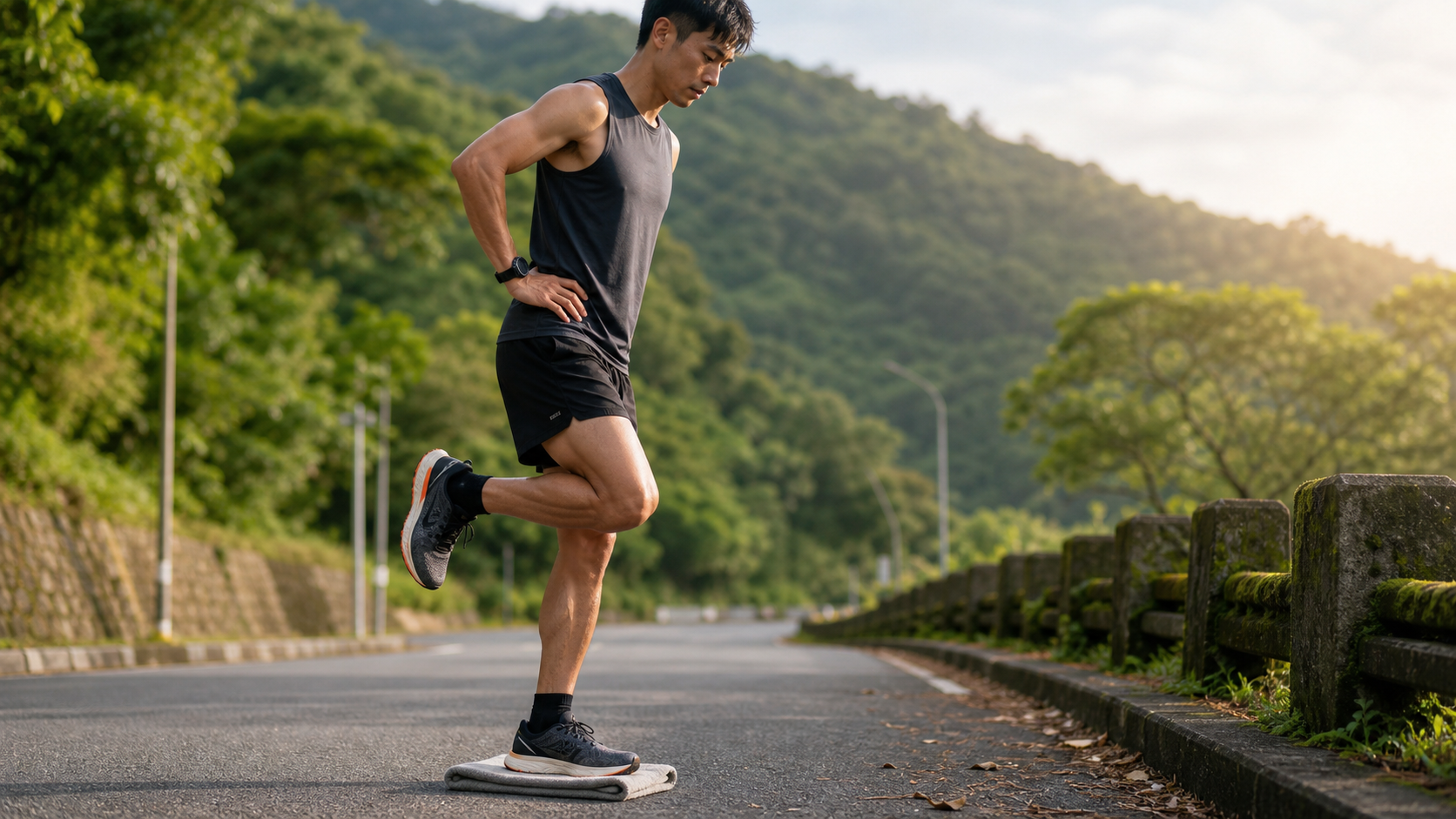
- Single-leg stance: Eyes open → eyes closed → on an unstable surface (BOSU ball/folded towel), hold 30–60 seconds per side, 3 sets
- Single-leg stance with ball catch: A partner tosses you a ball; maintain single-leg balance while catching it, training stability under perturbation
- Balance Board Training: Perform single- and double-leg balance on a wobble board or roller, ideal as a 5-minute activation before each run
Peroneal Muscle Strengthening
The peroneal muscles are the key muscle group for preventing inversion ankle sprains:
- Band Eversion: Seated, loop a resistance band around the forefoot, push outward against resistance, 3 sets × 15 reps/side
- Multi-directional band ankle training: Standing, loop a band around the ankle, perform dorsiflexion, plantarflexion, inversion, and eversion in four directions, 15 reps each
- Lateral band walking: Loop a band around the ankles, walk sideways 20 steps and back, strengthening lateral ankle stability
Calf Muscle Strengthening: The Core of Propulsion
The Science of Calf Raise Training
Double-leg calf raise (basic version):
- Stand on the edge of a step with the balls of your feet hanging off
- Lower slowly to the bottom (3-second eccentric), hold at the bottom for 1 second
- Rise quickly to the top (1-second concentric)
- 3 sets × 15–20 reps
Single-leg calf raise (advanced version):
- Same movement, but performed on one leg, strengthening asymmetrical ankle strength
- This is the functional exercise closest to the single-leg push-off in running
- 3 sets × 8–12 reps/side, gradually progressing to holding dumbbells
Bent Knee Calf Raise:
- Seated or standing with knees slightly bent, targeting the soleus (deep calf muscle)
- The soleus is the most important sustained-output muscle group for marathon runners
- 3 sets × 20 reps
Eccentric Training for the Achilles Tendon
Eccentric calf lowering is the gold-standard exercise for treating and preventing Achilles tendinopathy:
- Stand on a step with both feet, rise up on both toes to the top
- Switch to one leg, lower slowly over 3–5 seconds
- 3 sets × 15 reps daily for 12 weeks
- Clinical research indicates that sustained eccentric training produces significant improvements in chronic Achilles tendinitis
Ankle Mobility Training
Insufficient dorsiflexion range of motion is one of the primary causes of compensatory knee injuries:
- Wall Ankle Mobilization: In a lunge facing a wall, drive the front knee forward to touch the wall while keeping the heel flat, 20 reps per side
- Calf foam rolling: Foam roll the calves before running to release myofascial restrictions
- Clock Exercise: Standing on one leg, slowly move the toes toward the 12, 3, 6, and 9 o’clock positions, strengthening multi-directional ankle control
Practical Recommendations
- 5-minute ankle activation before every run: 20 calf raises + 10 ankle rotations/side + 30-second single-leg stance/side
- Boost proprioception before trail running: In the week leading up to a planned trail run, increase the frequency of unstable-surface training
- Active rehabilitation after a sprain: Ice for 48 hours after a mild sprain to reduce swelling; begin proprioception training from day 3 onward
- Don’t ignore side-to-side imbalances: If your dominant leg (push-off leg) is noticeably weaker than the other, add targeted single-leg training
- Consider barefoot running: Once a week, run barefoot lightly on grass for 10–15 minutes to strengthen the arch and ankle proprioception
Conclusion
Ankle strengthening often only gets attention after a sprain, but prevention is far more valuable than treatment. Investing 10–15 minutes per week in targeted ankle training not only dramatically reduces sprain risk but also, through stronger calf push-off power and better elastic tendon energy storage, lets you run faster, more steadily, and with greater endurance on Taiwan’s mountain roads and marathon courses.
Related Reading
- Ankle Sprains in Road Running: Acute Management and Rehabilitation Training Plan
- Running Rehabilitation After Ankle Sprains: Four Stages of Proprioception Training and a Safe Return-to-Running Protocol
- Sprains Caused by Running Form Deviations: A Complete Guide to Ankle Stability Training
- Calf and Ankle Strengthening for Runners: Preventing Achilles Tendon Issues
大禹嶺 到 武嶺牌樓 全程前後實況錄影 | 北進武嶺 | 東進武嶺 | KOM | 訓練台 | 坡度分析 | Taiwan KOM Last 10 km HARD | 公路車
6 年前
西進武嶺 免費訓練分析服務 Intervals | 練不夠還是練過頭?你哪一種類型選手?AI模型告訴你! | 備戰神器 | 公路車 訓練 | CT Yeh
4 年前
CT 喇低賽) 武嶺牽車 才是王道 西進牽車四小時內秘訣 攝手位置 如何判斷 防抽筋小秘訣
7 年前
Never Stop 西進武嶺 前後雙機 完整全程錄影 訓練台 實境
8 年前
一日北高/長距離團騎 常見問題補充篇 / 組團或跟團的眉角 / 壯車友容易被瘦車友慢性拉爆 / 原來屁股痛可能是這個原因...? / 風場配速法 / 公路車 / CT Yeh
2 年前
[教學] Premiere 影片 手震 修正 教學 防抖 單眼 影像 GoPro 穩定 Video Stabilization
8 年前
iPhone內建一秒變長腿🤣 車友必備#cycling
2 年前
再一組! 全碳幅條 碟煞/無內胎輪組 開箱! 到底好騎嗎? UNAAS X40 | 公路車 | CT Yeh
4 年前