The Science of Carbon-Plated Running Shoes: An In-Depth Analysis of Energy Return and Running Economy
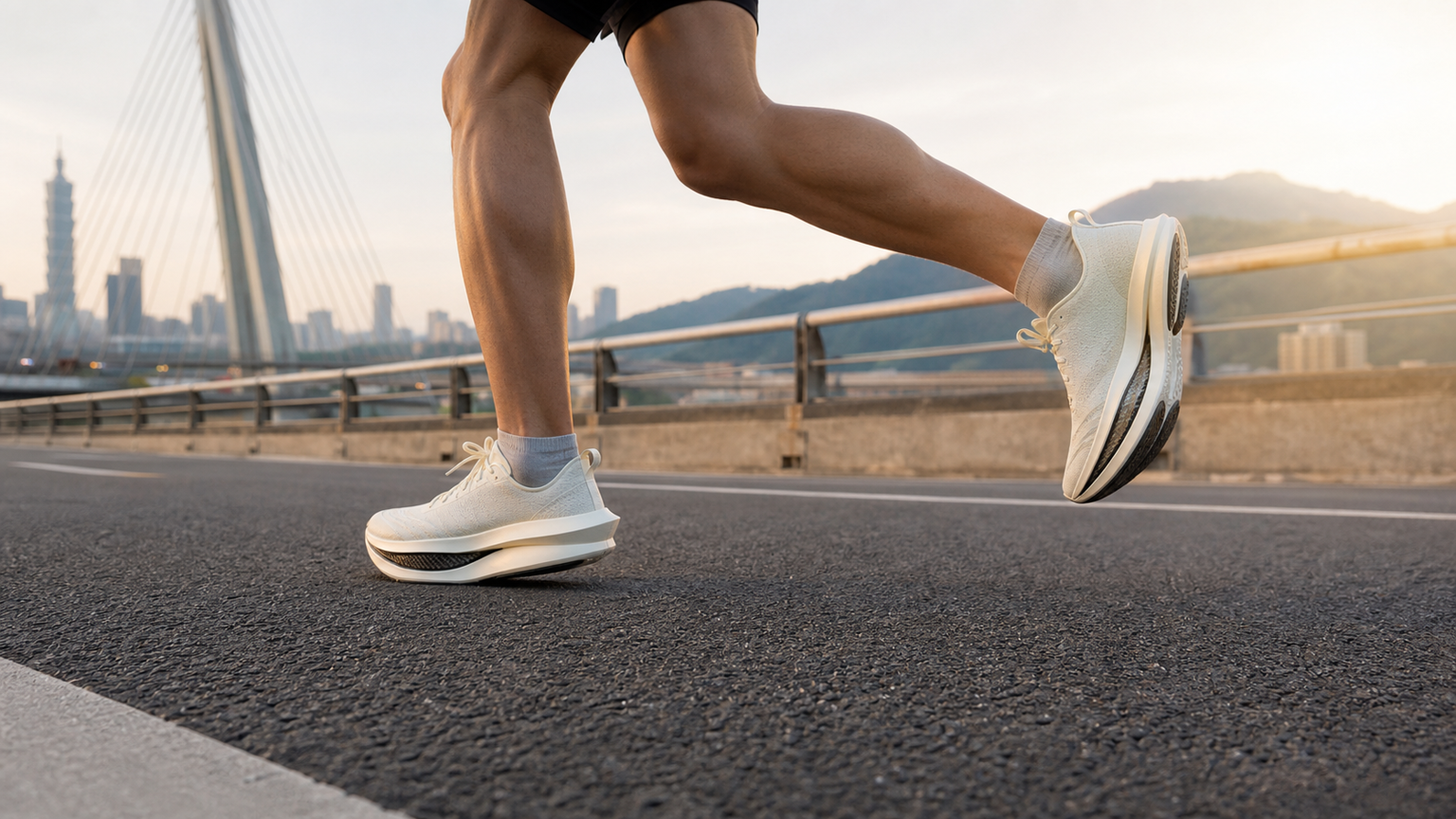
Introduction
When Nike unveiled the Vaporfly series in 2016, it sparked a revolution in the road running world. In the years that followed, brands such as Adidas, ASICS, New Balance, and Hoka successively launched their own carbon-plated running shoes. At the starting lines of the Taipei Marathon, Fubon Marathon, and Wan Jin Shi Marathon, pink, orange, and white “super shoes” are everywhere among Taiwanese runners. But what exactly is the science behind carbon-plated running shoes? Can they truly make every runner faster and more efficient?
The Mechanical Principles of the Carbon Fiber Plate
The core mechanism of carbon-plated running shoes comes from two synergistic systems: the carbon fiber plate embedded in the midsole, and the highly resilient foam encasing it (typically PEBA-based).
The carbon fiber plate itself possesses extremely high longitudinal stiffness, storing and releasing elastic energy at the moment of push-off. When the foot lands and body weight is applied to the forefoot, the carbon plate flexes slightly, converting a portion of mechanical energy into elastic potential energy; during the toe-off phase, the plate rebounds, returning the stored energy to the runner, creating what is known as the “catapult effect.”
Biomechanical research shows that a highly rigid metatarsophalangeal joint reduces wasteful energy expenditure in the toe flexors. In normal running, the human foot’s metatarsophalangeal joint performs negative work with every step—absorbing rather than generating energy. By spanning across this joint, the carbon plate effectively “bypasses” this point of energy loss.
Scientific Validation of Running Economy
Running Economy (RE) refers to the amount of oxygen a runner consumes at a given speed; the lower the value, the more efficient the runner. Multiple studies published in the British Journal of Sports Medicine and the Journal of Applied Physiology indicate that shoes equipped with carbon plates and PEBA foam can improve running economy by approximately 4–8%.
| Shoe Type | Running Economy Improvement | Target Population |
|---|---|---|
| Traditional EVA Cushioned Shoes | Baseline | Daily Training |
| Thick-Soled PEBA Without Carbon Plate | Approximately +2–3% | Beginner to Intermediate |
| Carbon Plate + PEBA System | Approximately +4–8% | Intermediate to Elite |
| Dual Carbon Plate Design | No Definitive Conclusion | Experimental |
It is worth noting that this improvement is not uniform for everyone. Research shows that runners with more mature running technique, naturally higher cadence (170–180 steps per minute), and those accustomed to forefoot or midfoot striking derive more significant benefits from carbon-plated shoes.
Applicable Scenarios and Limitations of Carbon-Plated Running Shoes
Despite their impressive performance, carbon-plated running shoes are not a panacea:
- Race-Day Shoes: The durability of carbon-plated running shoes typically ranges from 300–500 km, far lower than the 600–800 km of traditional training shoes. Therefore, most runners use them only for races or tempo runs.
- Pace Threshold: Some studies indicate that for runners with a pace slower than 6 minutes per kilometer, the propulsive benefits of the carbon plate are relatively limited, because the push-off force is insufficient to fully compress the foam and trigger the rebound mechanism.
- Muscle Adaptation Period: Runners wearing carbon-plated shoes for the first time often feel more fatigue in the posterior lower leg than usual. This is because the running biomechanics change, altering the recruitment patterns of the gastrocnemius and soleus muscles. A gradual increase in mileage is recommended.
- Trail or Rainy Surfaces: The outsoles of carbon-plated running shoes are designed for smooth surfaces, and their traction is noticeably inadequate on wet flagstone or muddy trails.
Practical Recommendations
For Taiwanese runners considering carbon-plated running shoes, here are several specific recommendations:
- First confirm your pace range: If your full marathon goal is under 4 hours (pace within approximately 5’41"), the benefits of carbon-plated shoes are relatively evident; if your goal is merely to finish, prioritizing comfort and durability is more reasonable.
- Test-run for at least 20 minutes: The propulsive feel of carbon-plated shoes takes some distance to experience. It is recommended to run a sufficient distance in-store or at a fitting event before deciding.
- Pair with daily training shoes: Avoid training in carbon-plated shoes every day to extend their lifespan and maintain diverse muscle stimulation.
- Be mindful of Taiwan’s hot and humid climate: PEBA foam softens slightly under high temperatures. It is recommended to store shoes in a cool place and avoid leaving them in a hot car for extended periods.
Conclusion
Carbon-plated running shoes are not magic, but rather solid biomechanical engineering. By increasing midsole stiffness, altering push-off torque, and enhancing energy return, they can indeed help runners improve performance under specific conditions. However, shoes are ultimately just tools; a solid training foundation and proper running form are the true foundations for achieving personal bests. Choosing the right carbon-plated shoes for yourself, combined with a scientific training plan, your PB on Taiwan’s racecourses is not out of reach.
Related Reading
- Biomechanics of Carbon-Plated Shoes: The Scientific Explanation of Elastic Return on Running Efficiency
- Shoe Midsole Thickness and Running Economy: The Science Behind Carbon-Plated Shoes
- Carbon-Plated Running Shoe Review: The Actual Performance Benefits of Thick-Soled Carbon Plates on Marathon Results
- The Sports Science of Carbon-Plated Running Shoes: An Analysis of the Nike Vaporfly Propulsion Mechanism
Unaas X50 全碳纖幅條輪 數據實測對比PK | Lun Hyper 的高階版 | 板輪爬坡也可以很厲害? ! 武嶺2小時大師一起親測! CP值超高 | 公路車 | CT Yeh
4 年前
Nepest NOVA 碳條輪組:輕量、空力、舒適一次滿足!/ 公路車 / CT Yeh
7 個月前
3D 列印車褲墊 / 舒適改善? / 無痕 x 分區壓縮 / ATK & Decider系列 / JE22黑科技 / #公路車 #CTYEH
11 個月前
全台首發!邁金P715踏板功率計!市場價格撼動者再出招 / 功率對比實測 / FAVERO ASSIOMA 可參考! / 公路車 / CT Yeh
1 年前
全台首發神車錶! iGPSPORT iGS630 兩趟一日北高的續航! 超強導航、功率訓練、超人性APP! Garmin & Bryton 有對手了嗎? | 公路車 |CT Yeh
3 年前
#公路車 #Fitting 靠人工智慧APP 幫你調整單車
6 年前
水金九不厭五分 10度寒流冷到不願停!feat. 卡卡 / 公路車 / CT Yeh
6 個月前
鉅齒紋輪組!? ControlTech MEG-T50 EVO 碳纖維幅條輪組/ 功率對比實驗 / 公路車 / CT Yeh
2 年前