Running Shoe Cushioning Systems Compared: A Full Breakdown of EVA, PEBA, Zoom Air, and Other Midsole Materials
Introduction
Walk into any sporting goods store in Taiwan, and the wall of running shoes is dizzying: Nike React, Adidas Boost, ASICS Gel-Nimbus, Hoka Clifton, New Balance Fresh Foam… every single one claims to offer “the ultimate cushioning experience.” But what materials actually lie behind these terms, and how do their physical properties differ? For runners, understanding midsole materials is the first step toward choosing the right shoe.
Traditional EVA: The Cornerstone of Value
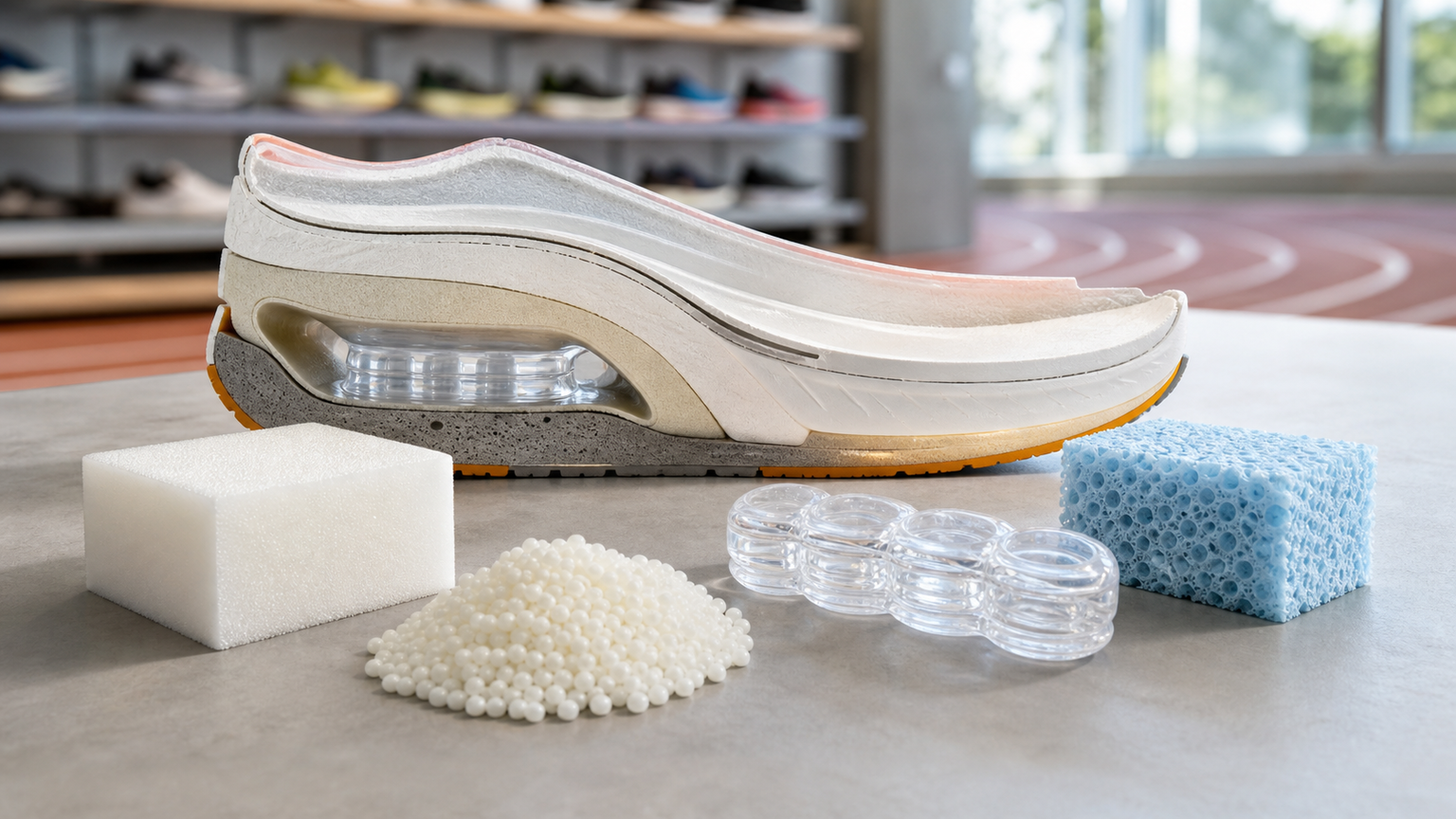
Ethylene Vinyl Acetate (EVA) is currently the most widespread midsole material in running shoes, found everywhere from cheap flip-flops to premium running shoes costing thousands of dollars.
The advantage of EVA is that it’s inexpensive to manufacture, lightweight, and its hardness can be controlled by adjusting foam density. However, traditional EVA’s biggest weakness is “compression fatigue” — after hundreds of repeated compressions, the foam structure permanently flattens, and cushioning performance drops significantly. It’s generally believed that a traditional EVA midsole reaches “functional retirement” after 500–600 km, even if it still looks intact on the outside.
Brands have developed improved versions built on the EVA foundation:
- Nike React: incorporates special polymers for improved energy return and durability
- ASICS FlyteFoam: blended with organic fibers to reduce compression fatigue
- Brooks DNA: uses non-Newtonian fluid principles to automatically adjust firmness based on impact force
PEBA: The Benchmark for Today’s Top-Tier Foam
Polyether Block Amide (PEBA) has become the most sought-after midsole material in high-performance running shoes in recent years. It started gaining traction with the success of Adidas Boost (which uses BASF’s TPU pellets, a structurally different material), and Nike ZoomX (which uses PEBA under the Pebax brand) pushed it to new heights.
Characteristics of PEBA:
- Energy return rate: lab data shows up to 80–85%, far exceeding EVA’s 55–65%
- Weight: roughly 10–20% lighter than EVA of the same volume
- Cold-weather performance: in the low temperatures of Taiwan’s winter mountain trail runs, PEBA loses softness less than EVA does
- Drawbacks: higher manufacturing cost, and it can still show slight deformation under high heat or prolonged compression
| Material | Energy Return | Durable Mileage | Weight | Temperature Adaptability |
|---|---|---|---|---|
| Traditional EVA | 55–65% | 500–600km | Medium | Good |
| Improved EVA | 62–70% | 600–700km | Medium-light | Good |
| TPU (Boost-type) | 75–80% | 700–800km | Medium | Excellent |
| PEBA/ZoomX | 80–85% | 300–500km | Light | Excellent |
Zoom Air: The Physics Logic of Air Cushioning
Nike’s Air technology has gone through numerous iterations since its debut in 1978. The modern Zoom Air unit uses a pressurized nitrogen-filled bag that generates a reactive force under compression, delivering fast-responding “elastic cushioning.”
Zoom Air’s design philosophy differs from PEBA foam: it emphasizes “response speed” over pure energy return rate. A Zoom Air unit placed in the forefoot (as in the Vaporfly series) can complete a compression-rebound cycle in an extremely short time after landing, working with a carbon plate to form a triple-propulsion system.
However, Zoom Air also has weaknesses: the air bag carries a (albeit very low-probability) risk of deflation, and its nitrogen compressibility shifts slightly in extremely cold conditions.
Other Notable Cushioning Technologies
- Hoka Meta-Rocker: strictly speaking, this is a structural design rather than a material, but its exaggerated curved outsole alters foot-strike timing, indirectly enhancing cushioning — a favorite among ultramarathon runners and daily long-distance runners.
- ASICS FF Blast+ (nitrogen-infused EVA): injects nitrogen into the EVA foaming process, resulting in a more uniform foam structure and more consistent rebound — an excellent-value mid-tier option.
- New Balance FuelCell: uses a PEBA formula paired with a forefoot carbon-fiber plate, and is rated highly for value among Taiwanese runners.
Practical Recommendations
Before choosing a midsole material, it’s worth asking yourself a few questions:
- How many kilometers do you run per week? Serious runners logging 50 km or more per week will find a PEBA shoe a worthwhile investment; beginners running under 20 km per week will find improved EVA more than sufficient.
- What’s your primary use case? For racing, PEBA/carbon-plate systems are the top choice; for daily training, TPU or improved EVA offers better value through greater durability.
- Taiwan’s hot, humid climate: during summer road runs, the softening of PEBA foam under high heat may slightly affect the sense of propulsion. If you regularly run under the midday sun for extended periods, TPU-type foams with better heat resistance may be the more stable choice.
- Budget considerations: PEBA shoes typically retail for NT$5,000–8,000 or more, while solid improved-EVA options can be found in the NT$2,000–4,000 range.
Conclusion
The pace of evolution in running shoe midsoles is astonishing, with new materials or formulas emerging almost every year. But no matter how far the technology advances, the core logic of shoe selection never changes: finding the cushioning formula that fits your foot shape, running form, and training needs is what truly matters. Next time you stand in front of a wall of running shoes, try looking less at the brand name and more at the midsole material — your understanding of that pair of shoes will be completely different.
Related Reading
- The Science of Running Shoe Cushioning: Comparing Rebound Rates of EVA vs. PEBA Foam
- Energy Return Rate of Running Shoe Foam: A Comparative Study of PEBA vs. EVA
- The Science of Running Shoes: Heel Drop, Midsole Materials, and Cushioning Trade-offs
- The Science of Choosing Running Shoes: Carbon-Plated, Stability, and Cushioned Shoes
Nepest NOVA 碳條輪組:輕量、空力、舒適一次滿足!/ 公路車 / CT Yeh
7 個月前
Unaas X50 全碳纖幅條輪 數據實測對比PK | Lun Hyper 的高階版 | 板輪爬坡也可以很厲害? ! 武嶺2小時大師一起親測! CP值超高 | 公路車 | CT Yeh
4 年前
單車元宇宙新霸主?TrainingPeaks Virtual 實測 / Zwift 完美平替? 還是超越?/ 有台灣國旗!前身 indieVelo / 公路車 / CT Yeh
1 年前
白沙屯媽祖進香在家走!UREVO 坡度自調走步機 / 可連接訓練遊戲APP MyWhoosh / 邊看直播邊走起來 / CT Yeh
11 個月前
再快都跟的上!? 單車跟隨攝影機之王 HOVERAir X1 PROMAX 全面實測 / 唯一!8K畫質&自行車專用模式和跟蹤信標&前後避障 / DJI Neo 可參考/ 公路車 / CT Yeh
1 年前
開箱) 近視車友 也可以很帥的 Envis Transform 太陽眼鏡開箱 翔鷹 配近視框超便宜秘訣
7 年前
2022台北國際自行車展 訓練台 試騎心得大全 差點腿軟走出! 元宇宙武嶺!| Garmin Tacx Oreka Xpedo Wahoo | 公路車 | CT Yeh
4 年前
訓練台體驗) 2019台北自行車展 三大家 訓練台體驗 Tacx Neo Flux 2 Xepdo Apx Wahoo Kickr
7 年前