Running Shoe Toe Box Width and Arch Support: A Complete Guide to Foot Shape Compatibility for Taiwanese Runners
Introduction
At every Taipei Marathon or Kaohsiung Marathon expo, you’ll always hear runners complaining that “a certain pair of shoes feels too tight in the forefoot” or that “my toes got blistered after a long run in new shoes.” The root of this problem lies in the systematic discrepancy between the foot shape characteristics of Taiwanese runners and the design benchmarks of European and American brands. Understanding your own foot shape, deciphering toe box specifications, and determining your arch support needs are essential knowledge for every serious runner.
Foot Shape Characteristics of Taiwanese People
According to local sports medicine research in Taiwan and surveys within the sporting goods industry, common foot shape characteristics among Taiwanese runners include:
- Wider Forefoot: The ratio of forefoot width to foot length in East Asians is typically higher than the average for Caucasians.
- Lower Arches: Among Taiwanese adults, the proportion with low arches (flat feet or mild flat feet) is approximately 20–30%.
- Tendency for Hallux Valgus: Long-term wear of shoes with overly narrow toe boxes, combined with Taiwan’s traditional flip-flop culture, has led to some runners developing mild bunions.
These characteristics mean that buying shoes based directly on reviews by European or American runners often leads to problems like forefoot squeezing and toe blisters.
Deciphering Toe Box Width Specifications
Running shoe toe box widths are usually indicated by letters, with slight variations between brands:
| Width Code | Common Name | Description |
|---|---|---|
| 2A / AA | Narrow | Suitable for those with slender, narrow feet |
| B / D (Women’s/Men’s Standard) | Standard | The default design for most brands |
| 2E / EE | Wide | Suitable for those with wider forefeet or higher insteps |
| 4E / EEEE | Extra Wide | For special needs or specific foot conditions |
Several brands for which wide-width options are relatively easy to find in Taiwan:
- New Balance: Comprehensive 2E and 4E options, with relatively ample inventory held by the Taiwanese distributor.
- ASICS: Wide versions are available in some physical stores in Taiwan.
- Brooks: Wide versions are offered for some models.
- Altra: Inherently features a wide toe box design (Zero Drop + FootShape Last), highly favored by runners with wide feet.
Arch Types and Support Needs
Arch height affects the degree of “pronation” during running, which in turn determines the appropriate type of support:
High Arches (Pes Cavus):
- The foot tends to roll outward during running (supination/underpronation).
- Landing impact is more concentrated on the outer forefoot and heel.
- Recommendation: Neutral running shoes with ample cushioning; avoid overly controlling shoe types.
Normal Arches:
- Mild, natural pronation, which is normal biomechanics.
- The widest range of choices; both neutral cushioned shoes and light stability shoes are suitable.
Low Arches (Flat Feet):
- Noticeable overpronation during running.
- May cause abnormal stress on areas such as the inner knee, shinbone, and plantar fascia.
- Recommendation: Stability or motion control running shoes.
How to Easily Test Arch Height:
- Wet the sole of your foot and step onto a dry piece of cardboard.
- Observe the shape of the footprint left behind.
- The wider the connecting section between the forefoot and heel in the middle of the footprint, the lower the arch.
Key Details for Trying on Running Shoes
Choosing shoes based solely on size numbers is far from sufficient. Please pay attention to the following when trying them on:
- Timing: Try shoes on in the afternoon or after a run, when your feet are fully swollen, closely mimicking their state during actual running.
- Forefoot Space: There should be about 0.5–1 cm of space from the tip of your big toe to the front of the shoe.
- Heel Fit: The heel should not slip at all; the heel counter should feel snug but not constrictive.
- Instep Lacing: After tightening the laces, there should be no obvious pressure on the instep, especially for runners with high insteps.
- Actual Running: If possible, try running in the store to feel the cushioning feedback and propulsion upon landing.
Practical Advice
- Measure Both Feet: A person’s two feet are usually not the same size; choose the size based on the larger foot.
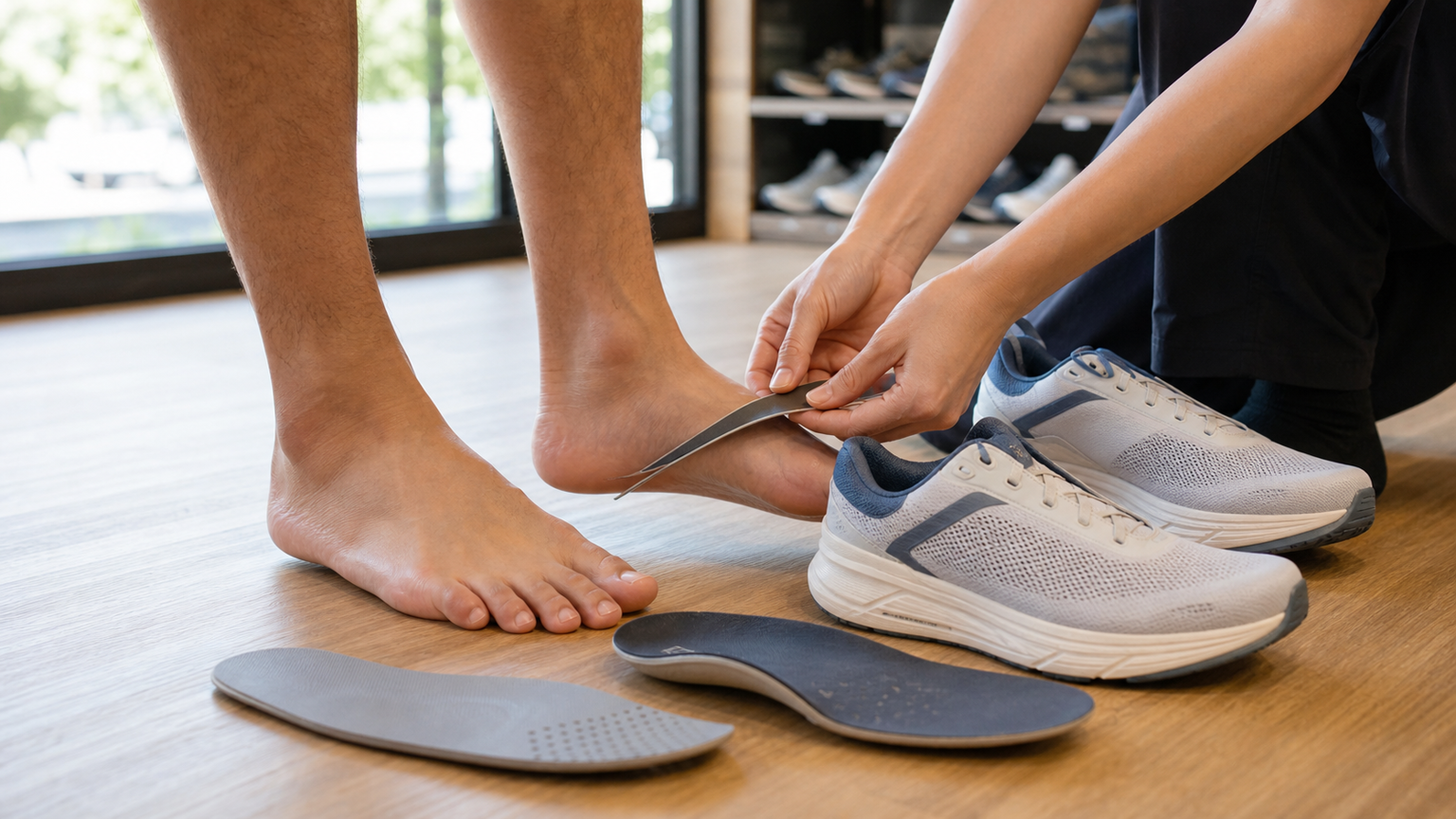
- Consider Custom Insoles: If off-the-shelf shoes cannot meet your arch support needs, you can visit a sports medicine clinic or a professional insole specialist for an assessment to create personalized arch supports. The cost in Taiwan is approximately NT$2,000–6,000.
- Rotate Running Shoes: Using two pairs of running shoes with different toe box characteristics simultaneously helps provide diverse stimulation to the foot muscles and can also extend the lifespan of the shoes.
- Be Aware of Foot Swelling on Long Runs: Feet can swell by half a size during the latter stages of a full marathon. If your race shoes fit perfectly at the start, toe compression issues may arise later in the long run.
Conclusion
A well-fitting pair of running shoes is the foundation for safe and enjoyable road running. Taiwanese runners should pay special attention to toe box width, an often-overlooked element in shoe selection, and not compromise their feet by blindly pursuing trendy shoe models. Every person’s foot shape is unique. Taking the time to find the shoes that truly fit you is, in the long run, the most worthwhile investment in your running career.
Related Topic Reading
- Road Running Shoe Buying Guide: Correctly Matching Foot Type (Flat, Normal, High Arch) with Shoe Models
- Trail Running Shoes vs. Road Running Shoes: Outsole Grip Requirements for Taiwan’s Mountain Trails
- Running Shoe Selection for Senior Runners: The Logic Behind Arch Collapse and Cushioning Needs
- Running Insoles and Arch Support: How to Choose the Right Insoles for You
單車 一日北高 ( 雙城 ) 肥宅雙人瘋狂行 紀錄片 REACTO
10 年前
一日北高/長距離團騎 常見問題補充篇 / 組團或跟團的眉角 / 壯車友容易被瘦車友慢性拉爆 / 原來屁股痛可能是這個原因...? / 風場配速法 / 公路車 / CT Yeh
2 年前
CT 喇低賽) 武嶺牽車 才是王道 西進牽車四小時內秘訣 攝手位置 如何判斷 防抽筋小秘訣
7 年前
再快都跟的上!? 單車跟隨攝影機之王 HOVERAir X1 PROMAX 全面實測 / 唯一!8K畫質&自行車專用模式和跟蹤信標&前後避障 / DJI Neo 可參考/ 公路車 / CT Yeh
1 年前
白沙屯媽祖進香在家走!UREVO 坡度自調走步機 / 可連接訓練遊戲APP MyWhoosh / 邊看直播邊走起來 / CT Yeh
11 個月前
Live) 備戰2019彰化經典百K 賽前攻略 (已完賽請看新影片
7 年前
2020 前十五名 台灣車友還在用的車錶? 同場加映武嶺四小時內的車友都用哪些車錶,以及車錶靈異經驗分享 北高居然騎了960公里!? | 車錶送修分享 | 公路車 | CT Yeh
5 年前
2026 車錶排行榜!誰是最多車友正在使用?練家子最愛哪款?🏆 (2萬名車友數據) / 公路車 / CT Yeh
5 個月前