Running Vests and Hydration Packs: Gear Selection Strategies for Ultramarathons and Long-Distance Running
Introduction
Ultramarathon events in Taiwan have flourished in recent years, from the Taroko Gorge Marathon and the Formosa Ultramarathon to various mountain trail races across the island. More and more runners are entering this discipline that requires self-sufficiency management. When race distances exceed 42 km, aid stations are spaced further apart, and terrain becomes more complex, a well-designed hydration pack is no longer a luxury but a necessity for safety and finishing.
Three Main Types of Hydration Packs
Hydration Pack
Traditional hydration packs place a 1–3 liter reservoir in the main compartment, with water accessed through a drinking tube. This design is more common in Taiwan’s mountain trail races. Its advantages are large capacity and stable center of gravity, making it suitable for long-distance trail races requiring multiple pieces of gear. The disadvantages are that cleaning is more troublesome, and the sloshing sensation of the reservoir is relatively noticeable while running.
Race Vest / Trail Vest
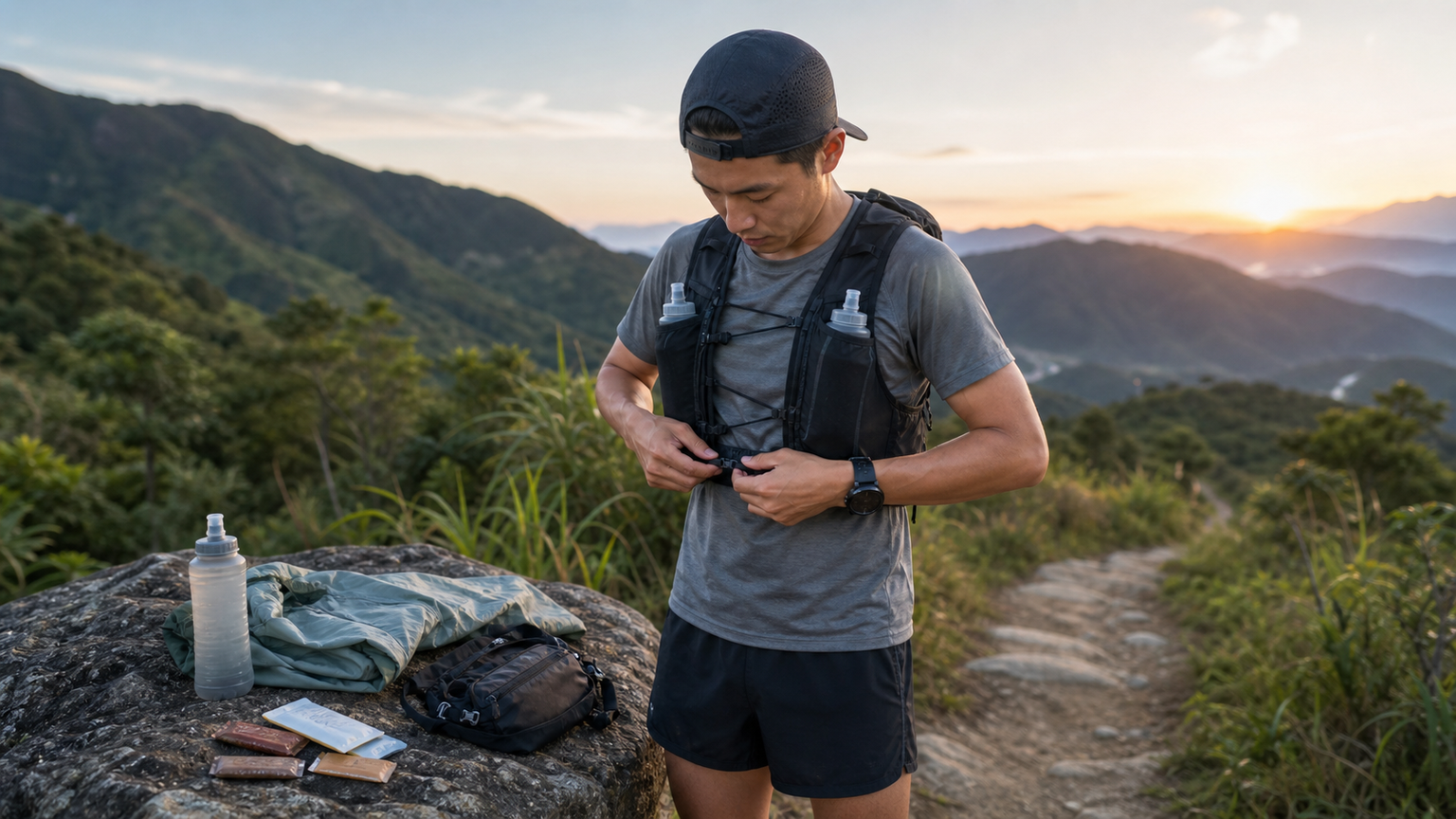
The most mainstream design in recent years, represented by series such as the Salomon Adv Skin and Ultimate Direction Ultra Vest. Race vests feature a form-fitting cut with soft flask pockets on the chest, paired with multiple pockets to distribute weight. This design virtually eliminates the sloshing problem of hydration packs, but capacity is relatively limited, typically between 5–12 liters.
Waist Pack and Handheld Bottle
The smallest capacity options, suitable for races within 30 km with more densely spaced aid stations. Waist pack capacity is typically 0.5–3 liters, while handheld bottles range from 150–500ml. Taiwan’s urban road races (such as the Taipei Marathon and Fubon Marathon) have aid stations spaced approximately 2.5–5 km apart, making waist packs or handheld bottles more than sufficient.
Capacity and Weight Trade-offs
| Type | Capacity | Empty Pack Weight | Suitable Distance | Representative Brands |
|---|---|---|---|---|
| Handheld Bottle | 150–500ml | 50–150g | Below Full Marathon | Nathan, Salomon |
| Waist Pack | 0.5–3L | 100–300g | Half to Full Marathon | Orange Mud, Nathan |
| Race Vest | 5–12L | 200–400g | Full Marathon to 100K | Salomon, UD, Osprey |
| Hydration Pack | 10–20L+ | 400–800g | 100K+ with Overnight Stays | Osprey, Gregory |
Basic principle for capacity selection: the amount of fluid needed between two aid stations (generally recommended at 500–800ml per hour), plus necessary solid nutrition (energy bars, salt tablets), plus mandatory gear (first aid kit, emergency blanket, flashlight, etc.), equals the minimum capacity required.
Mandatory Gear Requirements for Taiwan Races
Many Taiwanese ultramarathon events require runners to carry mandatory gear, which directly affects backpack capacity selection:
- Emergency Blanket: approximately 50g, compressed to the size of a palm
- First Aid Kit: containing gauze and elastic bandages, approximately 100–200g
- Flashlight/Headlamp: if there are nighttime sections, spare batteries must also be carried
- Rain Jacket: Taiwan’s mountain climate is highly variable; some races require carrying one
- Mobile Phone: essential for emergency contact
It is recommended to actually pack all mandatory gear during race preparation, then assess whether there is sufficient space for nutrition, rather than merely looking at the capacity figures on the spec sheet.
Key Details When Purchasing
- Try it on and run: The fit of a pack can only be assessed during actual running. It is recommended to visit a specialty running store with fitting services and actually jog for a few minutes while wearing it
- Adjustment system: Choose packs with multiple adjustment points—chest straps, waist straps, and side cinch cords should all be fine-tunable to suit the different body types of Taiwanese runners
- Fabric breathability: Taiwan’s summers are hot and humid; back panel breathability directly affects comfort on long runs. A 3D mesh back panel design can effectively reduce sweat accumulation
- Pocket accessibility: Chest pockets should allow one-handed removal of soft flasks while running, and back pockets should be openable without taking off the pack
Practical Advice
- Rent before buying: Some Taiwanese running communities or gear shops offer short-term rental services. For your first ultramarathon, you can rent first to test, confirm your needs, and then purchase
- Cleaning and maintenance: Rinse race vests with clean water after each use; soak soft flasks in vinegar water weekly for disinfection to extend their lifespan
- Backup pack: Before important races, be sure to complete at least one long-distance training run with your race pack to confirm there are no chafing points or discomfort
- Weight distribution: Place the heaviest items (reservoir or solid nutrition) closest to the back to help maintain a stable center of gravity
Conclusion
For ultramarathon runners, the hydration pack is gear that requires more personalized selection than running shoes. Taiwan’s abundant mountain ultramarathon events require runners to choose the most suitable hydration system based on each race’s distance, terrain, mandatory gear, and weather conditions. Investing time in research and testing to find that perfect pack that makes you “forget it’s on your back” is truly completing an essential part of ultramarathon preparation.
Related Reading
- Road Running Hydration Pack Buying Guide: Capacity Planning and Harness System Comparison for Trail Ultramarathons
- Running Hydration Belt Design and Capacity: How to Choose the Right Race Gear
- Running Hydration Waist Pack and Backpack: The Logic of Choosing Long-Distance Running Nutrition Gear
- Road Running Hydration Pack Buying Guide: Capacity, Reservoir Compatibility, and Front Pocket Suitability for Trail Running
單車 一日北高 ( 雙城 ) 肥宅雙人瘋狂行 紀錄片 REACTO
10 年前
3D 列印車褲墊 / 舒適改善? / 無痕 x 分區壓縮 / ATK & Decider系列 / JE22黑科技 / #公路車 #CTYEH
11 個月前
一日北高前的高裝檢 | 北高 360 | 挑戰11小時的裝備 | 一日雙塔 | 補給
6 年前
太平山單車員工旅遊 | 這樣玩CP值最高!| 公路車
5 年前
多到選擇障礙... 換個單車把帶想一個小時 / BTP / 編織&軟木特有材質超吸睛! / 公路車 / CT Yeh
1 年前
梅山36彎 奮起湖 #公路車 之旅 2400m
6 年前
北宜騎車⋯好刺激 差點被🐒尻 / 露營單車旅 / 公路車後背攜車架開箱!/ 百人大團露 / YAKIMA 設備開箱儀式感都來了 / 公路車 / CT Yeh
12 個月前
摔車後補裝備: 好市多新款單車安全帽& Specialized Romin 北高整路屁股都不痛的坐墊 | 一千元居然有MIPS | CT Yeh | 公路車
4 年前