Complete Comparison of Running Hydration Belt Designs: Handheld Bottle vs Belt vs Hydration Vest
Introduction
Hydration and nutrition during road running is one of the key factors affecting long-distance performance. However, how to carry your supplies is equally important—choose the wrong method, and not only will you feel uncomfortable while running, it may even affect your running form and accelerate fatigue. Handheld bottles, belts, and hydration vests each have their advocates, and the debate is ongoing in Taiwan’s road running community. This article attempts to provide a systematic comparison from three dimensions: biomechanics, practicality, and the characteristics of races in Taiwan.
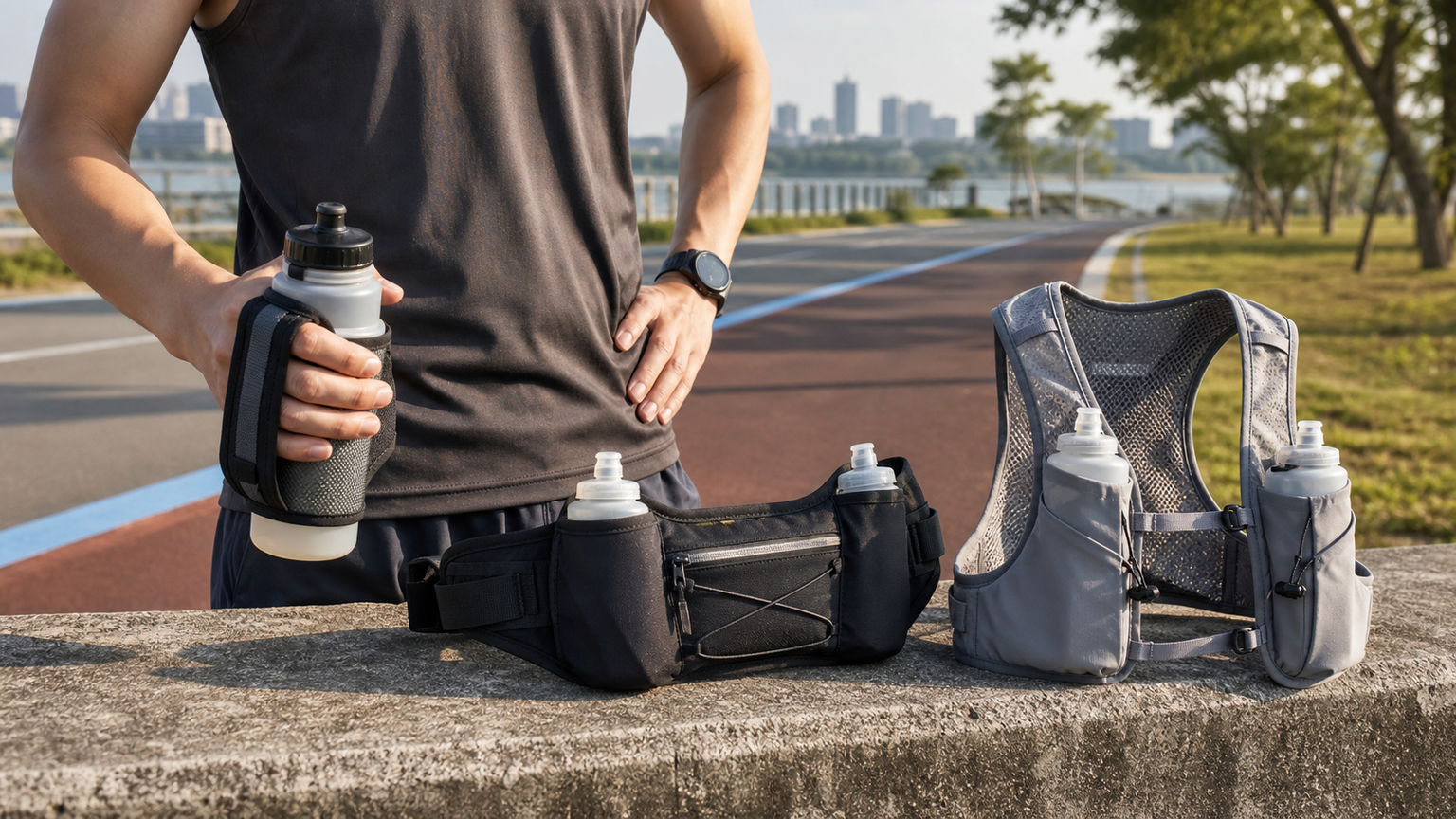
Handheld Bottle: The Simple, Direct Choice
The handheld bottle is the most intuitive way to carry hydration, typically equipped with a hand strap for securing, with capacities ranging from 250–500ml.
Advantages:
- Most convenient for drinking—no need to look down or reach behind your back
- Lightweight, with an empty weight of approximately 50–100g
- No pressure on the waist or shoulders
- Easy to clean, suitable for daily training
Disadvantages:
- Long-term weight bearing in one hand (even just 200g of water + bottle) may affect the symmetry of arm swing; research shows that prolonged weight bearing may cause mild discomfort in the shoulders and neck
- Limited capacity, usually only sufficient for races with aid stations every 5–10 kilometers
- When temperatures exceed 30°C, the water in a handheld bottle heats up quickly, resulting in a poorer drinking experience
Applicable to Taiwan’s context: For city road races such as the Taipei Marathon and Fubon Marathon, aid stations are approximately every 2.5–5 kilometers and provide water and sports drinks. A handheld bottle offers psychological reassurance and flexibility for hydrating between stations, making it a popular choice among full marathon runners in Taiwan.
Running Belt: The Versatile Option for City Road Races
Running belts (waist packs) offer a carrying capacity of 0.5–3 liters, are slim and form-fitting, and serve as an excellent storage solution for phones, energy bars, keys, spare cash, and other small items.
Several design approaches for running belts:
| Design Type | Features | Suitable For |
|---|---|---|
| Elastic waistband type | Ultra-thin, no bouncing | Phone + small item storage |
| Bottle belt | Carries 1–2 soft flasks | Hydration for half to full marathons |
| Multi-pocket belt | 1–3L storage capacity | Early stages of ultramarathons |
The key factor when purchasing a running belt is “anti-bounce design.” Cheap belts often bounce up and down or shift and rotate while running, which is not only annoying but can also affect running efficiency. Quality belts typically feature:
- Wide elastic waistbands to distribute pressure
- Multi-point adjustment buckles to ensure a secure fit for different waist sizes
- Low-center-of-gravity design, with bottles positioned near the pelvis rather than the waist
Running belt issues in Taiwan’s summer: In hot and humid conditions, a belt pressed against the skin at the waist significantly impedes heat dissipation. Some runners report heat rash on the waist area after long distances. It is recommended to choose designs with a mesh breathable layer on the back, or to wear a thin compression top between the belt and the skin.
Hydration Vest: The Best Solution for Long Distances
Hydration vests are currently the mainstream choice among trail runners and ultramarathoners, featuring front soft flask pockets plus rear storage space, providing the most comprehensive hydration and nutrition solution.
Why hydration vests are biomechanically superior to belts:
Weight distribution is the key. A belt concentrates all the weight at the waist, affecting pelvic stability; a hydration vest distributes the weight across the shoulders, chest, and back, closer to the runner’s center of mass, resulting in better running form maintenance over long distances.
Soft flasks vs. hard bottles:
Most hydration vests use soft flasks. Their advantages are that they automatically collapse and take up no space when empty, have no vacuum resistance, and can be squeezed for quick hydration. The downside is that after repeated use, they may develop odors that are difficult to eliminate; it is recommended to soak and clean them with baking soda water every 1–2 weeks.
Comprehensive Comparison of the Three
| Comparison Dimension | Handheld Bottle | Belt | Hydration Vest |
|---|---|---|---|
| Hydration convenience | ★★★★★ | ★★★☆☆ | ★★★★☆ |
| Impact on running form | Mild (one hand) | Moderate | Minimal |
| Breathability in Taiwan’s summer | ★★★★★ | ★★★☆☆ | ★★★★☆ |
| Suitable distance | Up to full marathon | Half to full marathon | Full marathon to ultramarathon |
| Storage for miscellaneous items | None | Ample | Most ample |
| Price range | NT$300–1,500 | NT$500–2,000 | NT$2,000–8,000 |
Practical Recommendations
- Configure by distance: For distances up to a full marathon, prioritize a handheld bottle (combined with race aid stations); for full marathons with longer intervals between stations or ultramarathons, upgrade to a hydration vest
- Try before you buy: Always try on belts and vests and actually run in them to confirm there is no bouncing or friction points before purchasing
- Pay attention to soft flask cleaning: In Taiwan’s summer, hydration fluids can easily breed bacteria in flasks after exercise; rinse with clean water after each use and do a deep clean once a week
- Storing energy bars: Taiwan’s summer heat can cause some energy bars or chocolate bars to melt; choose heat-resistant gels or jelly-type nutrition products, or store solid nutrition in pockets with insulation layers
Conclusion
There is no absolute right or wrong when it comes to hydration and nutrition carrying methods—only what is “suitable for your current training distance and race needs.” Taiwan’s city road races have dense aid stations, so a handheld bottle or lightweight belt can handle most situations; if your goal is mountain trail races or ultramarathons across Taiwan, a hydration vest is equipment worth seriously investing in. As your running mileage grows, your understanding of your hydration and nutrition needs will become clearer. Start with an entry-level option and gradually find the carrying system that suits you best.
Related Reading
- Hydration Pack vs Handheld Bottle vs Hydration Belt: A Complete Comparison of Road Running Hydration Methods
- Buying Guide for Road Running Hydration Bottle Carriers: Long-Distance Choices Among Soft Flasks, Belts, and Packs
- Running Hydration Belts and Packs: The Logic Behind Choosing Long-Distance Running Gear
- Running Vests and Hydration Packs: Equipment Selection Strategies for Ultramarathons and Long-Distance Road Running
類空拍神器 Feiyu Pocket 2s (有優惠連結)三軸穩定 運動攝影機 開箱!比GoPro 還強的滑順視角!三小時長時間錄影 行車記錄器 | 環花東365實測 | 公路車 CT Yeh
4 年前
CT 喇低賽) 武嶺牽車 才是王道 西進牽車四小時內秘訣 攝手位置 如何判斷 防抽筋小秘訣
7 年前
單車 一日北高 ( 雙城 ) 肥宅雙人瘋狂行 紀錄片 REACTO
10 年前
#PUSHBIKE 原來這麼好玩! 小朋友 滑步車 初體驗 超可愛
6 年前
詳測) 小米 電動打氣筒 公路車胎要充多久? 值得買嗎? 米家充氣寶 小心燙手!
7 年前
大家都在開箱的...單車用藍芽對講耳機真的有幫助嗎? SENA BiKom 20 長距離旅遊 & 海鷗繞圈賽 實際體驗心得 / 公路車 / CT Yeh
9 個月前
太平山單車員工旅遊 | 這樣玩CP值最高!| 公路車
5 年前
一日北高前的高裝檢 | 北高 360 | 挑戰11小時的裝備 | 一日雙塔 | 補給
6 年前