Introduction
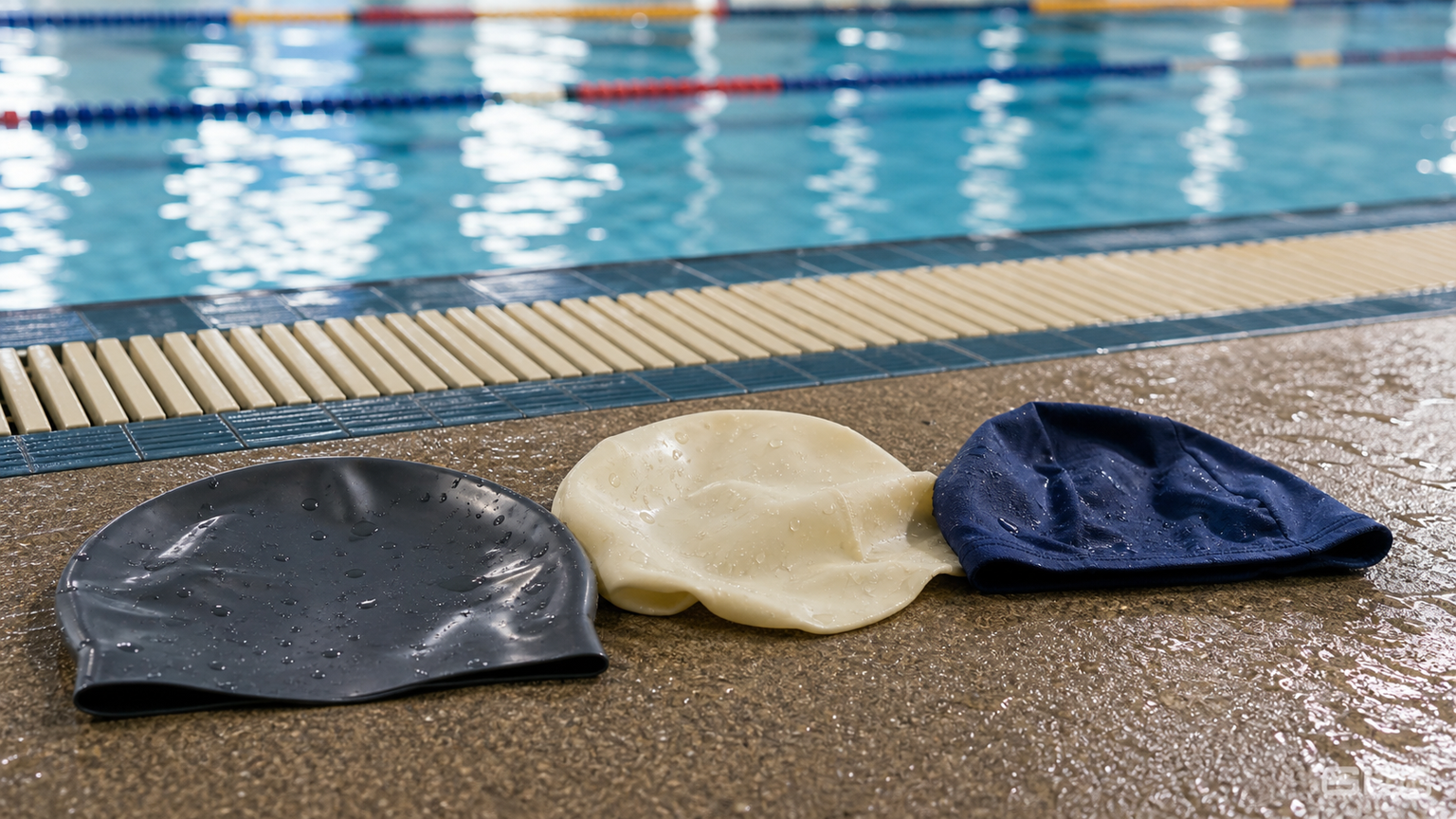
Of all swimming gear, the swim cap seems the least remarkable, yet it plays several important roles: reducing water resistance, protecting hair from chlorine damage, and improving visibility in open water. Nearly every pool in Taiwan requires swimmers to wear a cap, but many swimmers simply grab whichever one is on hand without ever considering the differences between materials. Silicone, latex, and fabric caps each have distinct physical properties and ideal use cases. Understanding these differences lets you make a smarter choice based on your training goals.
In-Depth Look at the Three Materials
Silicone Caps
Silicone caps are the current market mainstream and the top choice for most competitive swimmers. Silicone offers excellent elastic recovery, allowing it to hug various head shapes snugly without losing its shape.
Key Advantages:
- Excellent durability — typically lasts 2–3 years with normal use
- Smooth surface with a lower drag coefficient
- Protects hair well, since silicone doesn’t stick to hair easily
- Highly chlorine-resistant and won’t degrade from pool chemicals
- Wide range of colors, offering good visibility in open water
Key Disadvantages:
- Can feel hot and stuffy, which may be uncomfortable during long summer sessions
- Thicker silicone caps require some technique to put on; improper handling can tear them
- More expensive than latex caps (roughly NT$150–500)
Latex Caps
Latex caps are the traditional standard for competitive swimming, and many professional swimmers still prefer the snug feel of latex.
Key Advantages:
- Extremely lightweight, giving a “barely there” feel closest to swimming without a cap
- Theoretically the lowest drag of the three materials
- The most affordable option (NT$50–150)
- Easy to put on, with better elasticity than silicone
Key Disadvantages:
- Poor durability — tends to degrade and crack after 3–6 months of use
- Sticks easily to hair, requiring care when removing to avoid pulling out strands
- Not suitable for people with latex allergies (roughly 1–6% of the population)
- May develop a tacky surface after prolonged storage
Fabric Caps (Lycra/Spandex)
Fabric caps are mainly made from Lycra (spandex) or other elastic fibers, and serve a clearly different purpose than the other two materials.
Key Advantages:
- Best breathability, well suited to Taiwan’s tropical climate
- Gentle on the scalp, without a stuffy feeling
- Good for swimmers with thick hair or a larger head circumference
- Ideal for parent-child swimming and casual activities where competitive performance isn’t the priority
Key Disadvantages:
- Highest drag, as the fabric creates tiny wrinkles in the water
- Limited waterproofing, so hair will still get wet from pool water
- Not suitable for competition or performance-focused training
Material Specification Comparison Table
| Comparison Item | Silicone Cap | Latex Cap | Fabric Cap |
|---|---|---|---|
| Drag Performance | Excellent | Excellent | Poor |
| Lifespan | 2–3 years | 3–6 months | 1–2 years |
| Breathability | Poor | Poor | Excellent |
| Hair Protection | Excellent | Moderate | Poor |
| Latex Allergy Risk | None | Yes | None |
| Price Range (NT$) | 150–500 | 50–150 | 80–250 |
| Suitable for Racing | High | High | Low |
Choosing a Cap for Special Situations
The Challenge of Long Hair
Long hair is the biggest challenge when choosing a swim cap. Although silicone caps grip well, tucking a large volume of hair into the cap takes some technique: tie your hair into a low ponytail or bun first, then pull the cap on from the forehead backward — this greatly reduces scalp-pulling discomfort. Some brands offer a “long hair” version with a taller crown and more stretch.
Special Needs for Open Water
For open water training in Taiwan (such as at Penghu, Hualien, or Sun Moon Lake), a swim cap serves an important safety function beyond reducing drag — improving visibility for lifeguards and other water users. Bright fluorescent orange or fluorescent yellow silicone caps are the standard color choice for open water, and a thicker silicone cap can also provide a bit of extra warmth.
Double-Cap Racing Technique
Top competitive swimmers often use the “double-cap technique”: wearing a latex cap underneath to secure the goggle strap, then a silicone cap on top (covering both the latex cap and the goggle strap) to maximize streamlining. This technique is quite common in domestic competitive events such as the university championships.
Practical Recommendations
- Everyday training swimmers: a single silicone cap is enough, replaced roughly every 2 years
- Competitive swimmers: keep a “double-cap set” (latex + silicone) — use silicone for regular training and the double-cap technique for races
- Parent-child swimming or casual use: fabric caps offer the best comfort, especially for children who dislike the tightness of silicone
- People with latex allergies: strictly choose silicone or fabric caps, as skin contact with latex can trigger hives or even anaphylactic shock
- Care tips: rinse with fresh water after every use; a thin dusting of baby powder can help prevent a silicone cap from sticking to itself, while latex caps should be stored away from light
Conclusion
Choosing a swim cap involves far more than just appearance. Based on your training goals, head shape, and swimming environment, picking the right material can make every swim smoother. For swimmers in Taiwan, the hot climate makes breathability an important consideration — but if your goal is to boost swimming performance, the streamlined advantage of a silicone cap remains the top choice.
Related Reading
- Swim Cap Material Comparison: Silicone vs. Latex vs. Fabric — Which Suits Which Occasion
- Complete Swim Cap Material Comparison: Drag and Comfort Analysis of Silicone vs. Latex vs. Lycra
- When to Use a Racing Swim Cap: Training vs. Competition Differences and Proper Care
- Everyday Care for Swimming Gear: Cleaning and Extending the Life of Swimsuits, Goggles, and Caps
3D 列印車褲墊 / 舒適改善? / 無痕 x 分區壓縮 / ATK & Decider系列 / JE22黑科技 / #公路車 #CTYEH
11 個月前
多到選擇障礙... 換個單車把帶想一個小時 / BTP / 編織&軟木特有材質超吸睛! / 公路車 / CT Yeh
1 年前
訓練台體驗) 2019台北自行車展 三大家 訓練台體驗 Tacx Neo Flux 2 Xepdo Apx Wahoo Kickr
7 年前
大家都在開箱的...單車用藍芽對講耳機真的有幫助嗎? SENA BiKom 20 長距離旅遊 & 海鷗繞圈賽 實際體驗心得 / 公路車 / CT Yeh
9 個月前
單車 重低音 藍芽喇叭 音質實測 SoundBot SB525 Real Sound Test
8 年前
洗單車神器 吹水機! 實際洗車用用看 暴力洗鍊條大法 | 公路車 | CT Yeh
4 年前
[防寒衣體驗] 鐵人魂 三鐵 防寒衣試穿會 於松運 深水游泳池 鯨魚池
8 年前
公路車 BB培林大升級! / 備戰海鷗繞圈賽 Canyon Aerod & TIME 一起改 / MIT大廠 CEMA對鎖式陶瓷培林BB & 導輪 / 公路車 / CT Yeh
2 年前