Introduction
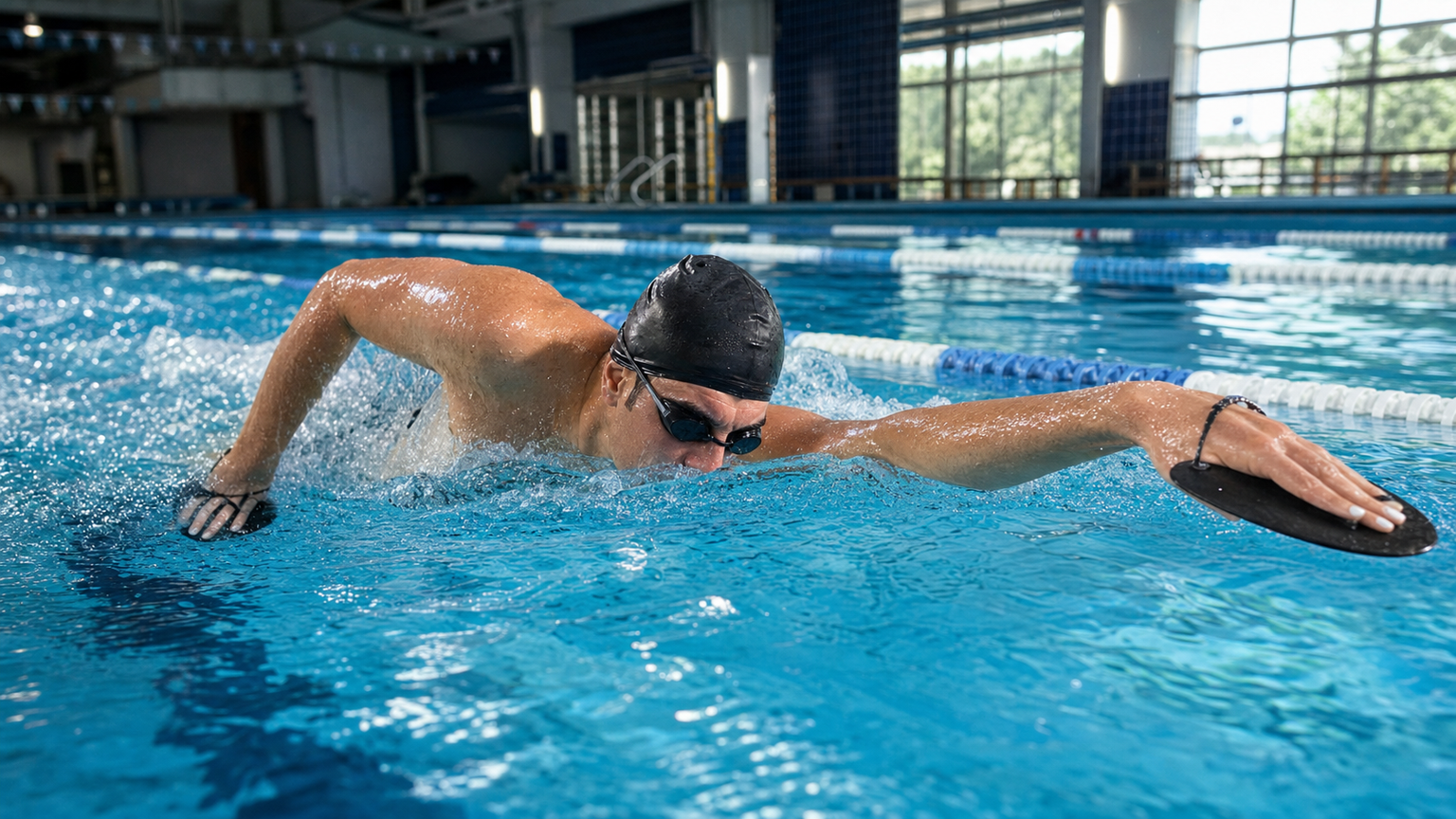
Swim hand paddles are one of the most common training aids in pool workouts, found in nearly every well-equipped swim training program. Used properly, hand paddles can significantly improve stroke efficiency and upper-body strength. However, like all training tools, improper use not only fails to deliver training benefits but can also place excessive strain on the shoulder joints. This article starts from the design principles of hand paddles and provides practical usage guidelines for swimmers in Taiwan.
Hand Paddle Designs and Training Purposes
Training Logic by Size Classification
| Size Category | Ratio to Palm | Primary Training Purpose | Suitable For |
|---|---|---|---|
| Small Paddles | Same size as palm or slightly smaller | Stroke technique correction, proprioceptive training | Beginners, technique refinement phase |
| Medium Paddles | 20–30% larger than palm | Balanced strength and technique | General training for intermediate to advanced swimmers |
| Large Paddles | 50% or more larger than palm | Maximum strength and water-catch volume training | Strength training phase for advanced athletes |
| Finger Paddles | Cover only the knuckles | Enhance finger water feel, correct stroke posture | Technique-oriented training |
The larger the hand paddle, the greater the water resistance to overcome with each stroke, and the greater the load placed on the shoulder rotator cuff. This is why coaches typically recommend that beginners start with small paddles.
Features of Different Paddle Types
Flat Paddles
The most traditional design—a flat plastic board secured with rubber straps. The advantage is simple design and affordability; the drawback is the lack of real-time feedback on wrist angle.
Ergonomic Paddles
Designed to follow the natural curve of the palm, with common brands such as the Speedo Power Paddle and Arena Elite Finger Paddle. They more naturally simulate the high-elbow catch position and are an excellent choice for advanced technique training.
Tech Paddles
Designed around a “feedback mechanism” as the core principle, such as the FINIS Freestyler Paddle (with an upturned front edge), which uses water pressure to give swimmers immediate feedback on whether their stroke path is correct.
The Science Behind Hand Paddle Training
How They Improve Stroke Efficiency
Hand paddles increase the effective surface area of the hand, allowing each stroke to displace more water. From a fluid dynamics perspective, propulsive force = water density × velocity squared × surface area × drag coefficient. Increasing the surface area (the core function of hand paddles) directly boosts the propulsion generated by each stroke.
Research indicates that regular hand paddle training enhances a swimmer’s “feel for the water,” enabling them to more efficiently use the palm and forearm to form a propulsive surface even after removing the paddles. In biomechanics, this effect is referred to as “post-activation potentiation.”
Shoulder Injury Risk Management
Swimmer’s shoulder is the most common swimming injury, and improper hand paddle use is a significant risk factor. The shoulder rotator cuff is prone to impingement syndrome under repeated high-load conditions.
High-Risk Behaviors:
- Using large hand paddles before stroke technique is stable
- Using hand paddles as a substitute for a pull buoy during long-distance upper-body training
- Using hand paddles for more than 30% of total swim volume in each session
- Continuing to use hand paddles while fatigued
A Scientific Hand Paddle Training Plan
Recommended Periodized Usage
- Base Phase: 1–2 hand paddle sessions per week, no more than 800–1000 meters per session, using medium paddles, focusing on high-elbow entry technique
- Strength Phase: 2–3 sessions per week, can increase to 1500–2000 meters, incorporating large paddle strength sets (e.g., 10×50m sprint paddles)
- Pre-Competition Phase: Reduce hand paddle volume, return to technique-focused training, use finger paddles to maintain water feel
- Recovery Phase: Suspend hand paddle use to allow the shoulders to fully recover
Combined Training
The combination of hand paddles and a pull buoy is the golden pairing for upper-body training. The pull buoy supports the lower body and eliminates the kicking variable, concentrating the training load entirely on the pulling motion. Adding hand paddles significantly increases the overall upper-body load, making it ideal for strength-oriented training sessions.
Practical Recommendations
- Beginners should start with a technique paddle the size of the palm or slightly smaller, mastering the correct high-elbow catch before increasing size
- If you feel any pain or tightness in the shoulders, stop using hand paddles immediately and consult a physical therapist
- When purchasing hand paddles in Taiwan, prioritize brands with complete size labeling such as FINIS, Speedo, and Arena, and avoid off-brand products with unclear sizing
- Replace hand paddle rubber straps as soon as they show signs of aging; broken straps can interfere with your stroke or even cause injury during swimming
- For children’s swim lessons, consider finger paddles—they are small, effectively enhance water feel, and do not place excessive load on the shoulders
Conclusion
Hand paddles are a “double-edged sword”—used well, they can significantly improve stroke efficiency in a short period; used incorrectly, they can accumulate into chronic shoulder injuries. Treat hand paddles as a supplementary tool rather than the main training content, and combine them with solid technique work to unlock their full training value.
Related Reading
- Hand Paddle Review: Size Selection and Training Purpose Correspondence
- Hand Paddle Buying Guide: Complete Analysis of Training Differences Between Large, Medium, and Finger Paddles
- Proper Usage of Resistance Training Aids (Hand Paddles / Resistance Pants)
- Complete Guide to Swim Training Resistance Tools: Application Strategies for Hand Paddles, Resistance Parachutes, and Resistance Cords
[教學] Premiere 影片 手震 修正 教學 防抖 單眼 影像 GoPro 穩定 Video Stabilization
8 年前
如何把 GoPro 影片 翻轉 批次 轉正?
6 年前
西進武嶺 免費訓練分析服務 Intervals | 練不夠還是練過頭?你哪一種類型選手?AI模型告訴你! | 備戰神器 | 公路車 訓練 | CT Yeh
4 年前
訓練台體驗) 2019台北自行車展 三大家 訓練台體驗 Tacx Neo Flux 2 Xepdo Apx Wahoo Kickr
7 年前
CT 喇低賽) 武嶺牽車 才是王道 西進牽車四小時內秘訣 攝手位置 如何判斷 防抽筋小秘訣
7 年前
Insta 360 One 超級防手震技術實測
7 年前
鉅齒紋輪組!? ControlTech MEG-T50 EVO 碳纖維幅條輪組/ 功率對比實驗 / 公路車 / CT Yeh
2 年前
西進武嶺 自製新版AI配速表產生器 x 賽前攻略 抱佛腳! 沒有功率計也可以產生配速表嗎?有什麼其他眉角賽前要注意的呢? | 西進武嶺 / 東進武嶺 KOM 攻略 | 公路車 | CT Yeh
4 年前