The Manufacturing Process of Carbon Fiber Frames: The Trade-off Between Weave Angles, Stiffness, and Weight
Introduction
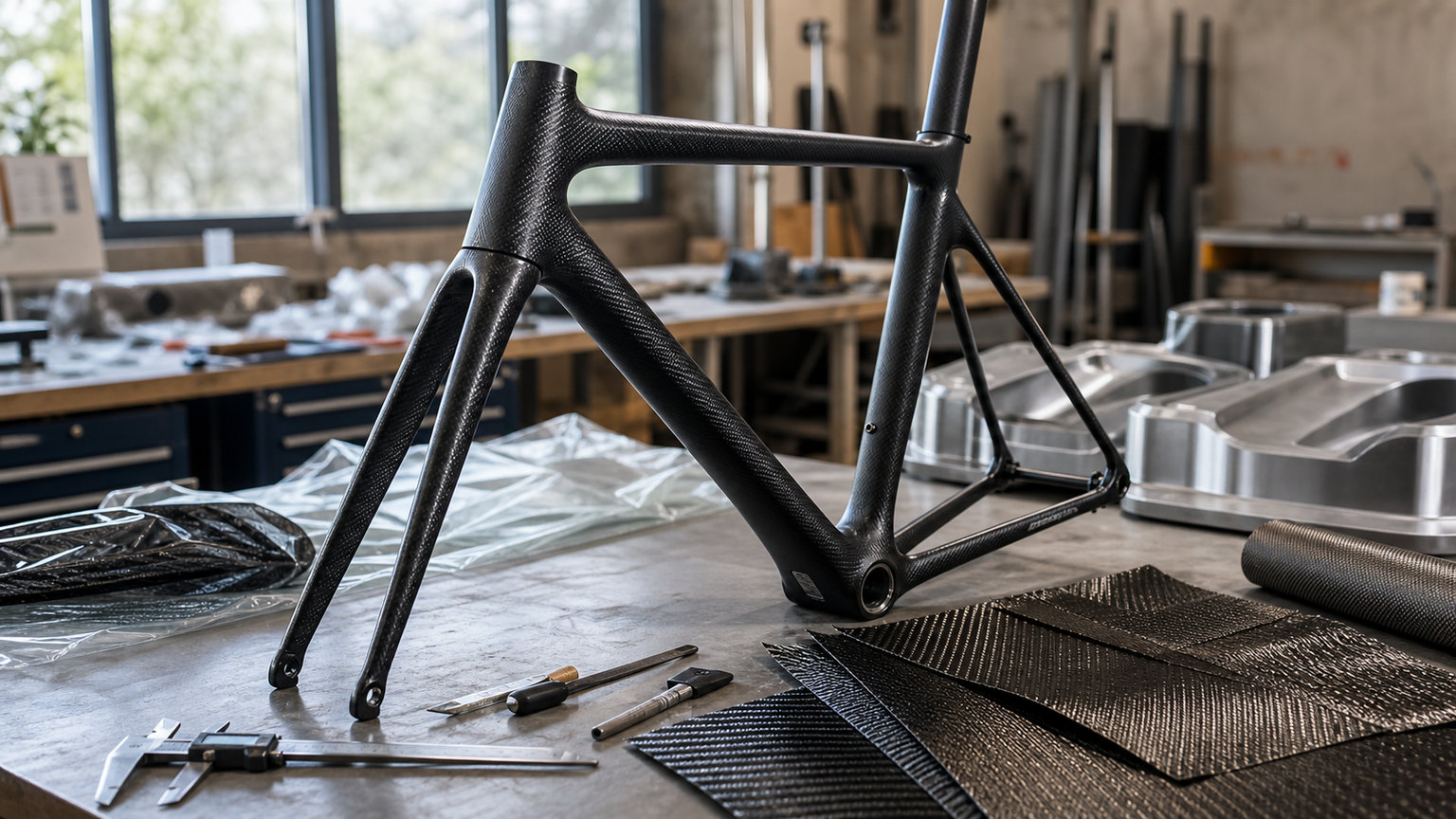
Walking into any bicycle shop in Taiwan, carbon fiber frames have become almost synonymous with competitive road bikes. However, behind the term “carbon fiber” lies a world of differences: from varying grades of carbon cloth like T300 to T1100, weave angles ranging from 0°/90° to ±45°, and manufacturing processes spanning from manual layup to high-pressure molding. What exactly is the difference in materials and craftsmanship between an entry-level carbon frame costing NT$50,000 and a top-tier racing frame priced at NT$200,000?
Grades and Characteristics of Carbon Fiber Materials
The core raw material of carbon fiber is polyacrylonitrile (PAN), which, after high-temperature treatments such as oxidation, carbonization, and graphitization, forms neatly arranged carbon atom chains. Commercially, common grades are classified based on the standards of Japan’s Toray:
| Grade | Tensile Strength | Tensile Modulus | Typical Application |
|---|---|---|---|
| T300 | 3,530 MPa | 230 GPa | Entry-level frames, mass production |
| T700 | 4,900 MPa | 230 GPa | Mid-range racing frames |
| T800 | 5,490 MPa | 294 GPa | High-end road frames |
| T1000/T1100 | 6,370+ MPa | 294 GPa | Top-tier racing frames |
| M40J/M60J | 4,400 MPa | 377–588 GPa | High-stiffness, lightweight frames |
It is worth noting that Strength and Modulus are different characteristics. High-modulus carbon fiber is stiffer and lighter but also more brittle; high-strength carbon fiber is more impact-resistant. Top-tier frames usually combine both characteristics, layering high-modulus carbon cloth in critical stress areas to control deformation, while retaining high-strength carbon cloth in tubes that must withstand impacts.
Weave Angles and Mechanical Analysis
The most unique advantage of carbon fiber is its anisotropy—it is extremely strong along the fiber direction and relatively weak in the perpendicular direction. Therefore, the layup determines the mechanical properties of the frame.
Common Weave Angles:
- 0° (Axial): Along the long axis of the tube, it resists bending and tension; used as the primary source of stiffness in down tubes and top tubes.
- 90° (Hoop): Wrapping around the tube cross-section, it resists flattening and provides lateral stiffness.
- ±45° (Bias): Resists torsional forces; used extensively in areas requiring stiffness transmission, such as the bottom bracket shell and rear triangle.
- 0°/±60° (UD/Weave Hybrid): Provides uniform strength distribution in specific directions.
Taiwan has many original equipment manufacturers (such as Giant, Merida, Fairly, etc.) that hold a significant position in global carbon fiber frame manufacturing. Engineers at these companies use Finite Element Analysis (FEA) to predict stress distribution for different layup schemes in computer simulations before verifying them with physical destructive testing.
Taking the head tube area as an example, braking forces, steering lateral forces, and road impacts act simultaneously during riding. Excellent designs will add ±45° layers to the outside of the head tube to resist torsion, thicken high-modulus UD layers at the fork junction to control deformation, and simultaneously retain sufficient high-strength layers to handle crash impacts.
Manufacturing Process: From Manual Layup to In-Mold Molding
Differences in Manufacturing Methods:
- Hand Layup: Technicians manually cut carbon cloth and place it into molds according to design blueprints. Precision and quality are highly dependent on the operator’s experience; this method is common for top-tier frames.
- Prepreg: Carbon fiber is pre-impregnated with resin, stored under refrigeration, and cured in an autoclave. Resin content is precise, and void content is low; this is the standard for high-end frames.
- RTM/C-RTM (Resin Transfer Molding): Dry carbon cloth is placed in a mold, and liquid resin is injected. Suitable for mass production; quality is relatively stable, but weight control is more difficult.
- Tube-to-Tube: Independent carbon tubes are joined together. This allows for the selection of different carbon cloths for different tubes with high flexibility, but the joints are the critical points for strength.
Air pressure inside the mold is also key. High-pressure molding can expel more air bubbles, reducing void content. For every 1% increase in void content, strength drops by approximately 7-10%. Top-tier frames usually require a void content of less than 1%.
Engineering Trade-offs Between Weight and Stiffness
This is the core contradiction in all carbon fiber frame design. Stiffness ensures efficient transmission of pedaling energy, but excessive stiffness can lead to fatigue on long rides; low weight allows for faster climbing, but sacrificing wall thickness affects durability.
A common industry metric is the “Stiffness-to-Weight Ratio.” Measured by BB stiffness/frame weight, a typical racing frame is about 120-160 N·m/°·kg⁻¹, while top-tier time trial frames can exceed 180.
Road conditions in Taiwan’s mountainous areas vary, and large potholes and asphalt cracks place higher demands on a frame’s shock absorption. This is why many professional riders in Taiwan, even while pursuing low weight, tend to choose frame designs with moderate vibration damping rather than the most extreme lightweight racing frames.
Practical Advice
- Don’t just look at material grades: T700 or T800 only represent the raw material; the layup design and manufacturing process are the decisive factors.
- Pay attention to certification standards: EU EN 14781 and UCI frame certifications are the baseline; some brands provide additional impact test data.
- Credibility of purchasing channels: “White-label” carbon frames of unknown origin often have issues with high void content; it is recommended to choose brands with warranty policies.
- Regular inspections: Carbon fiber damage (especially internal delamination) is difficult to judge with the naked eye. It is recommended to perform a full visual inspection at least once a year and send it to the factory for testing immediately after any collision.
- Storage in Taiwan’s summer: Leaving the bike in a closed vehicle for long periods in high temperatures may soften the frame’s epoxy resin; avoid such situations.
Conclusion
The charm of carbon fiber frames lies not only in their light weight but also in the ability to precisely tune mechanical properties for different riding needs—an advantage that aluminum or titanium alloys struggle to match. The next time you stand in front of a bicycle display, admiring those smooth, curved carbon frames, remember that behind them lies the accumulation of material science and manufacturing craftsmanship from hundreds of engineers. Understanding this knowledge not only helps you make more informed purchasing decisions but also allows you to appreciate this craft, which blends art and science, with a deeper perspective.
Related Reading
- Road Bike Carbon Frame Selection: Balancing Stiffness, Weight, and Budget
- Carbon Fiber vs. Aluminum vs. Titanium Frames: A Complete 2025 Material Buying Guide
- In-depth Review of Carbon Fiber Road Frames: A Comprehensive Comparison of Stiffness, Weight, and Vibration Absorption
- Carbon Fiber vs. Aluminum Frames: Actual Riding Feel Differences and Value-for-Money Analysis
多到選擇障礙... 換個單車把帶想一個小時 / BTP / 編織&軟木特有材質超吸睛! / 公路車 / CT Yeh
1 年前
Unaas X50 全碳纖幅條輪 數據實測對比PK | Lun Hyper 的高階版 | 板輪爬坡也可以很厲害? ! 武嶺2小時大師一起親測! CP值超高 | 公路車 | CT Yeh
4 年前
Nepest NOVA 碳條輪組:輕量、空力、舒適一次滿足!/ 公路車 / CT Yeh
7 個月前
鉅齒紋輪組!? ControlTech MEG-T50 EVO 碳纖維幅條輪組/ 功率對比實驗 / 公路車 / CT Yeh
2 年前
再一組! 全碳幅條 碟煞/無內胎輪組 開箱! 到底好騎嗎? UNAAS X40 | 公路車 | CT Yeh
4 年前
首發!LUN HYPER 第五代 2025最新版 碳幅條x鈦合金 輪組 D40 開箱 / 居然開始捲高端輪組了 / 公路車 / CT Yeh
11 個月前
Lun HYPER 第三代 D45碳幅條輪組 功率對比實測 / 鈦合金行星齒輪,中高階的製造水準 / 公路車 / CT Yeh
1 年前
功率實測 Lun Hyper 2023 碳幅條輪組 D45 碟煞 | 公路車 | CT Yeh
3 年前