Introduction
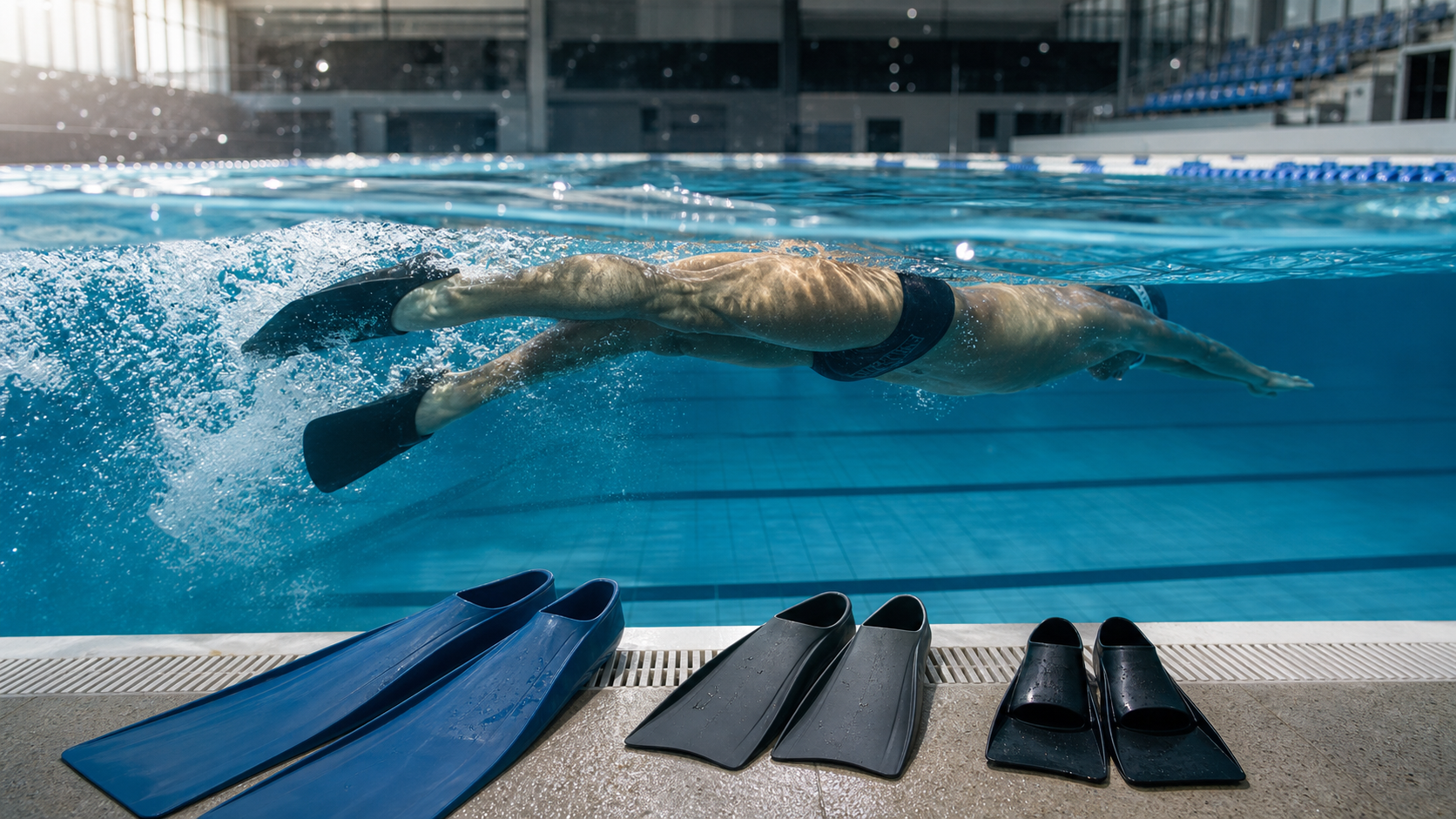
Training fins used in competitive swimming and fins used for snorkeling may look similar, but they represent two completely different training philosophies. The fins used in competitive swim training are precisely engineered in blade length, stiffness, and angle, with the goal of strengthening kick power while also improving kicking technique and ankle flexibility. Many swimmers in Taiwan use fins extensively during their training cycles, but don’t always fully understand the science behind them.
Classification and Design Principles of Fins
Classification by Blade Length
| Type | Blade Length | Training Effect | Suitable Strokes |
|---|---|---|---|
| Long Fins | 25–40 cm | Maximum buoyancy assistance, builds a sense of ankle relaxation | Freestyle, beginner backstroke |
| Medium Fins | 15–25 cm | Balances power and technique | Universal for all strokes |
| Short Fins (Zoomers) | 5–15 cm | Kick frequency training, sprint capacity | Speed training, butterfly |
| Monofin | 60+ cm | Dolphin kick specialty training | Butterfly underwater kick, competitive monofin |
The Training Significance of Blade Stiffness
Fin blade stiffness is generally divided into three levels: “soft,” “medium,” and “stiff.”
- Soft blades: The blade flexes naturally with each kick, reducing stress on the ankle — friendly for the ankle joint. Suitable for beginners and ankle flexibility training
- Stiff blades: Requires greater muscular force to propel the blade with each kick — this is the concept of “resistance training,” offering a stronger effect on leg strength development
Different training goals call for different stiffness levels. Choose soft blades during the technique phase and stiff blades during the strength phase — this is the basic logic behind periodized fin use.
The Speed Training Advantages of Short Fins (Zoomers)
The Mechanism for Increasing Kick Frequency
The core goal of short fin design is to increase kick rate. While long fins generate more propulsion per kick, an overly long blade actually limits the speed of the kicking motion. Short fins let the ankle’s movement stay closer to the rhythm of barefoot swimming, while still providing slightly more propulsion than swimming without fins.
Research indicates that training with short fins can effectively increase a swimmer’s kick rate while lowering the risk of technique degradation, making them a common training aid for speed swimmers during the pre-competition cycle. Many professional swim teams (including what can be seen in Taiwan’s national team training photos) make extensive use of short fin models such as the Speedo Biofuse or the FINIS Positive Drive Fin during short-course sprint training.
Specialty Training for the Butterfly Underwater Kick
In modern competitive swimming, the underwater dolphin kick has become a key technique in short-distance races, with many world record holders covering underwater kick distances of over 10–15 meters. Using short fins for underwater dolphin kick training strengthens the coordination of the kinetic chain from the core to the ankle, while providing moderate resistance without overloading the knee joint.
Applications of Long Fins for Beginners and Technique Training
Developing Ankle Flexibility
One of the core limiting factors in freestyle kicking efficiency is insufficient ankle plantarflexion range of motion. Long fins naturally apply downward pressure on the ankle during training, and over time this training can gradually improve ankle flexibility.
This effect is especially valuable for swimmers transitioning from land-based sports (such as triathletes), because long-term running often causes compensatory ankle dorsiflexion, which is unfavorable for the swimming kick.
Building Confidence for Beginners
For complete beginners unfamiliar with the water, the extra propulsion provided by long fins allows them to maintain good body position at the surface, building confidence in swimming. This is a commonly used teaching aid in swim schools.
Common Mistakes and Precautions
- Mistake 1: Loose heel, not fitted securely — The heel section of the fin should fully enclose the foot to prevent it from slipping off during swimming
- Mistake 2: Driving the kick from the knee instead of the hip — Wearing fins during training doesn’t mean you can “skip” proper kicking mechanics; the lower body should still be driven by hip movement
- Mistake 3: Over-reliance on fins — Fins are a training aid; if worn during every session, the legs may become accustomed to the fin’s assistance, making it harder to improve barefoot kicking ability
- Caution: Risk of toe injury — Rapid kicking while wearing stiff long fins can place excessive pressure on the toe joints; swimmers with prior injuries should be especially careful
Purchasing Recommendations
- Training-oriented short fins (Zoomer type) are the top choice for training benefit, and the FINIS Zoomer series has stable availability in Taiwan’s swim gear market
- Beginners just starting fin training can first borrow long fins from the pool’s equipment room to confirm their adaptation to fin training before purchasing
- A full foot pocket (hard sole) design is more stable than a soft sole and is recommended for swimmers with clear training goals
- Budget range: training fins NT$500–2,000, competitive short fins NT$800–1,500
Practical Recommendations
- It’s recommended to limit fin training to no more than twice a week, with each session covering 500–1,500 meters
- Triathletes can increase the proportion of short-fin kick training during their pre-race build to simulate the rapid kicking demands of open water
- Combining long fins with side-kick drills is an effective way to improve body rotation in freestyle
- Immediately after a fin session, do a short segment of barefoot swimming (such as 200m easy) to let the body recalibrate its normal kicking feel
Conclusion
The length of a fin doesn’t just affect the amount of propulsion — it directly determines the direction of training. Long fins develop technique and ankle flexibility, while short fins strengthen kick frequency and explosive power. Once you understand this core logic, you can choose the right fins for your current training cycle, allowing this seemingly simple piece of rubber equipment to deliver maximum benefit in training.
Related Reading
- Swimmer’s Knee: A Complete Guide to Breaststroke Knee Injuries
- Advanced Breaststroke Technique: Speed Differences and Technique Choices Between Narrow and Wide Kicks
- Choosing a Kickboard: Feel and Training Benefits of Hard vs. Soft Boards
- Breaststroke Scissor Kick: Correcting Knee Flare and Strengthening Muscle
滑雪新手們慘摔學習全紀錄(請開字幕),滑雪好好玩 | Snowboard + Ski | 岩原 スキー場 | 滑雪APP使用 | GoPro Max
6 年前
訓練台體驗) 2019台北自行車展 三大家 訓練台體驗 Tacx Neo Flux 2 Xepdo Apx Wahoo Kickr
7 年前
大家都在開箱的...單車用藍芽對講耳機真的有幫助嗎? SENA BiKom 20 長距離旅遊 & 海鷗繞圈賽 實際體驗心得 / 公路車 / CT Yeh
9 個月前
西進武嶺 免費訓練分析服務 Intervals | 練不夠還是練過頭?你哪一種類型選手?AI模型告訴你! | 備戰神器 | 公路車 訓練 | CT Yeh
4 年前
實景訓練台) 彰化經典百K 高強度喵團 90分鐘 跟著一起練功 2019 Indoor workout Changhua Classic 100 Taiwan
7 年前
#公路車 #Fitting 靠人工智慧APP 幫你調整單車
6 年前
首發 Garmin Edge 850 車錶 深入開箱!? / 公路車 / CT Yeh
10 個月前
Nepest NOVA 碳條輪組:輕量、空力、舒適一次滿足!/ 公路車 / CT Yeh
7 個月前