Introduction
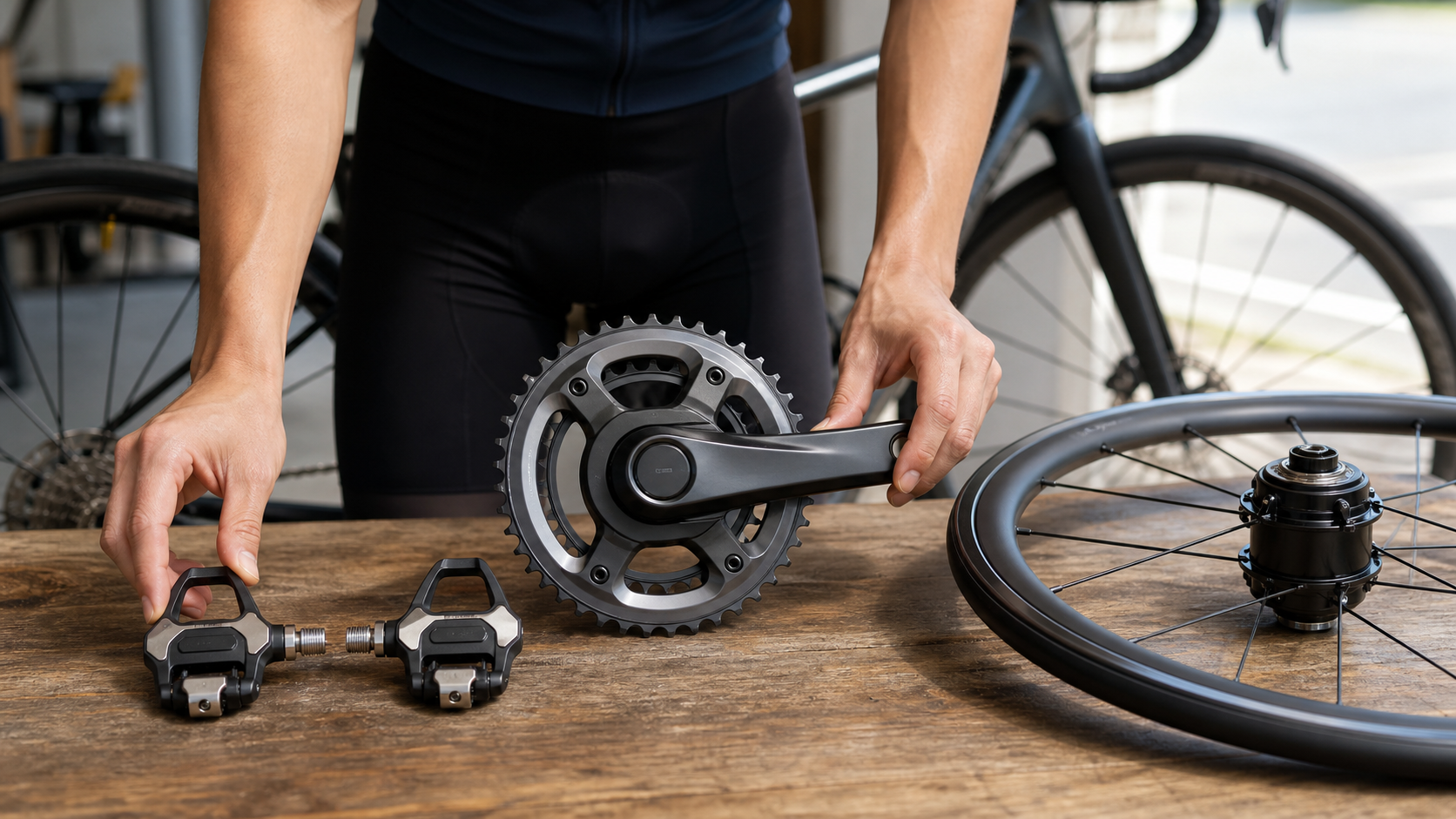
“Training needs data, and data needs a power meter” — this concept is gradually taking root in Taiwan’s competitive cycling community. A power meter directly measures the mechanical power (watts) a rider outputs, unaffected by the lag effect of heart rate, making it the most immediate and precise tool for assessing training intensity. However, the three main categories on the market — pedal-based (e.g., Favero Assioma, Garmin Rally), crank-based (e.g., Quarq, 4iiii, Shimano series), and hub-based (e.g., PowerTap) — differ significantly in characteristics. This article helps you find the most suitable option.
How Power Meters Work
The core of every power meter is the strain gauge, an electronic component that senses material deformation. When you pedal, the crank, pedal spindle, or hub axle experiences torque, and the strain gauge detects minute deformation and converts it into an electrical signal. Combined with cadence (revolutions per minute), power can be calculated:
Power (W) = Torque (N·m) × Angular Velocity (rad/s)
Accuracy is typically expressed as a percentage error, with top-tier power meters achieving ±1-1.5% and entry-level models around ±2-3%.
In-Depth Comparison of the Three Types
Pedal-Based Power Meters
Representative products: Favero Assioma Duo, Garmin Rally RS200/RK200
Advantages:
- Switching bikes only requires swapping pedals, ideal for multi-bike users
- Simple installation, no special tools needed
- Favero Assioma series offers excellent value (approx. NT$12,000-18,000 for dual-sided)
- Measures left and right leg power independently (dual-sided)
Limitations:
- Pedal system must be compatible (SPD-SL, SPD, LOOK, etc.)
- Pedal body adds weight (vs. lightweight pedals)
- Pedals take the brunt of a crash, posing higher risk
Crank-Based Power Meters
Representative products: Quarq DZero, 4iiii Precision, Shimano Dura-Ace/Ultegra PM
| Product | Accuracy | Measurement Side | Price (TWD) | Features |
|---|---|---|---|---|
| Shimano FC-R9200-P | ±1.5% | Dual-sided | NT$28,000+ | Best integration with Di2 |
| Quarq DZero | ±1.5% | Left crank estimation | NT$18,000-22,000 | Compatible with SRAM |
| 4iiii Precision | ±1% | Left side only | NT$6,000-9,000 | Top entry-level choice |
| Rotor INpower | ±1% | Left side | NT$15,000+ | Compatible with oval chainrings |
Crank-Based Advantages:
- Integrated into the drivetrain, no added weight sensation
- Measurement point is closer to the source of force, theoretically more direct
- Some brands support DIY installation (4iiii’s stick-on type)
Crank-Based Limitations:
- Switching bikes requires reinstallation, a more cumbersome process
- Single-sided options estimate the right leg from the left, with error depending on left-right leg balance
- Numerous bottom bracket standards (BSA, PF30, T47, etc.) require compatibility confirmation before purchase
Hub-Based Power Meters
Representative products: PowerTap G3 (discontinued but still circulating in the second-hand market)
Hub-based power meters were the earliest widely adopted form, measuring at the rear wheel drive end with a simple principle. However, their main drawbacks are: inability to measure left and right leg data separately, the need to replace the power meter when changing wheelsets, and major manufacturers having ceased updates — their market influence has significantly declined.
Single-Sided vs. Dual-Sided Choices
Single-sided power meters (left leg) estimate total power by multiplying left-leg power by 2, with accuracy depending on your left-right leg balance. Research shows that most non-professional riders have a left-right imbalance within the 5-8% range, meaning the estimation error from single-sided measurement is within acceptable limits.
When to Choose Single-Sided:
- Limited budget, used for training load management
- Primary goal is tracking training trends rather than precise testing
- Quick form assessment before races
When to Choose Dual-Sided:
- Conducting power analysis and pedaling efficiency assessment
- Having old injuries or known left-right imbalance issues
- Needing precise VO2max test data
Practical Applications of Power Meter Data
After purchasing a power meter, the most important step is establishing an FTP (Functional Threshold Power) baseline, the core metric for evaluating all training intensities. Common testing protocols:
- Ramp Test: Increase by 20W per minute until exhaustion, take 75% of the last fully completed minute
- 20-Minute All-Out Test: Take average power × 95%
- 60-Minute TT: Most direct but hardest to execute
Taiwanese riders can establish their personal “power fingerprint” by doing laps around Datun Nature Park, on Yangmingshan Tianmu Trail, or through repeated sprints on fixed segments, tracking training adaptations over the long term.
Practical Recommendations
- Top entry-level pick: 4iiii Precision left-side crank stick-on solution (approx. NT$6,000-8,000), ±1% accuracy, suitable for Shimano cranks
- Multi-bike users: Favero Assioma Duo pedal-based, switching bikes takes only 5 minutes, best dual-sided value
- Shimano Di2 systems: Consider Shimano’s factory PM crank, offering the best Di2 integration
- First step after purchase: Perform a Zero Offset calibration before every ride to ensure data accuracy
- Maintenance focus: Waterproofing (especially during Taiwan’s rainy season), and regular cleaning of connectors
Conclusion
The return on investment for a power meter depends on whether you truly use the data to adjust your training. An entry-level power meter at NT$8,000 paired with a systematic training plan far outperforms a high-end NT$50,000 power meter used only to display watts. Choose a solution that fits your budget and usage habits, then invest time in learning how to interpret data and plan training — that is the key to successful power-based training.
Related Reading
- Power Meter Buying Guide: Pedal, Crank, and Hub Options Fully Compared
- Power Meter Buying Guide: Accuracy and Convenience of Hub vs. Pedal vs. Crank Types
- 2025 Ultimate Power Meter Buying Guide: How to Choose Between Pedal, Crank, and Hub Types?
- Complete Power Meter Buying Guide: Full Analysis of the Pros and Cons of Crank, Pedal, and Hub Types
全台首發!邁金P715踏板功率計!市場價格撼動者再出招 / 功率對比實測 / FAVERO ASSIOMA 可參考! / 公路車 / CT Yeh
1 年前
Fitting訓練兩用功率車 ! Thinkrider ST900 完整實測!/ 坡度升降 / 鄰居測試/ smart bike/公路車/ CT Yeh
2 年前
ThinkRider 智騎 XXPRO 訓練台,高階機種功能 只要 1/3價格!? 實測功率對比、噪音實測 / 公路車 / CT Yeh
1 年前
訓練台體驗) 2019台北自行車展 三大家 訓練台體驗 Tacx Neo Flux 2 Xepdo Apx Wahoo Kickr
7 年前
Stages功率計 和 智騎 X7 Pro 訓練檯同時騎兩個 Rouvy 角色會一起進終點嗎?最後來點數據分析 | 公路車
5 年前
2026 車錶排行榜!誰是最多車友正在使用?練家子最愛哪款?🏆 (2萬名車友數據) / 公路車 / CT Yeh
5 個月前
單車 重低音 藍芽喇叭 音質實測 SoundBot SB525 Real Sound Test
8 年前
2025 自行車錶排行榜 兩萬車友大數據 / Garmin Bryton 排名會大洗牌嗎? / 全新的碼表前身分析 /公路車 / CT Yeh
1 年前